
Thesis
Most people listen to music, but far fewer make it. The recorded music industry generated $31.7 billion in 2025, growing for the eleventh consecutive year, and there were 752 million paid music streaming subscribers as of 2024, a number projected to reach 1.5 billion by 2035. That growth is being driven by the expansion of streaming into emerging markets and the ubiquity of music on online platforms. Yet, in 2026, only an estimated 129.7 million people worldwide actively make music, a process that requires years of training, expensive equipment, or access to a professional studio. The gap between the number of people who consume music and the number who can make it has never been meaningfully closed.
At the same time, demand for high-quality, original music has grown due to its ubiquitous use in short-form videos and on social media. In 2025, there were 200 million content creators worldwide, 98% of whom used music in their content. Social media has also become the primary driver of new music discovery, as 84% of songs that entered the Billboard Global 200 in 2024 first went viral on TikTok. The infrastructure for a song to reach millions of people has never been better, but the ease of producing music has not kept pace with the ease of distributing it. Generative AI is the first technology that is capable of closing this gap. AI models trained on vast audio datasets can now produce music indistinguishable from human-created songs at low cost, a trend that will continue as inference becomes more efficient.
Suno is an AI music platform that allows users to type a description and receive a fully produced song with vocals and instrumentation. For casual users, it removes the barrier to creating music entirely; for content creators, it provides more music options and customization for specific moods. But Suno’s ambition extends beyond music generation. With Suno Studio, a generative audio workstation for professional use, an Explore feed for streaming and discovery, and Hooks for short-form video, it is building toward a single platform that combines creation, streaming, and social media, a combination no incumbent in the industry owns as of 2026.
Founding Story
Suno was founded in 2022 in Cambridge, MA, by Mikey Shulman (CEO), Georg Kucsko (CTO), Martin Camacho (President), and Keenan Freyberg (COO, departed January 2025). The four founders met while working at Kensho, a financial technology company acquired by S&P Global in 2018.
Shulman graduated from Harvard in 2015 with a PhD in physics and served as Head of ML at Kensho. Kucsko also holds a PhD in physics from Harvard and was Head of AI Research at Kensho. Camacho graduated from Harvard with a degree in computer science and math at age 18 and served as Chief Architect at Kensho. Freyberg holds a PhD in quantum physics from Harvard and was Head of Strategic Initiatives at Kensho.
The founding team did not set out to build a generative music startup. Their first idea was to use AI to navigate and analyze music libraries, but all four were hobbyist musicians. Shulman, for example, spent years playing in bands and gigging in New York City, and the team noticed that audio was treated as a secondary priority in the world of AI. After becoming obsessed with an after-hours project using AI to generate music, they pivoted to music generation.
In April 2023, Suno released Bark, an open-source text-to-speech and audio model, to GitHub. It rolled out an early version of what would become its core product via a Discord bot in mid-2023 before launching a browser-based app in December 2023. In April 2024, the company released v3, its first music generation model. In July 2025, Paul Sinclair, former general manager at Atlantic Records, joined Suno as Chief Music Officer.
Product
Suno’s core product is a generative AI music platform that allows users to generate fully rendered songs from text prompts, including vocals, lyrics, and instrumentation. Its “Create” function is the core text-based music generation engine. The platform also includes Suno Studio, a generative audio workstation that supports multitrack editing with generative music capabilities.
Create
Source: Suno
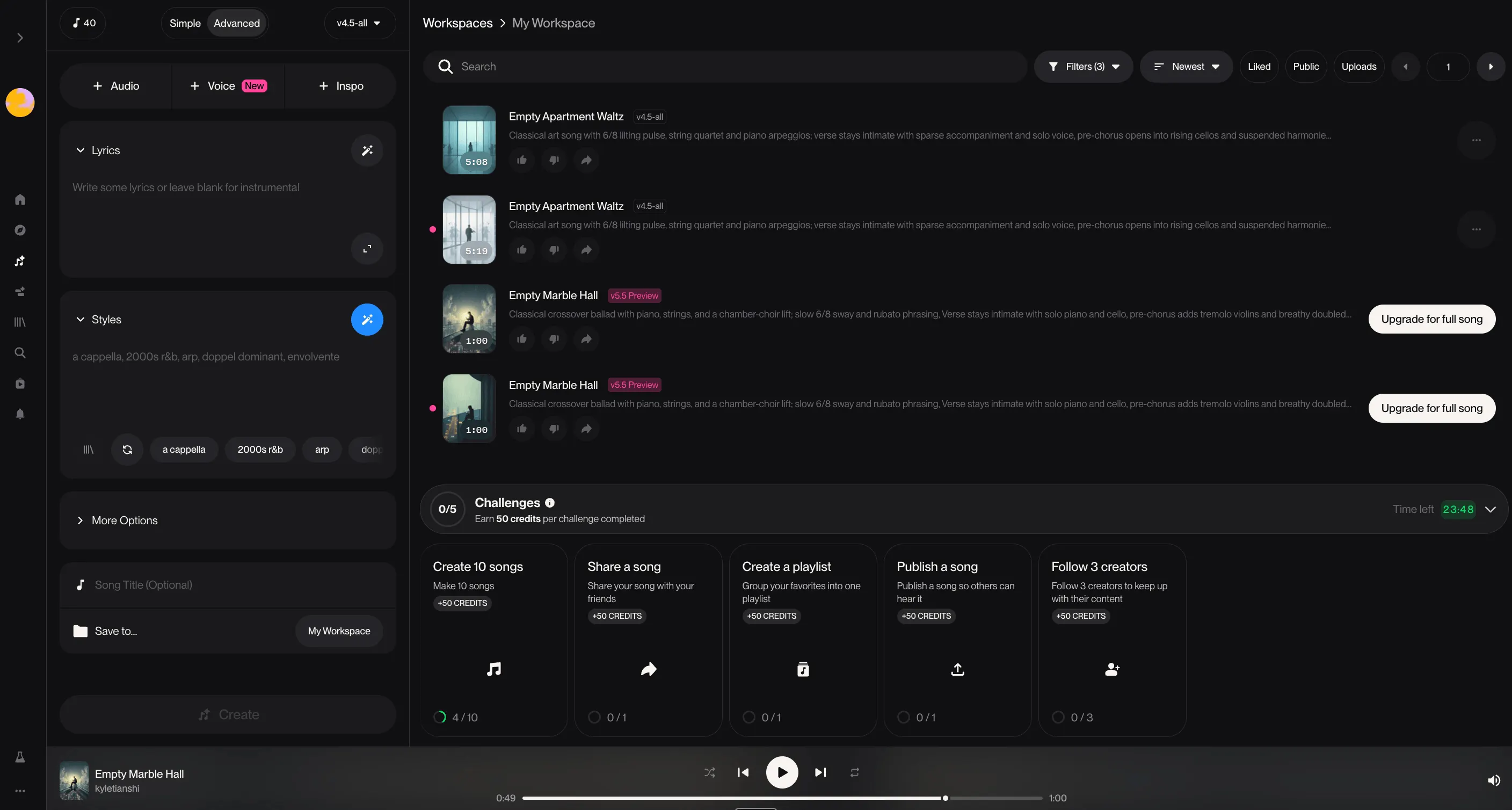
Create is Suno’s main music generation interface, operating in two modes. Simple Mode accepts a text-based description (e.g., “a sad acoustic song about rain”) and returns two generated versions. Users can upload their own audio, write custom lyrics, and toggle an option to generate an instrumental rather than a song with lyrics.
Advanced Mode provides greater control over the generation process, allowing users to upload audio clips, voice clips, inspiration songs, lyrics, and styles. The mode features custom settings, including a toggle for the singing voice’s gender, a slider for weirdness that controls how wild or unexpected the generated song should be, and a slider for style influence that controls how closely the song should match the style description. Song generation costs users credits, with bonus credits available through onboarding challenges such as creating ten songs, creating a playlist, publishing a song, and following three other creators.
As of May 2026, Suno offers six models for generation within Create. The free default is v4.5-all, which offers high-quality generation but excludes commercial-use rights. Paying users have access to the full lineup: v3.5, released in mid-2024; v4, released in November 2024, which improved vocal expressiveness and dynamic range; v4.5, released in May 2025, which extended track length to eight minutes and introduced smarter style mashups for consistency across longer compositions; v5, released in September 2025, which improved song-structure coherence and added persistent voice and instrument memory across generations; and v5.5, released in March 2026, Suno’s flagship model.
Alongside these releases, Suno has shipped a series of standalone features accessible from the Create menu: ReMi, a model for lyric generation; Remaster, which creates subtle variations of a clip; Voices, which lets users capture their voice for use in generated tracks; and Custom Models, which let users train up to three personalized versions of the model to match their taste.
Studio
Suno Studio is a generative audio workstation available exclusively to Premier subscribers that merges the capabilities of a digital audio workstation (DAW) like Ableton or Logic Pro with AI generation. Users can import existing Suno songs as stems (a layered group of vocals and instrumentals), edit them on a visual timeline, and generate new instrumental or vocal parts within the timeline using the same text-prompt interface as Create. Each generation produces two versions that can be composited together. Users can also upload their own audio recordings or record audio directly to Studio, and finished projects can be exported as a full song, a selected time range, or as multitrack stem files.
Explore
Source: Suno
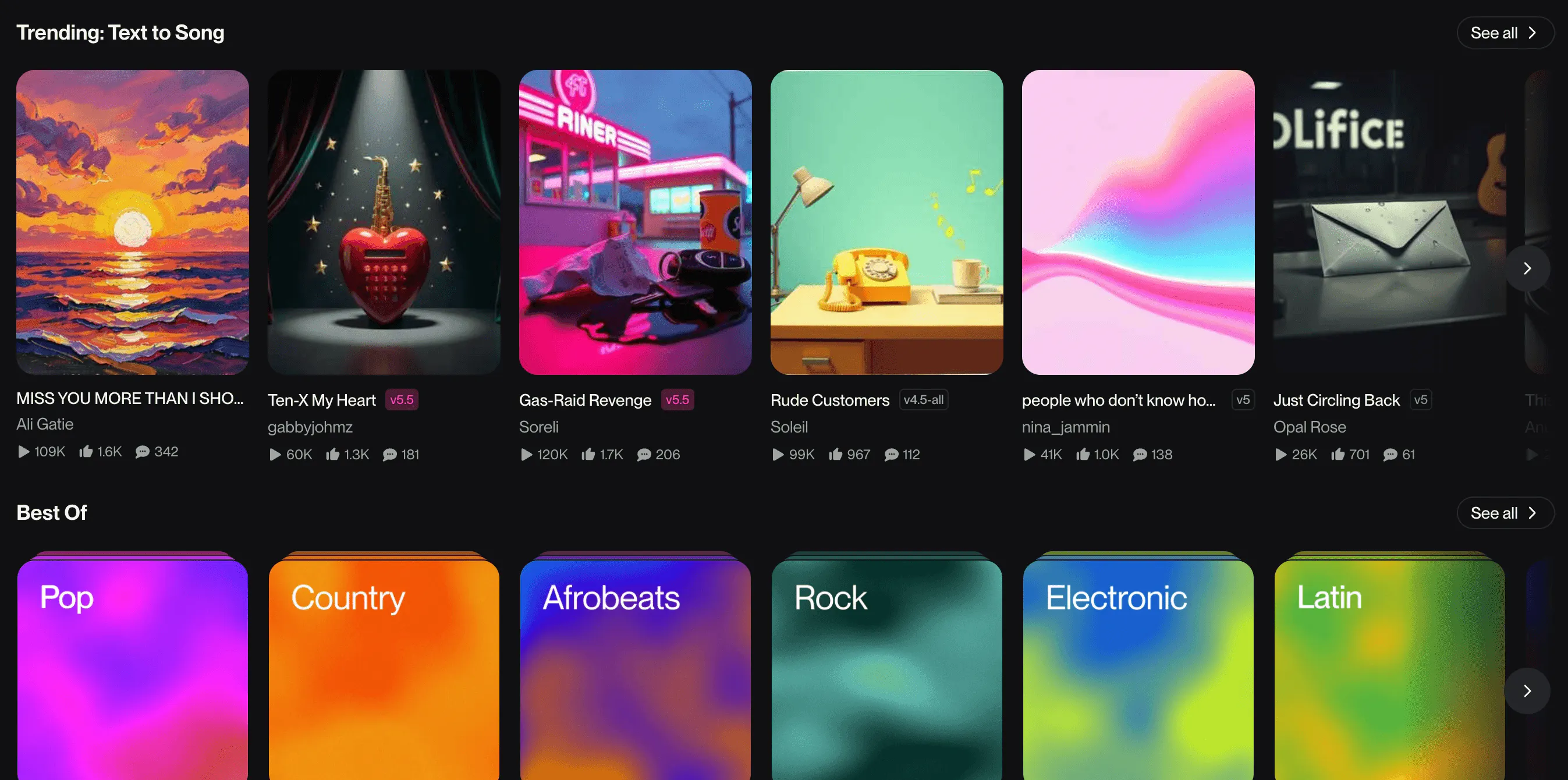
Explore is Suno’s social discovery feed. The page collects trending songs organized by genre, personalized playlists, contests where users remix songs for the chance to win money, and recommended creators. Users can like, remix, and comment on songs, follow creators, and upload their own music for a chance to be featured on the Explore page.
Hooks
Source: Suno
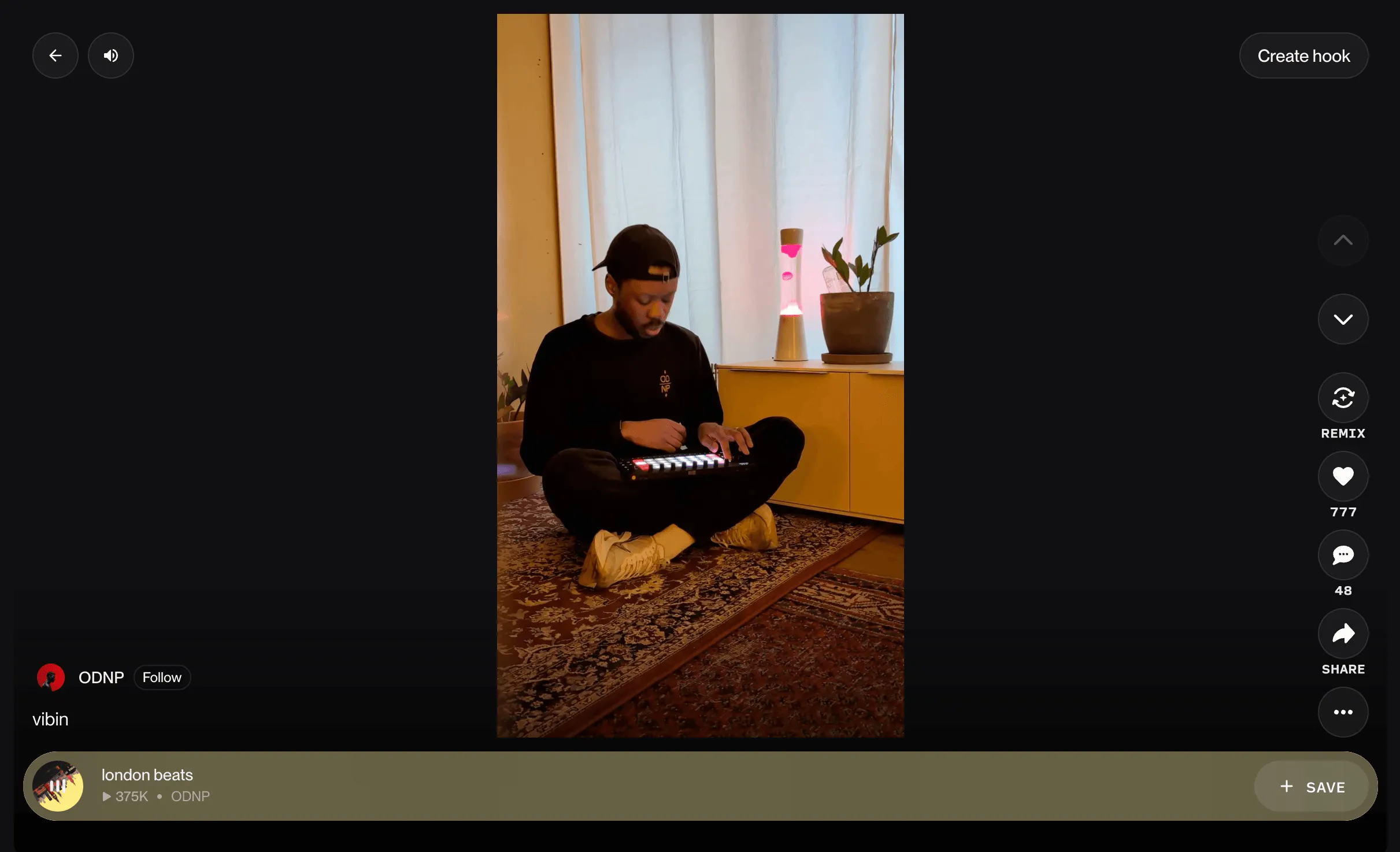
Hooks is a short-form video feature similar to TikTok or Instagram Reels. Users select a song, upload a visual clip, and publish a video that other users can like, comment on, share, and remix. Suno gives the option to render lyrics automatically as captions.
Market
Customer
Suno’s customer base breaks down into three segments. Casual consumers are Suno’s largest segment. The company reported 100 million users as of November 2025, most of whom have no formal musical training or are hobbyist musicians. Hobbyists use Suno to turn their musical ideas into songs without needing to learn an instrument or use a DAW. One unverified estimate suggests that 50% of first-time users reach the free-tier generation limit, a natural conversion trigger to paid plans.
Content creators like podcasters, YouTubers, and TikTokers use Suno to generate original, royalty-free music tailored to their content. For YouTubers specifically, licensing directly affects their revenue. YouTube alone processed 2.2 billion copyright claims in 2024, and payouts to rights holders have crossed $12 billion as of December 2024, making unlicensed music a constant risk for creators. Suno’s paid plans include commercial licensing, making it a higher-customization alternative to stock music libraries like Epidemic Sound.
Professional musicians and composers are the smallest segment but generate the most revenue per user. Harvey Mason Jr., Recording Academy CEO, has said that “every” songwriter and producer he knows has used Suno to generate new ideas. Grammy-winning producer Timbaland joined Suno as a strategic advisor in October 2024 and has since launched Stage Zero, an AI music and entertainment startup that uses Suno’s technology. The barrier to adoption from this segment is high, however, as copyright exposure is a blocker for any professional working under a label or publisher agreement.
Market Size
Suno competes within the recorded music industry, which generated $31.7 billion in revenue in 2025, with streaming accounting for 69% of that total. Streaming services had 752 million paid subscribers globally as of 2024, a figure projected to double to 1.5 billion by 2035. This is the market Suno intends to capture if its vertical service combining music creation, streaming, and a social platform succeeds. But as a tool for creators rather than a label, Suno captures value upstream of where recorded music revenue is generated, so its addressable share of that market is a fraction of the total.
More narrowly, Suno operates in the AI music market, valued at $5.2 billion in 2024 and projected to reach $60.4 billion by 2034, growing at a 27.8% CAGR driven by falling generation costs and rising adoption among creators. Within the creator segment, Suno also displaces the stock and production music market, valued at $1.5 billion in 2024 and projected to reach $2.4 billion by 2030, an 8.8% CAGR.
Competition
The AI music landscape can be subdivided into three categories: AI-native generation startups competing directly with Suno on product, foundation-model labs that can embed music generation into their existing distribution, and incumbent record labels.
ElevenLabs: Founded in 2022, ElevenLabs is an AI audio company that expanded to music generation with the launch of Eleven Music in August 2025. It raised a $500 million Series D at an $11 billion valuation in February 2026, led by Sequoia Capital. The company’s total funding as of August 2026 is $942 million from investors including Sequoia, a16z, and Lightspeed. ElevenLabs is the most direct licensing-compliant competitor to Suno, having launched with pre-existing rights-holder agreements with digital publishing platforms Merlin Network and Kobalt Music Group to use their music for AI training. It also offers enterprise pricing that allows music to be used for all online and offline commercial purposes, a meaningful advantage over Suno amid Suno’s ongoing litigation.
Udio: Founded in 2023, Udio is a generative AI model that produces music based on text prompts. It raised a $10 million seed round led by a16z in April 2024, its only disclosed round as of August 2025. After an October 2025 settlement with Universal Music Group (UMG), Udio agreed to rebuild its platform using only authorized and licensed music and pivoted away from original song generation toward a fan-engagement platform that lets users remix existing intellectual property.
Google DeepMind Lyria: Announced in 2023, Lyria is a generative AI music model developed by Google DeepMind. Lyria 3 and Lyria 3 Pro launched in February 2026 and March 2026, respectively, allowing users to generate up to three-minute tracks from text or image prompts. Lyria is exclusively trained on music Google has the right to use under its terms of service, which avoids the copyright issues Suno faces, and it is rolled out across Google AI Studio, YouTube, Vertex AI, and the Gemini API. Google’s distribution is the core advantage Suno cannot easily replicate.
Record Labels: UMG, Sony Music, and Warner Music Group (WMG) are incumbents using their legal and catalog advantages to shape the direction of AI music. UMG’s October 2025 settlement with Udio to launch a licensed fan-remixing platform, and late-2025 licensing deals from all three labels with Klay Vision, an “active listening” AI music platform, point to the vision these companies have for AI music: a controlled system where generation is tied to existing catalog, the opposite of Suno’s open-ended approach. Because the labels control the training data, catalogs, and relationships with big artists, they hold a durable advantage in building toward that vision.
Business Model

Source: Suno
Suno operates on a freemium subscription model across three tiers. The free tier provides 50 credits daily, equivalent to up to ten songs, but no rights for commercial use. The $ 10-per-month Pro plan grants 2.5K credits per month (up to 500 songs) and access to v5.5, Suno’s best model. Under this tier, users receive full ownership rights to songs created during their active subscription, allowing them to monetize tracks on platforms like Spotify, Apple Music, and YouTube. The $30-per-month Premier plan provides 10K credits monthly (up to 2K songs), includes full ownership rights, and unlocks Suno Studio.
The infrastructure and compute required to generate millions of songs daily are Suno’s dominant cost driver. From its founding through January 2024, Suno spent $32 million on compute but only $2K on data, a split that captures both the capital intensity of generative audio and the company’s strategy of minimizing licensed-data acquisition. Suno’s Series C raise was allocated accordingly, with compute receiving the most and the remainder split across M&A, discovery, marketing, data, and partnerships.
Traction
Suno reached $300 million in annual recurring revenue and 2 million paid subscribers as of February 2026, up from $200 million in ARR and 1 million subscribers at the time of its Series C raise in November 2025. Total users passed 100 million as of February 2026. As of December 2025, Suno users generate 7 million songs daily, equivalent to an entire Spotify catalog’s worth of music every two weeks. In December 2023, Suno launched an integration with Microsoft Copilot, letting users generate songs directly within the product, its first major distribution partnership with an enterprise. In November 2025, Suno also acquired Songkick, a concert discovery platform, as part of its settlement with WMG.
Valuation
Suno has raised a total of $775 million across its Series B, Series C, and Series D rounds as of June 2026. Its Series D was a $400 million round in June 2026 led by Bond Capital at a $5.4 billion valuation, with new investors IVP, Forerunner, Union Square Ventures, Alkeon Capital Management, and Quiet, plus participation from existing investors Matrix, Lightspeed, Menlo Ventures, and Schroders Capital.
In November 2025, Suno raised a $250 million Series C led by Menlo Ventures at a $2.45 billion valuation. In May 2024, it raised $125 million in Series B funding at a $500 million valuation, led by Lightspeed Venture Partners and Matrix, with early angel backers including Nat Friedman, former CEO of GitHub, and Daniel Gross. Suno’s valuation has more than doubled in the roughly seven months between the Series C and Series D, tracking a comparable jump in ARR over the same period.
Key Opportunities
Social Streaming
Suno’s ambition extends beyond music generation. In January 2026, Shulman described his vision for Suno to become an interactive, social platform that is the next format for recorded music, a single vertical service spanning music creation, social media, and streaming. The product already reflects early steps toward that goal: the Explore page lets users find songs and follow creators, Hooks is a short-form video feed analogous to TikTok, and Suno’s acquisition of Songkick in November 2025 marked its first move into the live music space. In December 2025, Shulman also discussed features such as Interactive Albums, where artists release tracks that fans can remix and extend. No incumbent controls both the creation and distribution of music, and existing platforms are built around passive listening, leaving room for Suno to combine the two.
Professional Music Production
Professional adoption of Suno is accelerating organically. Recording Academy CEO Harvey Mason Jr. stated in December 2025 that “every” songwriter and producer he knows has used Suno, with use cases ranging from generating new ideas to filling in parts of songs to full song ideation. Suno’s acquisition of WavTool, a browser-based DAW with AI generation, in June 2025 brought in professional-grade editing software and a core team to build the Premier-only Suno Studio, which launched three months later in September 2025. Features in Suno Studio, such as stem separation, timeline editing, and MIDI export, bring Suno closer to traditional DAWs like Ableton and Logic Pro. As of May 2026, Suno had not disclosed enterprise pricing or contracts, and its pricing page lists only consumer subscription tiers, which leaves the conversion of professional interest into high-value commercial contracts unproven.
AI Artists
Suno is emerging as the engine behind a new category of creators who produce and release music without access to traditional production resources. The clearest example is Xania Monet, an AI music project created by poet Telisha Jones, who turns her poems into songs using Suno. After debuting on several Billboard charts in September 2025 and accumulating tens of millions of streams on Spotify, Monet signed a $3 million record deal with Hallwood Media. In July 2025, Hallwood also signed Suno user and AI music creator imoliver.
Suno captures value from such contracts only indirectly, but the more significant implication is that AI-generated music can achieve mainstream success. That validation attracts more professional creators to the platform and builds the case for Suno to offer artist services such as distribution and publishing administration, which would give it a direct stake in artist revenue.
Key Risks
Copyright Lawsuits
In June 2024, UMG, Sony Music, and WMG jointly filed a copyright infringement lawsuit against Suno, alleging that its product copies protected recordings to generate similar music. In November 2025, Suno settled with WMG for an undisclosed amount and committed to releasing a licensed model in 2026. However, the suits from UMG and Sony have since escalated: in May 2026, the two labels moved to expand the complaint from 560 works to more than 61K after using Audible Magic, an audio fingerprinting technology, to scan Suno’s training data. With statutory damages capped at $150K per work for willful infringement, the expanded complaint carries a theoretical maximum above $9 billion.
Suno’s legal defense is that it transforms existing works and does not sample songs, which it argues is what copyright infringement would require. An adverse ruling could force Suno to retrain its model, change its product, or pay damages. The clearest precedent is Udio’s settlement with UMG in October 2025, which led Udio to abandon open-ended song generation entirely and pivot to a fan-remixing platform.
Foundation Model Labs
Google, ElevenLabs, OpenAI, and other foundation model labs each present distinct competitive threats to Suno, and none carries the copyright-litigation exposure Suno faces. Google trained Lyria 3 on music it has the right to use under its terms of service and can embed music generation across YouTube, Gemini, and Workspace at comparatively little cost. Eleven Music by ElevenLabs is cleared for commercial use through licensing agreements with Merlin Network and Kobalt Music Group. OpenAI is also reportedly developing a music generation tool as of October 2025. None of these competitors needs to acquire users from scratch, as each already has millions embedded in its existing services.
Adoption Ceiling
AI music may never close the quality gap that matters to the artists Suno needs to win over. In November 2025, only 6% of surveyed producers reported using fully generative tools, and 82% of producers opposed generating full songs from text prompts. Quality was the top objection, cited by 35% of the producers who opposed AI.
The quality problem is both technical and perceptual. Generative AI produces music that closely resembles its training data, so what it creates often lacks distinction or surprise, and listeners tend to devalue the music when they know the creator is an AI. For Suno to move beyond low-stakes tasks like stem separation and idea generation, it needs output good enough to overcome the stigma of being AI-generated.
Summary
Suno is a generative AI music platform with 2 million paid subscribers, $300 million in ARR, and a $5.4 billion valuation as of June 2026. It aims to become the next format for recorded music, a vertical platform where users stream, discover, share, and create without leaving Suno. Whether that succeeds depends on resolving the active copyright suits from UMG and Sony and outcompeting Google and ElevenLabs, neither of which faces the same litigation exposure.