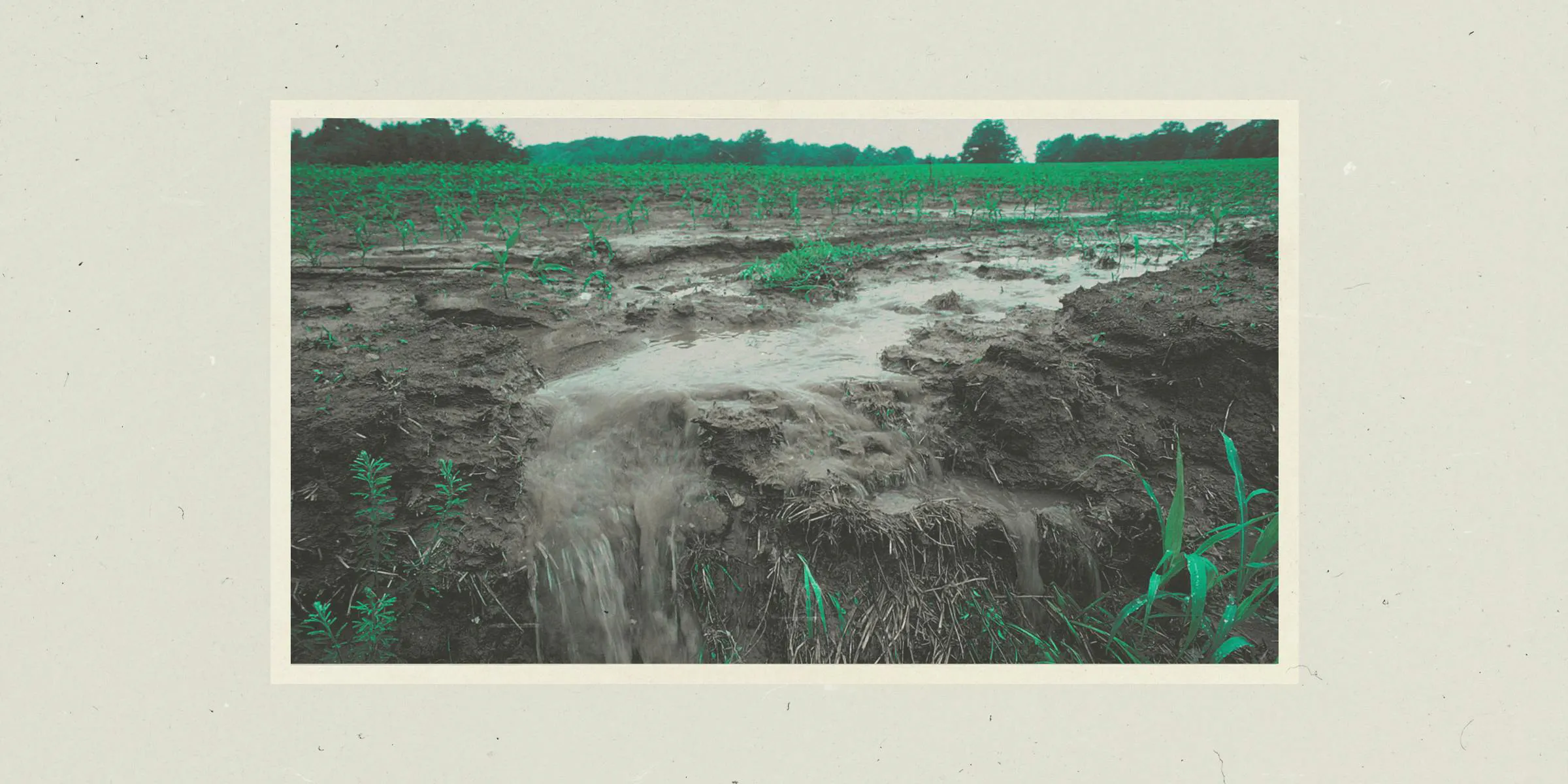
The Midwest has been America’s breadbasket for nearly two hundred years. The grasses that covered the prairies, through thousands of cycles of birth and decomposition, produced perfect conditions for the kind of rich, deep, and fertile soil required to grow anything from corn, to soybeans, wheat, potatoes, and more.
For the longest time, this “black gold” was seen as an inexhaustible, divine geographical endowment. “The soil is the one indestructible, immutable asset that the nation possesses. It is the one resource that cannot be exhausted; that cannot be used up. It may be impaired by abuse but never destroyed,” wrote Milton Whitney, the Chief of the Bureau of Soils in 1909.
It was a reasonable point of view. After all, it was commonly assumed that stark geological shifts were not something that could occur over human time scales. However, from our vantage point now, it is clear that soil degradation and erosion are accelerating even within individual human lifespans, impacting not only the arable soils of the American Midwest, but fertile land all over the world.
Soil erosion is the removal of the topmost layer of soil, typically by water runoff, heavy wind, or tilling. Soil degradation often comes as a consequence of soil erosion and intensive farming practices which lead to a decline in soil structure, alongside a decline in concentrations of nutrients and healthy microorganisms that contribute to plant growth. Together, they are a specter haunting global agriculture.
Jeremy Grantham, a climate investor who has repeatedly pointed out the dire consequences of soil degradation, said in 2018 that the world is now losing “about a half a percent of our arable land a year.” The fear is that if nothing changes, everything from lower crop yields to crop failure may become increasingly common. Grantham warned in the same year that “there are only 30 to 70 good harvest years left, depending on your location. In 80 years, current agriculture will be simply infeasible for lack of good soil.”
In 2022, researchers estimated that 57.6 billion metric tons of soil had been lost in the American Midwest since farming began 160 years ago. Evidence of this is clear in Iowa, where the average topsoil depth decreased from 14-18 inches at the start of the 20th century to 6-8 inches by the start of the 21st. This is particularly problematic because it takes more than 25 years for just a single millimeter of soil to form under natural conditions, but in the Midwest, erosion is whisking away at a rate of .5 to nearly 2 millimeters per year.
Farming practices like tilling, which breaks up the earth in preparation for sowing, are notable contributors to soil erosion. Farms that rotate crops between corn and soybeans, for instance, will need to till their land ahead of every cultivation. This can ruin the soil structure, and destroy the ecosystems of bacteria and fungi locked inside.
However, the greatest contributor to soil erosion by far is the weather. The increasingly erratic weather patterns brought on by climate change, the vicious cycle of hotter temperatures, higher rates of evaporation, and thus more destructive downpours have literally washed some of the best soils away from the fields. A particularly bad series of spring storms in 2013 resulted in more than 12 million tons of soil being swept away from Iowa’s farmland. The most heavily affected farms lost as much as 40 tons of topsoil per acre.
Events like this are truly devastating because there’s a direct relationship between topsoil thickness and crop yield. The shallower the topsoil, the less water and nutrients are retained and made available for plants.
To compensate for such regular losses, farmers apply synthetic fertilizers to enhance the nutrient content in the soil. The United States already has one of the highest rates of fertilizer application in the world. A 2020 study by the University of Colorado estimated that one-third of the fertilizer used in corn production just goes towards compensating for “ongoing loss of soil fertility,” resulting in ever greater input costs to farmers every year. While synthetic fertilizer is one of the great wonders of the modern world — a technology whose history and use we covered previously — its repeated application inadvertently contributes to even greater soil degradation over time.
Synthetic fertilizer, or ammonia, is oxidized and converted to hydrogen ions, water, and nitrate, which is taken up by plants. When too much ammonia is added, an excess quantity of hydrogen ions accumulates in the soil, contributing to acidification. Already, studies have shown that the pH levels of Iowa farmland have fallen appreciably. Greater soil acidity disrupts the soil microbiome, which itself plays a critical role in nutrient cycling.
It’s already been demonstrated that nutrient-rich soil leads to nutrient-rich food. Predictably, as the fertility of soil has fallen in the United States, the nutritional content of crops has similarly declined. The USDA has already observed a notable drop in the quantities of protein, calcium, phosphorous, iron, riboflavin, and vitamin C in industrially-grown fruits and vegetables over the past fifty years.
A further issue on the horizon is the availability of supplementary fertilizers. While synthesizing ammonia for nitrogen content is possible, other key nutrients, like phosphate come from non-renewable sources. Estimates suggest that there are enough phosphate deposits to last another 400 years, however, 75% of the high-grade phosphorus reserves are found in Morocco, adding a precarious geopolitical element to the quest for global food abundance.
Clearly, agriculture is an extremely tricky business. While industrial and technological innovations over the last century have contributed to higher yields alongside a decrease in the manual labor required to generate them, it appears a new set of challenges is on the horizon for agriculture if business is left as usual.
Some of the proposed solutions involve adopting no-till farming, which involves leaving crop ground undisturbed until the next season of planting.
Rather than breaking up large rows of dirt to sow new seeds, no-till planters deposit seeds alongside the residue of previous crops without plowing the soil. Already, 74% of North Central and Midwest cropland use either no-till or reduced-till practices. Another commonly touted solution is to use cover crops, which are crops grown on fields after the main cash crop has been harvested, and before the next one has been planted. This way the soil is protected by plant cover, without lying fallow and left open to the elements.
There are even more innovative solutions to the problem of soil degradation. Biofertilizers, for instance, are either naturally occurring or genetically engineered microbes that can be introduced into fields to assist in the natural production of essential soil nutrients. Another approach involves coating seeds in biofertilizing microbes, making nitrogen-absorbing crops, like wheat or corn, look a lot more like nitrogen-fixing plants, like legumes.
Genetic modification has already played a massive role in food production, creating more resilient crops, capable of maintaining high yields, even in spite of drought. It’s likely that genetic experimentation and technology will play an even greater role in helping address the growing agricultural challenges of the future.
As it stands, a third of the world’s soils have already been eroded, according to a 2015 report by the UN’s Food and Agriculture Organization (FAO). The world has terraformed itself into a slightly less arable place just in the past handful of human lifespans. However, if we can do that, it’s certainly possible that we can find the solutions necessary to terraform our most important lands back to a state of health and fertility.



