Thesis
AI is upending paperwork across white-collar industries, including law and healthcare, due to the structured, precise, and repetitive nature of white-collar work. In the law industry, for example, 80% of the Am Law 100 used Harvey as of September 2026, up from 42% in August 2025 and 28% in 2024. Furthermore, in 2025, 77% of legal professionals used generative AI for document review. In healthcare, 81% of physicians reported using AI professionally in 2026, up from 38% in 2023, and 70% of physicians at UCSF used AI scribes to draft clinical notes in 2026.
Life sciences overall, where global spending on medicines is projected to reach $2.6 trillion by 2030, is beginning to see a similar shift. Paperwork in life sciences is slow and costly. Drafting a full clinical study report (CSR) takes eight weeks or more, and a 2024 study estimated that each additional day of delay in drug development costs roughly $500K in lost sales. In 2025, pharma companies spent $9.1 billion outsourcing regulatory affairs, a figure projected to reach $13.8 billion by 2030, and another $2.5 billion on medical affairs outsourcing, projected to grow to $5.1 billion by 2031. Automating this work in-house has proven difficult. In June 2025, Merck, a large pharmaceutical company, noted that companies in its industry "have faced challenges building a platform that generates full CSRs of regulatory quality," and that its platform took 18 months and a team of more than 80 experts, built jointly with McKinsey, to do so.
Collate is an AI document generation platform that automates paperwork for drug, diagnostic, and medical device development. Collate launched in January 2025 on the belief that life sciences companies seek to automate their paperwork. In June 2026, Collate CEO Surbhi Sarna said many had tried building AI capabilities themselves and decided to outsource instead. Its platform drafts the documents each stage of a product's life requires, from design records in research and development to clinical study reports and regulatory filings, and a person has to verify each document before it can be exported. Collate aims to be the single system that writes those documents for every team that produces them, from research through market approval.
Weekly Newsletter
Subscribe to the Research Rundown
Founding Story

Source: Forbes
Collate was founded in January 2025 by Surbhi Sarna (CEO), Nate Smith (CTO), and Jigish Patel (Chief Architect and Security Officer). Sarna traces the origins of the company to her years running nVision Medical, a medical device startup, where "every step I turned, there was a slog of paperwork." Her later role as a Y Combinator partner gave her what she called "a front row seat to the best of software, and the amazing capabilities of AI." In a January 2025 interview, she said the opportunity "could only be started by someone that lived both that documentation piece day-in and day-out, and also understood the power of AI."
Sarna and Smith had worked together as YC partners, and decided to co-found Collate after Sarna's eight-year-old son asked whether Smith was visiting their house on a "co-founder date." Collate launched at the J.P. Morgan Healthcare Conference in January 2025 with no customers and no commercial product.
Before founding Collate, Sarna spent much of her career in medical devices. After graduating from UC Berkeley in 2007 with a degree in molecular and cell biology, she worked as an engineer for Abbott Vascular and BioCardia, two medical device companies. She then founded nVision Medical, a device company that sought to enable the earlier diagnosis of ovarian cancer.
Before nVision was ultimately sold, it raised $16.4 million in funding, completed three clinical trials, and obtained two first-in-class FDA approvals. Sarna sold nVision Medical to Boston Scientific for up to $275 million in 2018 and remained on as President until 2020. She then joined YC as a visiting partner in September 2020, became a group partner focused on healthcare and biotech in November 2021, and left YC in February 2025.
Smith studied electrical and computer engineering at Olin and worked as a product manager on Google Analytics and Google Search, where he led the first major redesign of Google's Image Search UI. Shortly after leaving Google in 2011, he co-founded Lever (YC S12), a talent acquisition software company with over 5K customers. He served as Lever's CEO from 2012 to 2014, its CTO from 2014 to 2020, and its CEO again from 2020 until Employ acquired the company in 2022, by which point Lever had raised $122.8 million. Smith then joined YC as a visiting group partner from October 2023 to October 2024.
Patel spent more than 15 years as a software engineer, and Collate's about page credits him with owning compute platforms, real-time data infrastructure, and SSL services at Netflix, Airbnb, Symantec, and VeriSign. He worked as a senior software engineer at Netflix from 2015 to 2023 and as a staff software engineer at Airbnb in 2024, and he left Airbnb in December 2024 to co-found Collate.
Product

Source: Collate
Collate provides a platform that drafts, reviews, and updates the documents a life sciences company produces from research through market approval. Users work from a home workspace where they can ask Collate to draft a new document, run a gap analysis, conduct a root cause analysis, or translate a document. Customers interact with the platform through a browser-based application that they can drop source documents and reference material into, and it integrates through native APIs with customer systems including SharePoint and other data hubs. Collate's homepage organizes the platform around research and development, preclinical and clinical trials, quality management, and bringing products to market, and its Learn More page walks through 11 functions, from R&D and manufacturing to regulatory affairs, legal, marketing, sales, and support.
Research and Development
In research and development, Collate drafts design briefs, feasibility studies, risk assessments, iteration and test outputs, and design history files for product development teams. Collate extended its research tooling in August 2025, when it announced that it had acquired MantleBio (YC S23) for an undisclosed sum. MantleBio's platform integrated existing research tools like electronic lab notebooks, instruments, and databases to make research data more accessible across an organization, and the company described its product as one that "makes data engineering easy (and sometimes fun) for scientists." Its founders, Emily Damato and Madeline Schade, had joined Collate as engineers in April 2025, before the acquisition was announced.
Preclinical and Clinical Trials
For preclinical and clinical teams, Collate targets study protocols and reports, sample handling protocols, informed consent documents, safety reports, and case report forms. Collate also drafts standard operating procedures for clinical, preclinical, and lab teams. These protocols are generated by referencing prior protocols the team used and checking against other documents to ensure consistency and quality.
Quality Management
Collate's quality and manufacturing work targets the documentation behind a company's quality management system and production, including corrective and preventive action records, change control documentation, manufacturing process approvals, assembly instructions, and post-market surveillance reports. Collate comes pre-loaded with FDA submission requirements, 21 CFR rules, and ISO standards. As another feature to assist with compliance, Collate allows companies to simulate audits in preparation for ISO certification and the Medical Device Single Audit Program (MDSAP), which verify that a company's procedures are documented and followed and that staff are trained on them.
Bringing Products to Market
Collate's regulatory affairs work centers on the filings that take a product to market, which combine clinical data, test results, and design documentation and must be kept current throughout a product's life.

Source: Collate
Some regulatory submissions run to 10K pages. In June 2026, Sarna said that Collate saves customers 50-90% of the time these documents take, and that a document that might have taken seven months can be finished in a month or less. Device makers file a 510(k), the filing that shows the FDA that a new device is equivalent to one already on the market, and Collate claims to cut the time to prepare one from about 11 weeks to under three.

Source: Collate
Responses to health authority questions are one of the bottlenecks Collate targets. In May 2026, a Collate customer ranked regulatory writing among the areas with the biggest return on investment in accelerating drug development. A large pharma company's health authority question response process takes 10-12 weeks on average, and a customer reported that Collate saves two to three weeks of that cycle.
Source: Collate
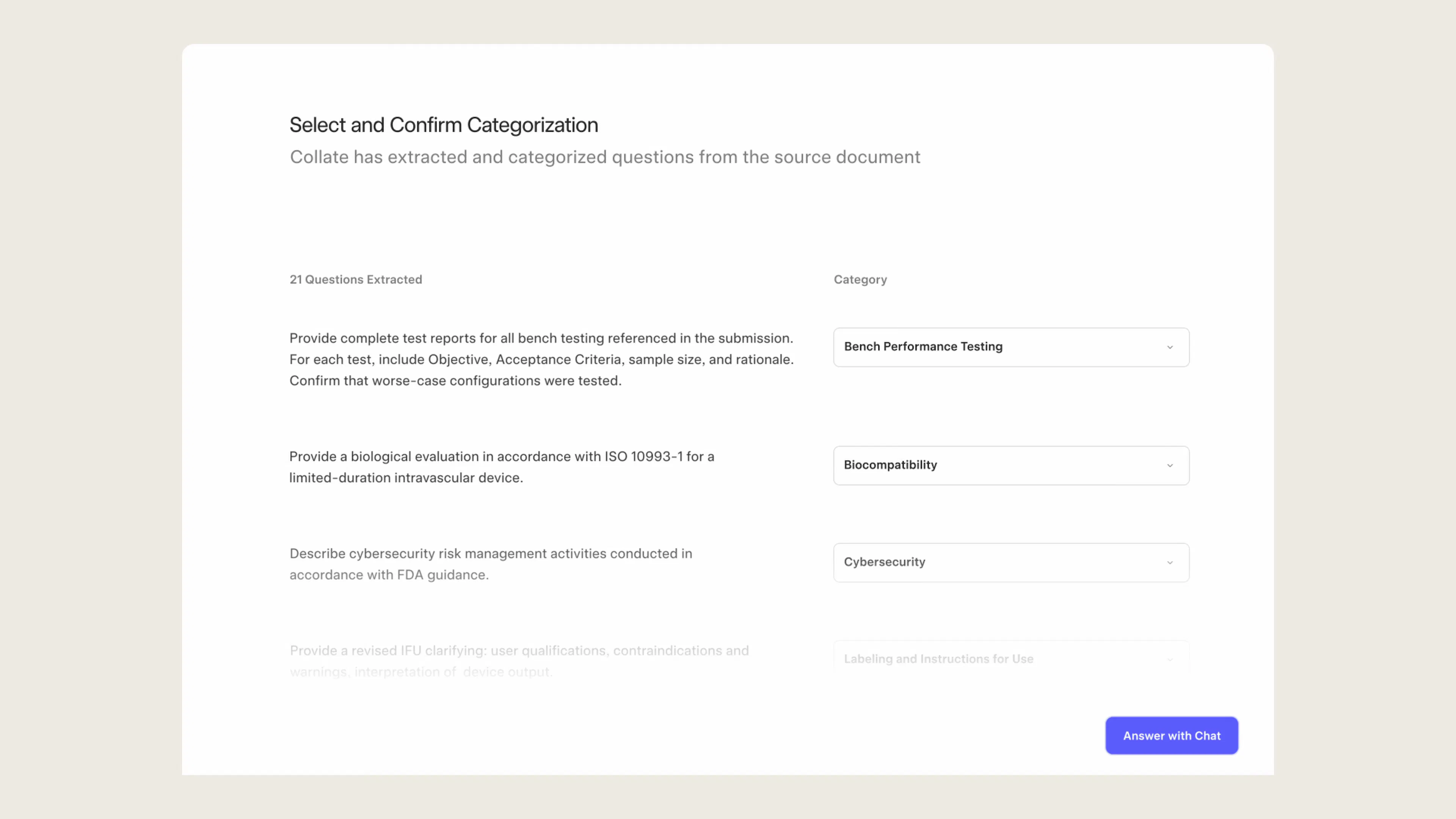
In Collate's workflow, a team uploads the questionnaire it received from the regulator, and the platform extracts each question and sorts it by category, such as bench testing, biocompatibility, or cybersecurity, before drafting answers. No document, filing, or report can be exported from Collate without a person verifying it first, and in June 2026, Sarna siad the platform's accuracy was above 90%. One customer said in a July 2026 expert-network interview that tools from Collate or Veeva can draft a document that is roughly 80% complete, with a medical or clinical manager still doing the final 10-20%. Collate's security page lists AES-256 encryption for documents at rest, zero-retention policies with the third-party AI providers it uses, and a separate database and file store for each customer.
Market
Customer
Collate's target customers are companies that develop drugs, diagnostics, and medical devices. As of June 2026, its customers included big pharmaceutical companies, major medical device manufacturers, and publicly traded biotech firms, and in June 2026, Collate said that top-20 pharma and medical device companies used its platform.
Each of those product types follows its own quality and documentation rules, and Collate staffs its deployments accordingly. In October 2026, its solutions team was hiring quality engineers with separate specialties in diagnostics, medical devices, and therapeutics. It was also recruiting an implementation manager to connect Collate to PTC's Windchill, the software some of its customers use to manage their product design records, which means part of each deployment is integrating with the systems where a customer's existing documents already live.
Inside these companies, Collate targets several functions in addition to regulatory teams. Its Learn More page describes the paperwork of 11 functions, from R&D and manufacturing to clinical trials, quality, legal, marketing, and sales, which could imply Collate pitches each customer on adopting it in many departments. The largest documents among its resources are for regulatory affairs, where some submissions run to 10K pages.
Market Size
The number of drugs in development worldwide rose from 6K in 2001 to a peak of 23.9K in 2025, and each requires protocols, reports, and documentation before reaching patients. As of June 2026, one large pharma company created more than 100 document types daily across 225 active clinical trials. Device filings have also grown. The average 510(k) in 2008 ran more than seven times as many pages as in 1983, and by 2017 averaged 1.2K pages.
In parallel, the global regulatory workforce grew from 98.2K people in 2021 to 124.4K in 2024. Companies have also pushed regulatory overflow outward. In 2025, pharma spent $9.1 billion outsourcing regulatory affairs, and this spend is projected to reach $13.8 billion by 2030. Medical affairs outsourcing was $2.5 billion in 2025, and is projected to grow to $5.1 billion by 2031.
Medical writing, the category closest to the documents Collate drafts, was estimated at $3.9 billion in 2025 and projected to reach $7 billion by 2031, with regulatory writing accounting for 41.9% of 2025 spend. Spending on life sciences software is larger. In October 2025, Veeva, a Collate competitor, put its total addressable market at more than $20 billion across clinical, regulatory, safety, quality, and commercial software, data, and services.
Competition
The most direct competition comes from AI-native startups that draft regulatory and clinical documents. Companies in this category include Collate, Weave Bio, Bluenote, Peer AI, and Yseop. Collate's differentiation from them is breadth, as it targets documents for research, clinical, quality, regulatory, and commercial teams. A second group provides the systems of record where those documents are stored, managed, and submitted, and two of its members, Veeva and Certara, are adding AI drafting of their own. It includes Veeva, ArisGlobal, which Dassault Systèmes owns as of November 2026, and Certara, which sells regulatory writing software.
Direct Competitors
Weave Bio: Founded in 2022, Weave Bio is an AI-native regulatory platform that drafts INDs, responds to health authority questions, and runs NDA workflows. In October 2025, it raised a $20 million Series A led by U.S. Venture Partners, and it had raised a total of $43 million as of November 2026 from investors including Innovation Endeavors, Magnetic Ventures, Character, TMV, and Serrado Capital, at an undisclosed valuation. As of September 2026, Takeda was deploying Weave across 14 active drug programs. Both Weave and Collate automate regulatory submissions, but Weave stays within regulatory affairs, whereas Collate also drafts clinical, quality, and research documents.
Artos: Founded in 2023, Artos drafts the content of IND applications, NDAs, and biologics license applications, including clinical and nonclinical summaries, clinical study reports, and investigator's brochures. It raised a $16 million Series A in April 2026 and had raised a total of $16.5 million as of November 2026, with Y Combinator among its investors. Its valuation has not been disclosed. Like Weave, Artos concentrates on regulatory submissions, while Collate sells across the product lifecycle.
Peer AI: Founded in 2023, Peer AI builds AI agents that help medical writers draft protocols, clinical study reports, IND applications, investigator's brochures, and plain-language summaries, with expert review at set checkpoints. It raised a $12.1 million seed round in October 2025 co-led by Flare Capital Partners and SignalFire at a $33 million post-money valuation, and it had raised a total of $14.4 million as of November 2026. Peer AI sells to medical writers as a drafting assistant, while Collate provides a platform for every team that produces regulated documents.
Yseop: Founded in 2007, Yseop provides Yseop Copilot, which drafts clinical study reports, patient narratives, and manufacturing submissions and integrates with Microsoft Word and Veeva Vault; Eli Lilly and Novartis are customers. It had raised $12.8 million in venture funding as of November 2026, including a December 2023 round led by Novartis, and it received a €10 million growth investment from Claret Capital Partners in October 2025. Its valuation has not been disclosed. Yseop works inside the tools medical writers already use, while Collate offers its own workspace.
Bluenote AI: Founded in 2022 by former Color Health executives, Bluenote is an enterprise generative AI platform that drafts IND modules, clinical study reports, and corrective and preventive action reports. It had raised a total of $10 million as of November 2026, all in a December 2024 round led by Lux Capital with participation from Elad Gil, Menlo Ventures, and McKesson Ventures. Its valuation has not been disclosed. Bluenote supports more document types but works from templates, where Collate drafts without one.
Incumbents
Veeva Systems: Founded in 2007, Veeva sells cloud software for life sciences across clinical, regulatory, quality, safety, and commercial areas. Veeva is a public company with a market cap of $49.7 billion as of November 2026. Veeva's Vault is the system of record where Collate's customers store and submit the documents Collate drafts. In May 2026, Veeva announced Falcon, an agentic platform whose regulatory agent handles health authority correspondence, with early-adopter availability planned for November 2026, and it plans to launch Veeva Agentic Authoring, a separate application that drafts submission documents, in late 2027. Veeva's advantage is that it owns its customers’ system of record, while Collate has to work alongside them.
ArisGlobal: Founded in 1987, ArisGlobal sells regulatory, safety, quality, and medical affairs software to more than 200 life sciences customers, including half of the top 50 biopharma companies. Before its acquisition, its only recorded outside investment was a July 2019 private equity round from Athyrium Capital Management, with no amount disclosed. Dassault Systèmes agreed in July 2026 to acquire ArisGlobal for $1.8 billion in cash and closed the deal in October 2026, placing it alongside Medidata in Dassault's life sciences business. Like Veeva, ArisGlobal sells the systems where regulated documents are managed, while Collate sells the drafting.
Certara: Founded in 2008, Certara sells CoAuthor, generative AI software for regulatory and medical writing with more than 275 templates for electronic Common Technical Document submissions. Certara is public with a market cap of $1.6 billion as of November 2026. CoAuthor builds documents from templates, an approach a Collate customer contrasted with Collate drafting without one.
Business Model
Collate has not published pricing on its website, and it sells through demos rather than self-serve plans. Rather than charging a single fixed fee, Collate establishes prices on a per-customer basis. At one top-10 Japanese pharma company, Collate cost less than $10 per user in 2026, against up to $2.5K per user on other platforms and $800 per user per year, plus a setup fee of over $30K, for Deep 6 AI. A New York academic medical center estimated its Collate spend in the tens of thousands of dollars.
Collate pairs its software with services. It describes its product as "AI-native, GxP compliant software that executes the most time consuming tasks out-of-the-box," and its forward-deployed engineering team partners with customers to build workflows for specific uses. In January 2025, lead investor Satish Dharmaraj expected Collate to grow inside each customer "from project to project, and department to department."
Traction
Collate signed its first customer in May 2025 and had signed some 50 more as of June 2026. In June 2026, Collate said that top-20 pharma and medical device companies used its platform, and in a May 2026 job posting, it described its customers as including Fortune 100 life sciences organizations. In August 2025, Collate was expected to reach $1 million in revenue in 2025, up from an estimated $0 in 2024. Collate had not disclosed revenue figures as of November 2026.
Valuation
In June 2026, Collate raised a $95 million Series A led by Redpoint Ventures at a valuation of $900 million, with participation from CRV. This brought its total funding to $125 million and increased its valuation 9x in less than two years after its January 2025 $30 million seed round, also led by Redpoint Ventures, at a $100 million valuation, with participation from First Round Capital, Conviction, Y Combinator, and Garry Tan.
Key Opportunities
Low-Cost Adoption
As of 2026, Collate cost under $10 per user at a top-10 Japanese pharma company, far below the up to $2.5K per user that similar platforms charged. This low price allowed that company to run a full pilot for under $20K. The low price has made it easier for customers to adopt Collate as opposed to more expensive vendors, for whom they would have to run a request for information, a request for proposal, and possibly a proof of concept before adoption.
Expanding Within Existing Customers
Even in the companies where Collate has been trialed, it is siloed to small groups of employees: 30 users at a top-10 Japanese pharma, 30 at a New York academic medical center, and specific therapeutic areas within R&D at a top-five global pharma, as of mid-2026. Collate can grow by making its platform easier to set up for each new team, so that it can spread from one department to the rest of the company without a new pilot each time. With approximately 50 customers as of June 2026, growing seat count inside each is the nearest path to revenue.
More Document Types Across Functions
In June 2026, Sarna predicted that most life sciences companies would sign deals to use AI for their paperwork within six to nine months. One large pharma company creates more than 100 document types daily, and as of June 2026, Bluenote supported more document types than Collate. Collate has described its platform as one that authors any document type on demand, and its Learn More page covers 11 functions. Each document type Collate adds is another team inside an existing customer it can sell to.
Key Risks
Regulatory Scrutiny of AI Drafting
Regulators have begun scrutinizing AI-written documents in life sciences. In April 2026, the FDA sent a warning letter to Purolea Cosmetics Lab, which had used AI to write its drug specifications, procedures, and production records, and required that any AI output used in its manufacturing be reviewed and cleared by an "authorized human representative" of the firm's quality unit. It appears to be the FDA's first warning letter to explicitly address AI use in drug manufacturing, and procedures and quality records are among the documents Collate drafts. Limitations on how much of the regulatory document writing pipeline Collate can automate with its accuracy as of June 2026 may inhibit Collate's future growth. Sarna put what she called Collate's accuracy above 90%, and every document still needs a person to verify it before export.
As of November 2026, the FDA's January 2025 draft guidance on AI in drug development excluded AI used for "drafting/writing a regulatory submission" from its scope, and it remained a draft. The FDA has also adopted AI for its own reviews: its Elsa tool launched in June 2025, and its May 2026 version added custom agents and document generation. A future rule on AI-written filings could change how much review Collate's customers must do.
Incumbent Systems of Record
Customers already use Veeva. Although Veeva and Collate are not perfect substitutes and are in some cases complements, Veeva can sell drafting into a system its customers already run, while adding Collate means a second tool: teams have to be retrained to use Collate and are "unlikely to switch unless something better comes along." In May 2026, Veeva announced Falcon, its own agentic platform, and it plans to ship a drafting application in late 2027. Dassault Systèmes closed its acquisition of ArisGlobal in October 2026, putting regulatory, safety, and quality software alongside Medidata's clinical trial systems under one owner. Both incumbents can sell drafting to customers who already store their documents with them.
Slow Adoption Within Customers
Because Collate's prompts have to be adjusted for each new department, a New York academic medical center had to run pilots for departments before they could adopt Collate. As of mid-2026, Collate remained confined to small groups of employees at the customers interviewed. With pilots costing under $20K, small deployments mean small contracts.
Weekly Newsletter
Subscribe to the Research Rundown
Summary
Collate develops AI tools to automate life sciences paperwork, from research records through regulatory submissions. Since its 2025 launch, Collate has raised a total of $125 million as of November 2026, including a June 2026 Series A at a valuation of $900 million, with Redpoint leading both rounds, and has signed approximately 50 customers. Sarna has said Collate saves customers 50-90% of the time these documents take.
The open question is whether Collate can expand from small pilots to company-wide use before Veeva ships its own drafting application, expected in late 2027, and before Dassault Systèmes folds ArisGlobal's regulatory software into its life sciences business.