The word “flexible” is often used as a selling point when talking about software. Zapier markets its 7K integrations, Notion touts 30K templates, and Twilio literally calls its contact center software “Flex” because it can do whatever customers want it to do.
But now we’re seeing an explosion of software creation as software enters what feels like a post-scarcity world. An ocean of “vibe coding” will produce dramatically more software than we’ve seen before. How can software companies differentiate when anyone with an internet connection and a niche idea for a feature can spin up a competitive product?
The answer might be abandoning flexibility in favor of offering software that is more “opinionated” and taking a stance on how exactly a product should work rather than letting users drown in a sea of flexibility. In one of our latest memos, we unpacked how Owner has done just that for independent restaurants. Owner’s CEO Adam Guild has argued that his product’s advantage comes from reducing options for customers and being “extremely opinionated” about its software, which he argues improves online ordering conversion rates and SEO ranking:
“All small business software before Owner was built to be maximally customizable. But Owner is optimizing for giving customers performance, not customizability. For example, restaurant owners can upload their logos and brand colors into the Owner website generator. But they can’t change the placement of CTA buttons, information hierarchy, or order conversion flow.”
From restaurants to project management, there are dozens of use cases that are going to be flooded with software. With AI, it’s never been easier to create software, but it’s also never been harder to find the right software. Opinionated software historically has been rarer and not always successful. But in an AI-fueled world, it might be the main way to differentiate the slop from the ideal software.
What Is Opinionated Software?
The idea of opinionated software is usually attributed to David Heinemeier Hansson (DHH), co-founder of 37Signals, which released the full-stack framework Ruby on Rails and project management software Basecamp. He coined the term in 2006 in a book he co-authored called “Getting Real.” In a chapter titled “Make Software Opinionated,” he argues that software makers should take sides when it comes to their products:
“Some people argue software should be agnostic. They say it’s arrogant for developers to limit features or ignore feature requests. They say software should always be as flexible as possible. We think that’s bullshit. ****The best software has a vision. The best software takes sides. When someone uses software, they’re not just looking for features, they’re looking for an approach. They’re looking for a vision. Decide what your vision is and run with it.”
Opinionated software isn’t just about how products are designed. It’s also about the workflows the product supports, and what the “right way” to do a job is. All the products DHH and 37Signals have made exemplify this philosophy.
Ruby on Rails, a full-stack, open-source web-application framework, prepackages the folder structure, database connections, and code templates to speed up developer onboarding and reduce the amount of time spent configuring every detail. Basecamp, a project management app similar to Asana, famously doesn’t have Gantt charts despite endless requests for them because it is “inconsistent” with what 37Signals thinks is the right approach to project management. With its email service HEY, all messages funnel into just three fixed streams, and users are forced to screen every new sender the first time they send a message.
Modern Use Cases for Opinionated Software
Since DHH’s book came out, there have been some clear examples of software companies adopting the same approach to building opinionated software:
Superhuman: Emphasizes inbox-zero, and optimizes for keyboard shortcuts
Arc (The Browser Company): Tried to reimagine browsing around “spaces” and a sidebar tab library, though they are now pivoting
You Need A Budget (YNAB): Forbids forecasting money you don’t have, enforces zero-based budgeting
Roam Research: Emphasizes bi-directional linking and doesn’t allow folders
Looker: Requires the use of LookML, its proprietary language, and ad-hoc SQL queries are highly discouraged
Medium: No customization, had “Direction over Choice” as a core design principle
Owner: Websites are all standardized for performance
Some of these companies, like Linear or Owner, have put their opinions front and center in defining their products. Others aren’t so obvious, like social media. Gone are the days of fully customizable HTML-based MySpace profiles. Except for a profile picture, a bio, and some links, every profile on X, TikTok, and Facebook looks the same. The introduction of algorithmic social feeds introduced an even stronger opinion. “We know what you want to see better than you do.” While consumers seem to have put up with these opinionated frameworks for social media, it hasn’t been as successful in software.
Opinionated Software’s Mixed Track Record
Opinionated software sounds great. People typically build software precisely because they have opinions, so why be “agnostic,” as DHH says, when you can take a stance? But the problem with opinions is that people have to agree with you if you want them to be successful. And that hasn't always ended up working out for the most opinionated software builders.
Consider DHH’s companies: Ruby on Rails is a success, with nearly 5% of developers using it according to a 2024 survey. But it has fallen far behind other web application frameworks like Node.js (41%) and React (40%), which are known for being far less opinionated and more flexible.
Basecamp, founded in 1999, bootstrapped to an estimated $280 million of revenue by 2024. But that still lags behind newer competitors like Monday.com, which was founded in 2012 and did $1 billion in revenue over the last 12 months, and Asana, which was founded in 2008 and did $738 million in revenue over the last 12 months. HEY launched more recently in 2020 and had “tens of thousands of customers” as of January 2024, but that pales in comparison to Gmail’s 1.8 billion users or Microsoft Outlook’s 400 million.
Opinionated software companies are by no means a collection of failed products. Basecamp and HEY’s success is meaningful. Linear was valued at $1.25 billion, and Superhuman and Looker were both acquired. But in a world where software companies are generating billions of dollars of revenue and shaping whole industries, opinionated software success looks more modest. If you invested exclusively in companies over the last 10 years based on how opinionated they are, you probably wouldn’t have done very well.
The Struggle To Be Opinionated
So what’s going on here? Why is building opinionated software so clearly not the path of least resistance? In some cases, these opinions are being put forward in what are already notoriously known as “tar pit” ideas, like productivity or personal finance. In other cases, companies are competing with behemoths like Google or Microsoft, which is never easy. But there are other fundamental obstacles to putting forward opinionated software.
First, being too opinionated limits your ability to handle different types of customers. The biggest software products in the world are highly flexible. Microsoft Excel is used by over one billion people, has hundreds of use cases, and caters to individuals, small businesses, and large enterprises alike. Excel obviously has some design choices that enforce constraints, but its design philosophy seems to be “sure we can add a button for that,” which allows for endless customization. Similarly, Salesforce’s AppExchange and Atlassian’s Marketplace now both list thousands of apps, letting their products flexibly integrate with thousands of other features.
So Owner’s opinionated software may work for small restaurants, but moving upmarket and working with the largest restaurant chains may force them to become less opinionated to succeed.
Second, opinionated software may have a TAM that is inherently limited to the people who happen to agree with your opinion. Sometimes, opinionated software is just wrong about what the vast majority of customers want. Roam Research pushed hard on the value of bi-directional links, but most people still take notes the old-fashioned way. The Browser Company’s Arc built a cult following, but most people still use a more traditional browser, and now the company is pivoting to a new browser.
Some companies end up abandoning their opinionated approach to accelerate their growth, like Instagram did. As designer Naz Hamid wrote, Instagram was highly opinionated when it started by only allowing photo uploads and not allowing videos or disappearing stories. Then Instagram’s rapid growth and intense competition from Snapchat and TikTok in its market made it reconsider its product, and like every other social media company, it now has “Stories” and “Reels”. Contrast that with VSCO, which has remained opinionated in its social network by emphasizing photos and not having like counts, comments, or algorithmic feeds. Unsurprisingly, VSCO also does not have the billions of users Instagram does.
Third, there’s a difference between taste and data-driven opinions. Many of the companies we’ve described have “taste” driven opinions. Roam Research, YNAB, and Linear didn’t design their products on A/B tests of what works, but instead based on how they think workflows should work!
The way Owner and TikTok are opinionated is different and driven by data. Owner is making decisions based on which website templates perform best on Google SEO, not based on some opinionated view on how websites should look. TikTok’s algorithm constantly adjusts based on experimentation, not just “taste” for what videos might be good.
Data-driven opinions seem to work quite well, in part because they are actually “flexible” to whatever the data is showing. It’s taste-driven opinions that seem to struggle, because they are often inflexible, even if the data gives reason to believe the opinion is wrong.
AI Pulls Opinions To The Surface
The introduction of endless software via AI means that any feature can be reproduced with a prompt. As Akash Bajwa, an investor at Earlybird, explains, this means AI will make the opinions and tastes of the software creator the primary way to differentiate against competitors.
Enterprise software incumbents have traditionally won by having the most complex but also the most feature-rich and flexible platforms. But AI is making it easier than ever to build whatever features you want with a few simple prompts. If there are 20 different software tools all with similar features, then differentiation will have to come from how opinionated each tool is on the user experience, designs, and workflows. In other words, if you can do something with any of these tools, then which approach is the way you should do it?
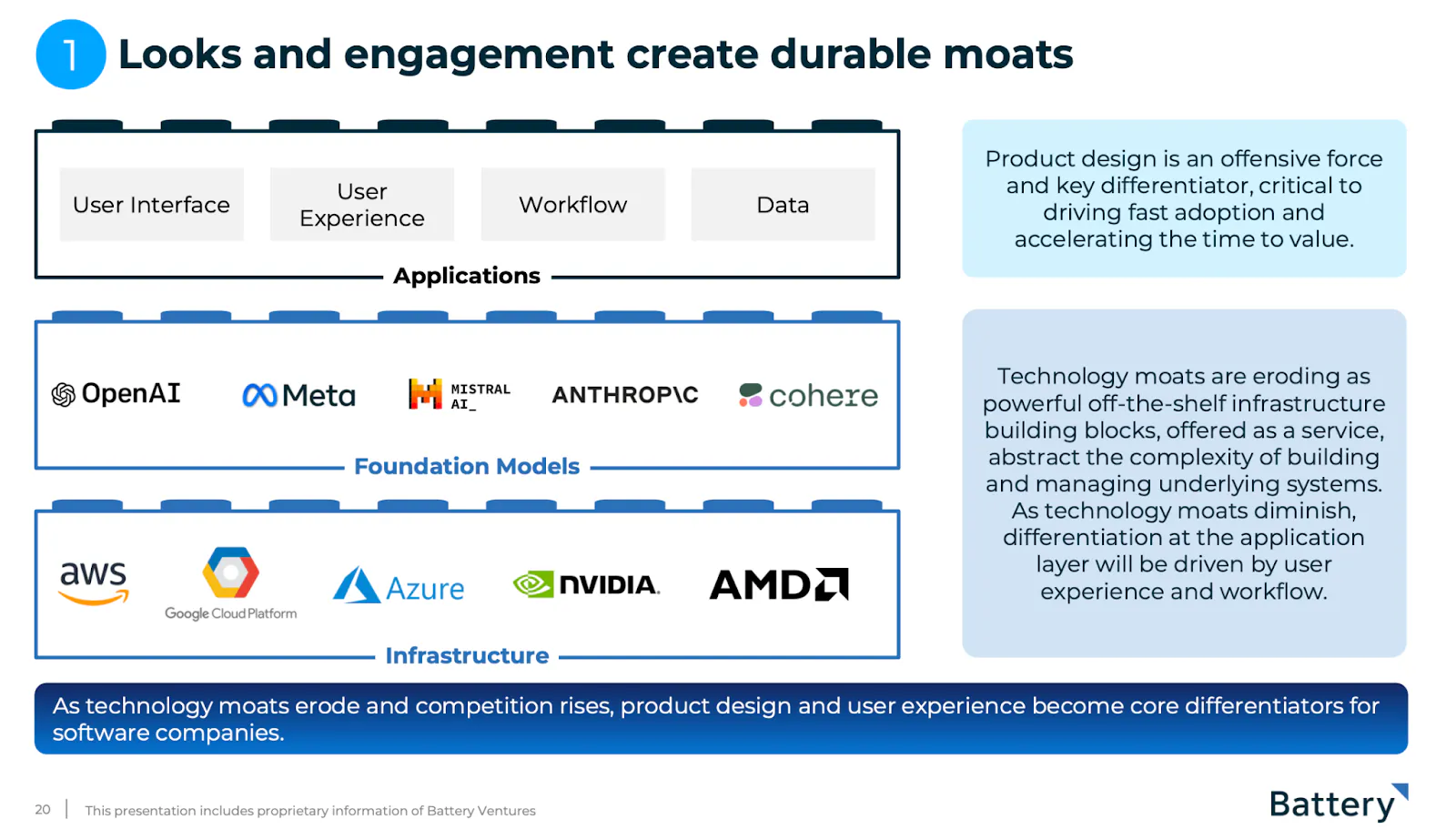
One 2024 report from Battery Ventures argues that, as technology moats diminish and off-the-shelf infrastructure makes it easy to spin up any product, product design in the application layer of any product will become the “offensive force and key differentiator”.
Anu Atluru’s viral essay “Taste is Eating Silicon Valley” makes a similar argument:
“In a world of scarcity, we treasure tools. In a world of abundance, we treasure taste. Everyone’s software is good enough. Software used to be the weapon, now it’s just a tool. The barriers to entry are low, competition is fierce, and so much of the focus has shifted — from tech to distribution, and now, to something else too: taste.”
Where some people talk about taste, others talk about being opinionated. But they each point to a core idea: Knowing what to build is becoming just as important as how to build it. The craft or perspective with which the software is built will set it apart.
Ideas Over Execution
There’s a long-running debate about whether ideas or execution matters more in building startups. You often hear “ideas are cheap and execution is expensive,” but that argument is becoming less persuasive now.
AI is making execution easier and raising the importance of ideas, but it's also creating a lot of uncertainty about what workflows will look like in the future. Will we all be wearing AI listening devices that integrate with a personal OS? Will the browser look fundamentally different? Will the AI chat interface still be dominant in five years?
There’s no way to A/B test these, and being opinionated and right about the way software will work in the future will create a new set of generational companies.