Thesis
Historically, advances in AI depended largely on larger training runs, more data, and greater compute. However, for enterprises using existing models, the challenge is increasingly running those models reliably and economically in production. Enterprise LLM budgets grew 75% year over year in 2025 and shifted from pilot funding to permanent IT and business-unit budgets. As of October 2025, generative AI model spending was projected to rise from $14 billion in 2025 to $39 billion by 2028, with much of the increase tied to production use. Unlike training, which occurs periodically, inference is a recurring cost that generally grows with application usage. As of November 2025, production LLM systems already process tens of trillions of tokens per day, making latency, availability, and cost central to whether AI applications can operate at scale.
In 2025, 88% of enterprises reported regular AI use, while nearly two-thirds had not successfully scaled AI across the organization. The main barriers were often operating, governance, and integration challenges rather than model quality alone. Closed-model APIs from providers such as OpenAI and Anthropic are easy to adopt, but can limit customization, deployment control, and cost management at high volumes. Open and open-weight models such as Llama, Mistral, Qwen, and DeepSeek give companies more control over model behavior and deployment. Smaller and specialized models can also be adapted for specific tasks, customers, or domains. This is leading some enterprises to use a mix of closed, open, and customized models rather than relying on one provider, with 37% reportedly running five or more models across experimentation and production.
Running open or enterprise-owned models creates its own infrastructure burden. Serving them at scale requires GPU capacity, performance optimization, autoscaling, monitoring, and capacity planning. Real-time and agentic applications increase request volume while placing tighter limits on response time. Self-hosting gives enterprises more control, but also exposes them to GPU costs, supply constraints, and ongoing reliability work. Most application teams do not want to build and maintain this infrastructure for every model they use.
Fireworks AI provides a managed platform for running open and enterprise-owned models in production. It handles GPU provisioning, autoscaling, performance optimization, monitoring, and failover, allowing teams to deploy and manage models without building a separate inference stack. The company addresses the gap between enterprises that want greater control over their models and the operational work required to run them at scale.
Founding Story
Source: Sequoia Capital
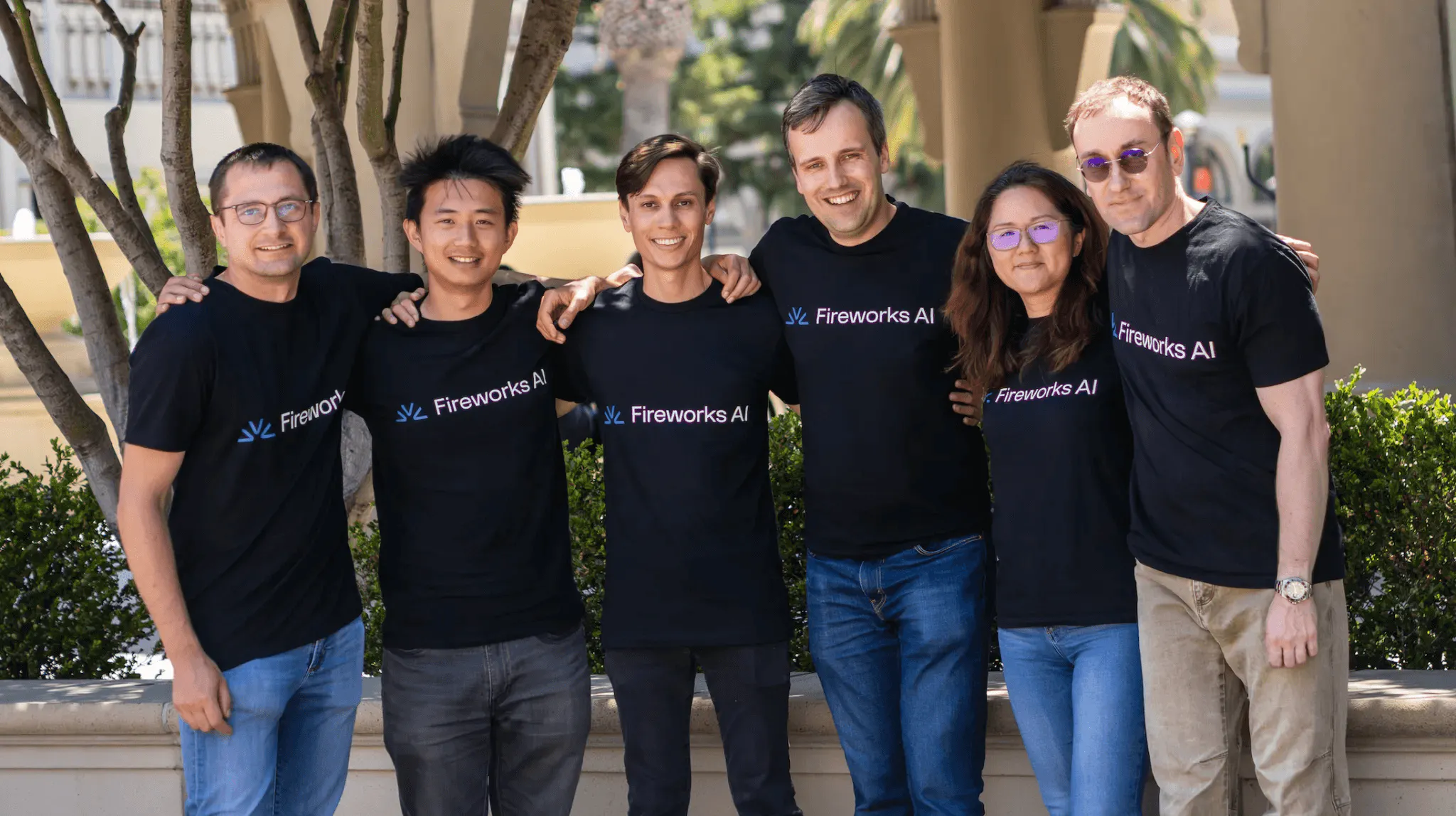
Fireworks AI was founded in 2022 by Lin Qiao (CEO), Dmytro Dzhulgakov (CTO), Benny Chen, Chenyu Zhao, Dmytro Ivchenko, James Reed, and Pawel Garbacki to make production-scale inference accessible and affordable to enterprises. The idea grew out of their experience building large-scale AI systems at Meta and seeing how difficult it was for companies without Meta’s resources to run AI products reliably and affordably.
Qiao had spent much of her career working on the systems behind machine learning. After studying computer science at Fudan University and completing a Ph.D. at the University of California, Santa Barbara, she worked at IBM and LinkedIn before joining Meta. There, she built and led a team that grew from five engineers to more than 300. The group developed tools such as Caffe2 and PyTorch and helped Meta use machine learning across its data centers, consumer products, and virtual and augmented reality devices. Dzhulgakov and several other future Fireworks founders worked with Qiao on these problems at Meta. Their projects included advertising systems, recommendation products, and the systems used to run models in live applications. They also saw software developed at Meta adopted more widely and used in areas such as streaming recommendations and autonomous vehicles.
This work gave them a close view of what happens after an AI model has been trained. Companies still need to run the model inside a live product so that it can generate answers, recommendations, images, or other results for users. This process is known as inference. Running inference in a live product creates a different set of challenges from training the model. The system must respond quickly, work reliably for large numbers of users, and keep computing costs under control.
Qiao and her colleagues saw that, as AI models improved, these practical limits increasingly determined whether companies could turn them into viable products. Through conversations with friends and industry contacts, the founders found that many businesses wanted to build AI products but did not have hundreds of specialized engineers or easy access to large amounts of computing power. They could often obtain or develop a capable model, but struggled to run inference quickly, affordably, and reliably at scale.
That gap became the basis for Fireworks AI. In late 2022, Qiao and her co-founders left Meta to build a service that would handle much of the technical work required to run AI models in live products. Their goal was to help companies launch and expand AI products without having to build a large internal infrastructure team. Fireworks focused on reducing computing costs, improving response times, and making inference easier to operate at scale.
Product
Source: Sequoia Capital
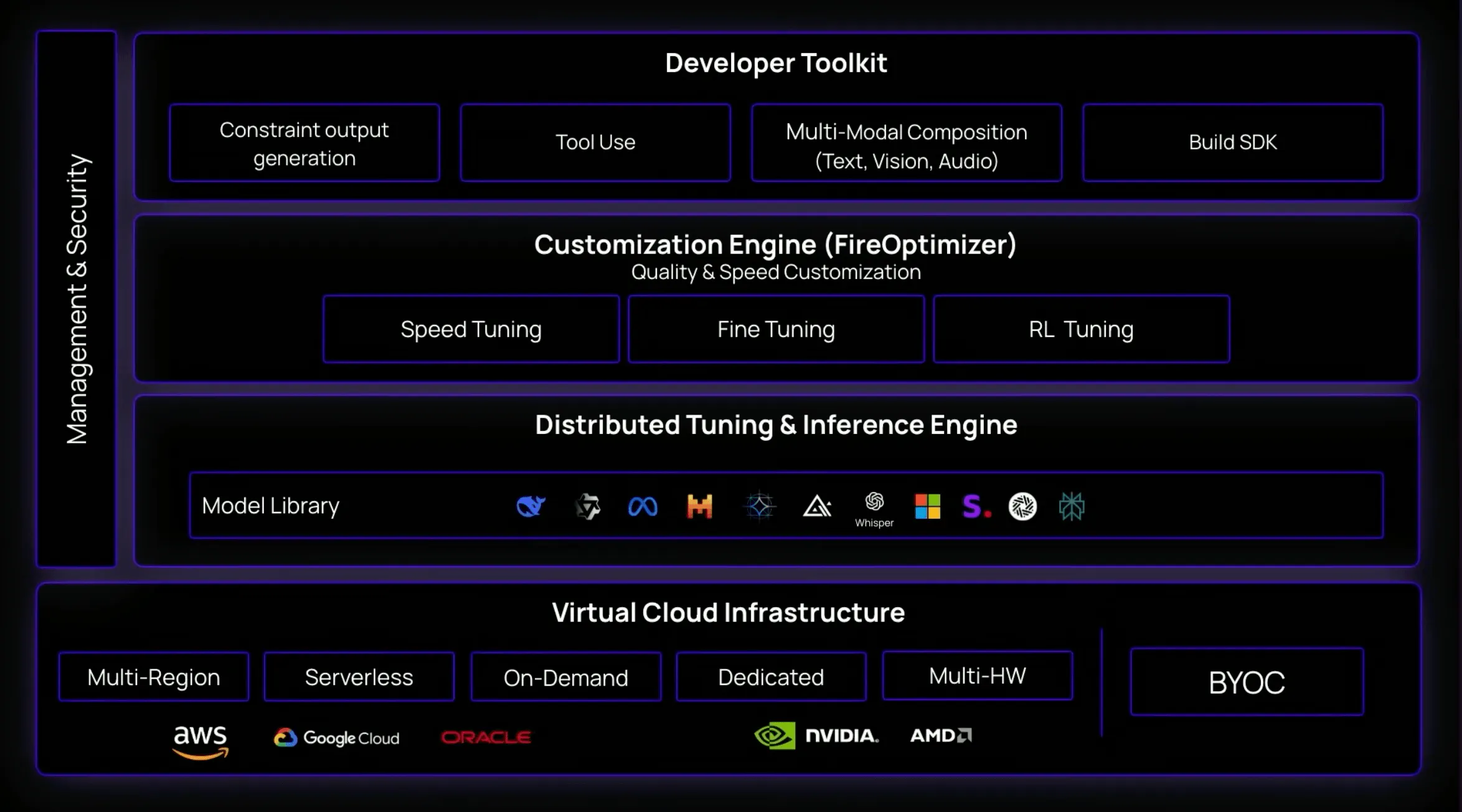
Fireworks AI is a platform for deploying, fine-tuning, and running open and enterprise-owned AI models in production. Without a managed platform, teams often assemble separate tools for model hosting, GPU management, autoscaling, performance optimization, monitoring, traffic routing, and failover. These tools may come from different vendors or run across several clouds, leaving engineers to connect and maintain the full system themselves. This setup becomes harder to manage as an application grows. A team may begin by testing a model on a small GPU instance, but rising traffic creates new requirements around capacity, latency, cost, reliability, and model updates. Each requirement adds another tool or internal service, turning a basic deployment into a fragmented infrastructure stack that takes time away from product development.
Fireworks AI brings these functions into one platform. Teams can select or upload a model, fine-tune it, deploy it, and manage it through the same system. Fireworks AI handles GPU capacity, autoscaling, request processing, performance optimization, monitoring, traffic routing, and failover. This allows teams to move from testing to production without building and maintaining separate infrastructure for each stage. Fireworks AI provides APIs for calling models and managing deployments.
Fireworks AI Platform
The Fireworks AI Platform runs and manages models in production. It is built for applications that require low latency, high request volume, and reliable performance.
Source: Fireworks AI
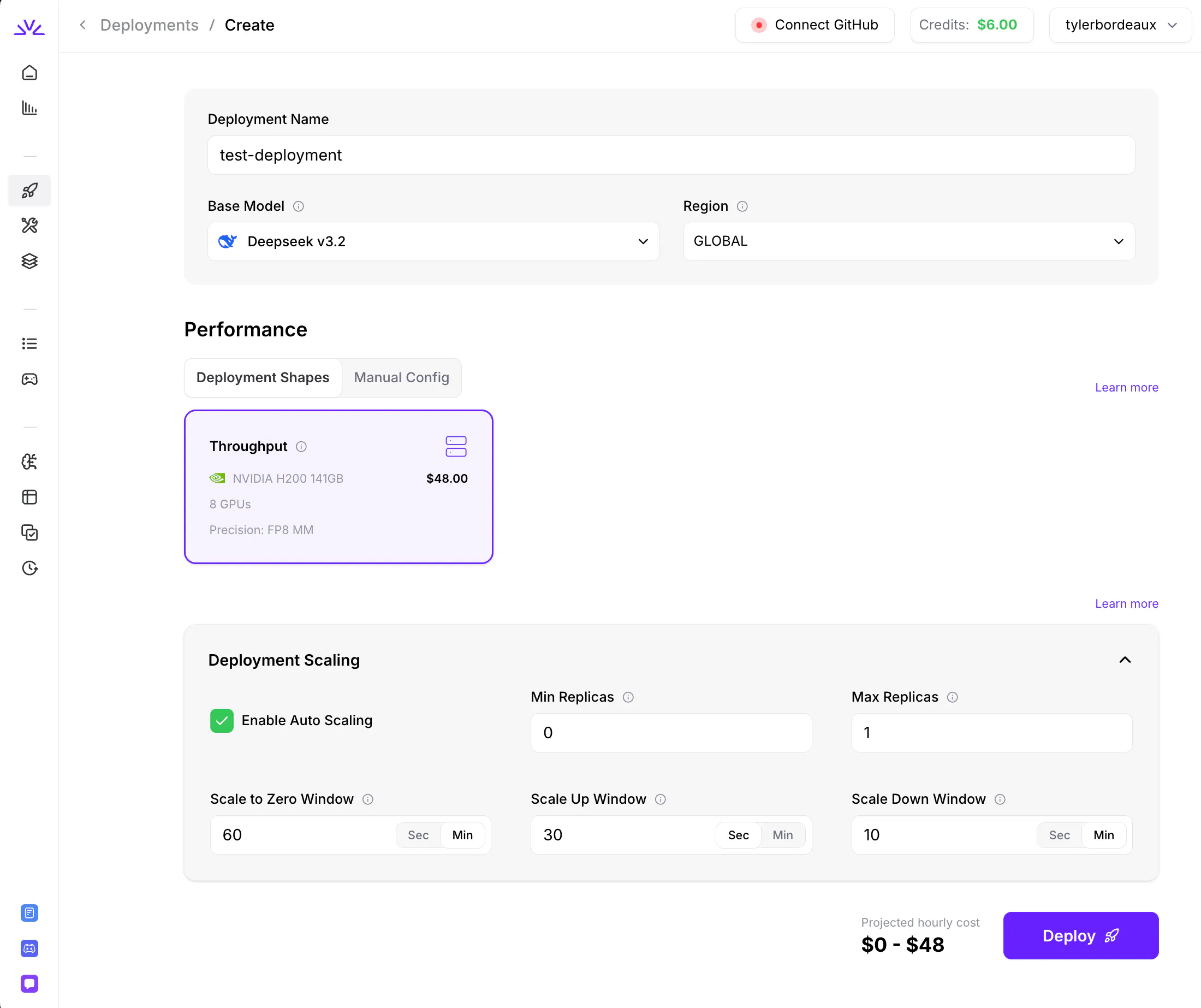
Teams can choose between serverless and dedicated deployments. In a serverless deployment, Fireworks AI assigns shared compute capacity as requests arrive, and customers pay based on usage. This is useful for testing and workloads with variable traffic. In a dedicated deployment, GPU capacity is reserved for one customer, providing more predictable performance, stronger isolation, and greater control for high-volume, latency-sensitive, or regulated workloads. Deployments can also run across multiple regions. Fireworks AI manages replication, traffic routing, and failover, so teams do not need to build these systems themselves.
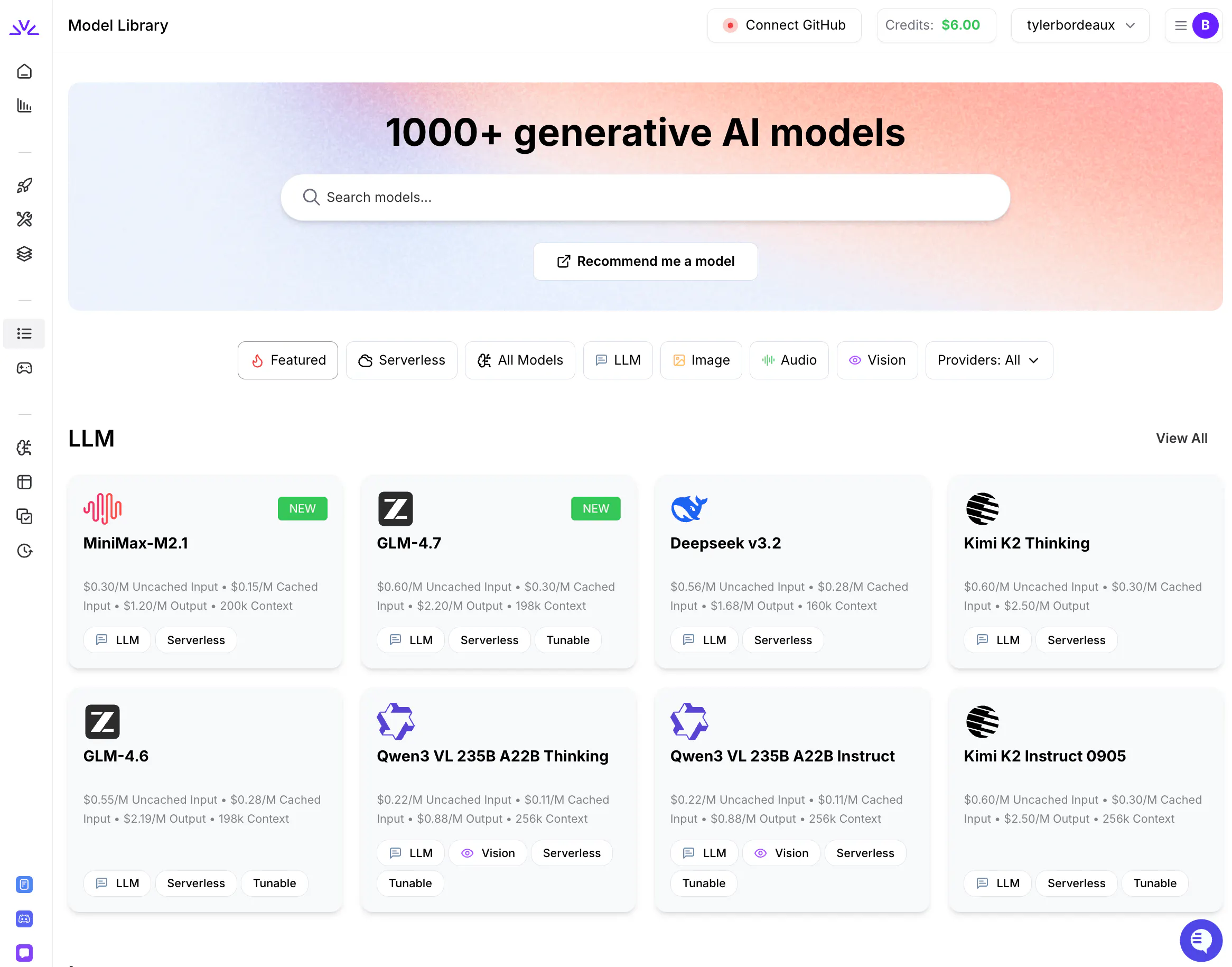
The platform supports open-weight models across text, vision, and multimodal workloads. Customers can add, replace, or update models without rebuilding their application infrastructure. They can also use different models for different tasks based on quality, latency, and cost.
Model Serving and Lifecycle Management
Source: Fireworks AI
Teams can select a supported open model or upload a model they own, then deploy it through a consistent API. Fireworks AI provides tools to test, version, and release model updates without taking the application offline. Customers can send a small share of traffic to a new model or configuration before rolling it out more broadly. This helps teams identify changes in quality, latency, or reliability before they affect all users.
The same application can use several models. Additionally, through the Fireworks Nexus harness, requests can be routed based on the task, required response time, or cost. For example, a smaller model may handle simple requests, while a larger model handles more complex work.
Teams can fine-tune or adapt models using their own data and requirements. This can improve performance on tasks that depend on company-specific knowledge, language, or workflows. Adapted models run on the same platform as the original model. Teams can test, deploy, and manage them without creating a separate infrastructure stack. They can also maintain different versions for specific products, customers, or use cases.
Optimization and Performance
Fireworks AI applies techniques such as request batching, prompt caching, speculative decoding, and parallel processing to improve speed and GPU utilization. These optimizations are built into the platform, so customers do not need to develop and maintain them independently.
The platform also manages how requests are scheduled across available GPUs. This helps reduce unused capacity, maintain more consistent response times, and handle traffic spikes.
For high-volume applications, these improvements can lower the cost per request and make performance more predictable as usage grows.
Scalability, Reliability, and Observability
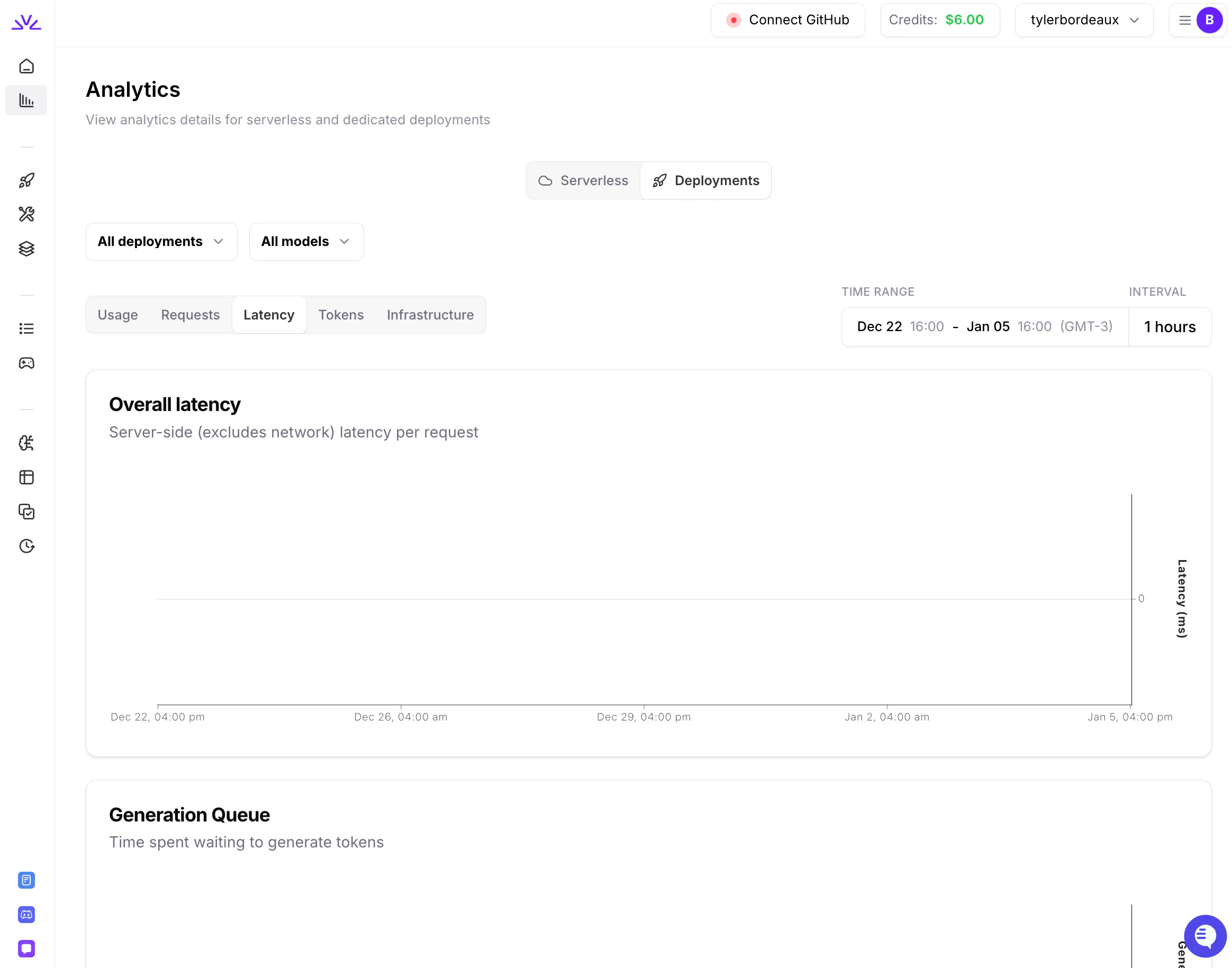
Fireworks AI manages autoscaling, capacity, and failover as demand changes. Multi-region deployments can reduce latency for users in different locations and provide backup capacity if one region becomes unavailable.
Source: Fireworks AI
The platform tracks latency, request volume, throughput, errors, and usage. Teams can use these metrics to monitor performance, identify problems, compare configurations, and manage costs. This gives customers a single view of how their models and infrastructure are performing in production.
Enterprise and Governance
Fireworks AI keeps each customer’s data and models separate from those of other customers. Enterprises can also use private deployments and controlled environments when required. Customer inputs are used to run the customer’s workloads rather than train models owned by Fireworks AI. These controls support companies with security, privacy, and regulatory requirements.
Market
Customer
Fireworks AI serves enterprises that run high-volume, user-facing AI products. These workloads are often sensitive to latency and may involve millions of inference calls per day. At that scale, small differences in speed or cost can have a large effect on product performance and margins. Customers include developer tools, productivity platforms, marketplaces, telecom companies, contact centers, and consumer services, with users such as Uber, DoorDash, Notion, Samsung, Verizon, Upwork, GitLab, and Quora.
The typical customer offers AI features to a large user base and needs predictable latency, stable costs, and control over how models are adapted. These needs become more important as a workload moves into production. A model that is too slow or expensive at low volume may become uneconomic when usage increases by 100 or 1K times. Many customers also need models adapted to proprietary data or specific tasks. Rather than relying only on fixed frontier APIs, they tune open models to meet defined targets for latency, accuracy, and cost. For some narrow workloads, these specialized models can perform better than larger general-purpose models while running faster and at lower cost.
Customers usually start on Fireworks’ self-serve platform with one important workload, such as code editing, search, agent workflows, or real-time voice. They expand after testing the workload’s quality, latency, and cost. As usage grows, deployments move from prototypes to production environments with stronger controls. Customers can choose where their data and workloads run, while Fireworks manages model performance, reliability, and scaling.
Teams typically have to choose between frontier model APIs and self-hosted open models. Frontier model APIs can be costly at scale and offer limited control, while self-hosting open models requires teams to manage infrastructure, performance, and reliability. Fireworks sits between these options by providing open-model customization without requiring customers to operate the full infrastructure themselves.
Customer examples show how this works in practice. Cursor reported about 1K tokens per second using Fireworks’ speculative decoding, around 13 times faster than standard Llama 70B and nine times faster than its GPT-4-based approach, while also improving edit accuracy. Notion reduced latency from about two seconds to 350 milliseconds for AI features used across more than 100 million users. Cresta runs millions of real-time contact-center interactions from one base model with thousands of LoRA adapters and reported costs up to 100 times lower than GPT-4 on some workloads. Upwork uses Fireworks AI to support real-time, personalized proposal generation.
Market Size
Inference is becoming a larger share of generative AI spending as companies move models from testing into production. As of October 2025, generative AI model spending was expected to rise from about $14 billion in 2025 to $39 billion in 2028, with specialized and fine-tuned models accounting for most of this growth. Production LLM systems already process about 50 trillion tokens per day, making inference a usage-based market that grows with application demand.
Fireworks AI’s addressable market is the portion of this spending that moves to inference platforms used to serve, tune, and manage models in production. As of October 2025, industry estimates placed the inference platform-as-a-service (SaaS) market at $105.2 billion by 2030. Fireworks AI could capture a portion of this market through a platform that covers model spending, infrastructure, and runtime costs.
Competition
Competitive Landscape
Fireworks AI competes in the market for running and customizing AI models in production. Buyers seem to choose among three options: closed-model APIs (like OpenAI and Anthropic), managed inference platforms, and AI services offered by large cloud platforms (like Google and Amazon). Fireworks AI’s closest competitors are managed inference companies such as Together AI and Baseten. Like Fireworks AI, they host, serve, and fine-tune open models for customers. They compete on model performance, reliability, customization, and cost.
Closed-model providers such as OpenAI and Anthropic remove most infrastructure work. Teams access models through an API while the provider manages scaling and reliability. This works when teams need to launch quickly and require limited control over the model. Fireworks competes for workloads where customers need more control over model choice and tuning, or where latency and cost become important at higher volumes.
Large cloud platforms such as AWS, Microsoft Azure, and Google Cloud already provide many enterprises with infrastructure, security, and procurement services. Expanding their managed inference products would give existing customers a low-friction option because they could add the service without introducing another vendor. Customers may choose this convenience even when a specialist provides better performance or lower costs.
Closed-Model Platforms
OpenAI: Founded in 2015, OpenAI provides proprietary models such as GPT through its API and products including ChatGPT. Customers can use these models without managing hosting or GPU infrastructure. Compared with Fireworks AI, OpenAI offers a simpler setup but gives customers less control over model choice, customization, and infrastructure. In March 2026, OpenAI raised $122 billion at a post-money valuation of $852 billion, bringing its total funding to $201.1 billion as of August 2026.
Anthropic: Founded in 2021, Anthropic provides its proprietary Claude models through an API, with a focus on reliability and safety for enterprise customers. Like OpenAI, it manages the model and infrastructure for customers but offers less control than an open-model platform. In May 2026, Anthropic raised $65 billion in Series H funding at a $965 billion post-money valuation, bringing its total funding to $132 billion as of August 2026.
Managed Inference Platforms
Together AI: Founded in 2022, Together AI provides cloud infrastructure for training and deploying generative AI models, with access to a broad catalog of open-source models. Like Fireworks AI, it offers managed inference and model deployment and supports model training. In July 2026, Together AI announced $800 million in Series C funding, bringing its total funding to $1.3 billion as of August 2026.
Baseten: Founded in 2019, Baseten provides infrastructure for deploying and serving models in production. It competes directly with Fireworks AI on latency, throughput, reliability, and enterprise deployment. In June 2026, Baseten announced $1.5 billion in Series F funding, bringing its total funding to $2.1 billion as of August 2026.
Large Cloud Platforms
Amazon Bedrock: Introduced in 2023, Amazon Bedrock is a managed service for building and running generative AI applications on AWS. It gives customers access to multiple foundation models and integrates with AWS security, identity, networking, and procurement systems. For enterprises already using AWS, Bedrock may be easier to adopt than a specialist provider because it fits into existing infrastructure and vendor contracts. This can outweigh differences in inference cost or latency. Amazon has been publicly traded on the NASDAQ since 1997 and had a market cap of $2.9 trillion as of August 2026.
Gemini Enterprise Agent Platform: Introduced in 2021, Gemini Enterprise Agent Platform is Google Cloud’s platform for building, deploying, and managing machine-learning models. It integrates with Google Cloud’s existing security, governance, data, and purchasing systems. Enterprises already using Google Cloud may choose its agent platform because it is easier to add and standardize than a separate inference provider, even when a specialist offers better performance or lower costs. Alphabet has been publicly traded on the NASDAQ since 2004 and had a market cap of $4.4 trillion as of August 2026.
Business Model
Source: Fireworks AI
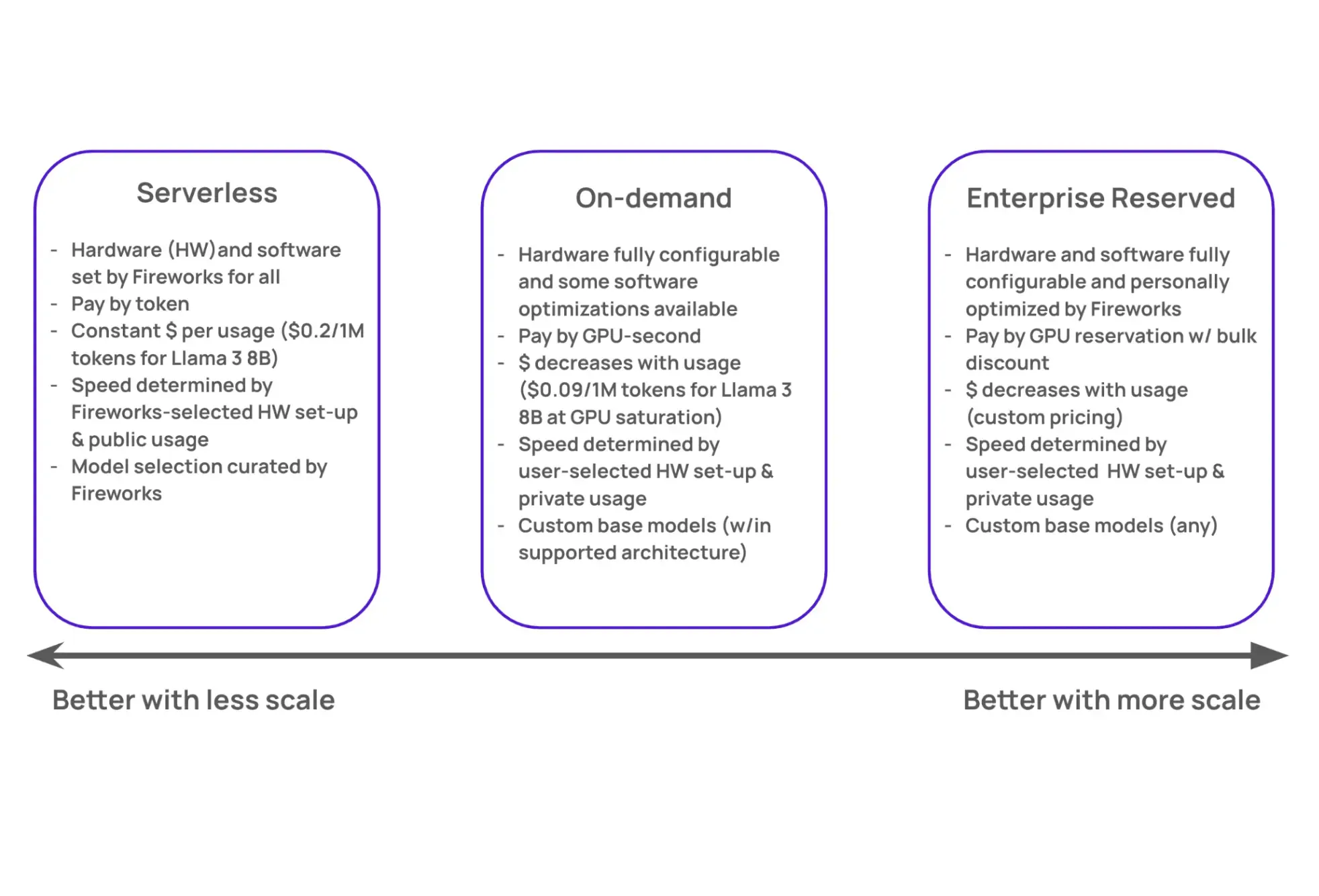
Fireworks AI charges customers based on compute usage. Pricing is measured by tokens, image-generation steps, audio seconds, or GPU time, depending on the workload. The company does not charge per seat or rely on fixed subscription contracts. Revenue increases as customers run more workloads.
Fireworks claims to provide inference at a lower cost than many closed-model APIs, especially at high volumes. It runs optimized open models through serverless inference, batch processing, fine-tuning, and dedicated GPU deployments. This spending would otherwise go to cloud providers or proprietary model companies.
The business likely has high infrastructure costs. Cost of goods sold mainly includes GPUs, networking, and model serving. As of July 2025, gross margins were ~50% with management targeting ~60% through improved GPU utilization.
Traction
Source: Sequoia Capital
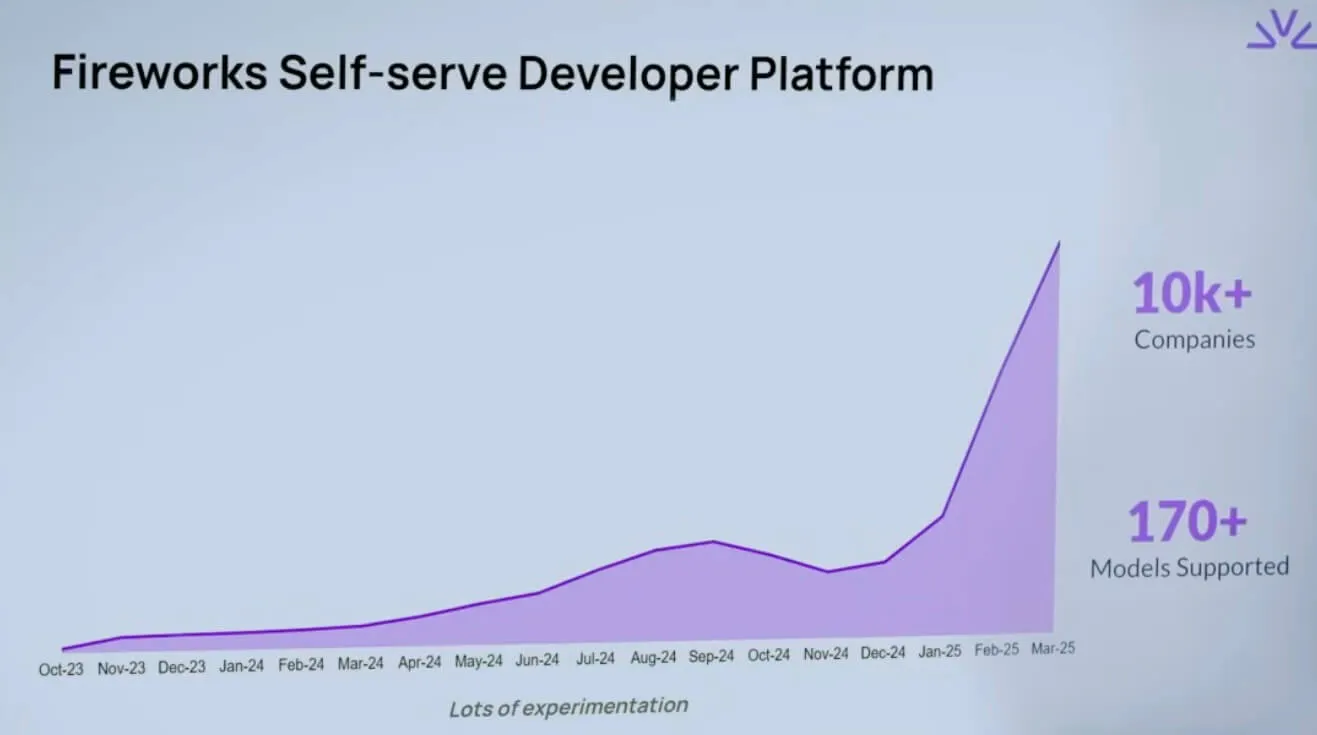
From 2024 to 2025, Fireworks AI’s usage and adoption showed substantial growth. As of July 2024, the company’s platform served 1K enterprises and processed over 140 billion tokens daily. One year and four months later, in November 2025, the company surpassed 10K companies served and 10 trillion tokens processed daily, reflecting a 10x increase in enterprise customers and a 70x increase in daily tokens processed. As of July 2026, notable customers included Samsung, Verizon, Uber, Notion, Doordash, Cursor, and Upwork. These companies maintain unique, high-scale, latency-sensitive workloads with sustained token throughput.
Fireworks AI delivers measurable performance and cost gains, reducing latency, increasing throughput, and lowering inference costs in production environments. The platform powers real-time inference for products serving hundreds of millions of end users. Expansion within accounts is driven by increased inference usage, with spend scaling as customers run more production traffic through the platform.
In July 2026, Fireworks AI announced that it surpassed $1 billion in annualized revenue run rate and served more than 40 trillion tokens per day. It reported that 95% of those tokens came from models specialized on customer data, optimized for specific jobs, implying that companies are focused on building their own proprietary models.
Valuation
In July 2026, Fireworks AI raised $1.5 billion in Series D funding at a $17.5 billion valuation led by Atreides Management, Index Ventures, and TCV. With its Series D funding, Fireworks AI is planning to expand its compute infrastructure, grow its engineering team, and continue building its platform. As of August 2026, Fireworks AI has raised $1.8 billion in total funding.
Its Series D took place just over two years after its Series A. In March 2024, it announced a $25 million Series A round led by Benchmark. Four months later, in July 2024, Fireworks AI raised an additional $52 million Series B led by Sequoia at a $552 million valuation, which Qiao described as a 4x increase over its prior valuation. In October 2025, it raised a $250 million Series C, co-led by Lightspeed Venture Partners, Index Ventures, and Evantic, valuing the company at $4 billion. The Series C included strategic participation from NVIDIA, AMD, MongoDB, and Databricks.
Key Opportunities
Adapter-Based Model Fleets
Some enterprises are moving from one general-purpose model to one base model with many smaller versions adapted for specific workflows, customers, or domains. These smaller versions are often created with LoRA adapters, which are small sets of additional model weights that change how the base model behaves without requiring the full model to be retrained or copied.
One of Fireworks AI’s customers, Cresta, an AI platform for contact centers, uses this approach in production, serving millions of real-time contact-center interactions from one base model with thousands of LoRA adapters. Instead of running a separate full model for each use case, teams can route requests to different adapters based on the customer, task, or context.
This creates a possible expansion area for Fireworks beyond inference. As companies use more adapters, they need systems to store, test, version, deploy, monitor, and replace them. Managing thousands of adapters also creates challenges around latency, isolation, usage tracking, and cost. Fireworks could provide this management layer alongside model hosting.
This would make Fireworks more closely tied to how customers run models in production. The more it manages adapter routing, caching, usage, and performance, the more work customers would need to do to move to another provider.
Hardware Flexibility May Increase Demand for a Neutral Runtime
Enterprises may not want to depend on one cloud provider or one type of GPU. Prices can change, hardware can be hard to obtain, and some workloads may need to run in specific regions or dedicated environments. Using several providers and deployment types could reduce these risks, but it would also make the infrastructure harder to manage.
Fireworks could benefit if customers want one software layer that works across these different environments. Its model-agnostic approach may allow customers to use the same API while the underlying hardware changes. Investment from both NVIDIA and AMD may support this positioning, but it does not prove that demand will develop in this direction.
The opportunity depends on whether Fireworks can deliver similar performance, reliability, and pricing across different hardware setups. If it can, customers may use Fireworks to manage inference across providers instead of building that system themselves. This could make the platform more useful as companies adopt multiple hardware and cloud options.
Key Risks
Bundled Cloud Platforms Winning by Default
AWS Bedrock and Gemini Enterprise Agent Platform add managed inference to cloud platforms that many enterprises already use. These services integrate with existing identity controls, private networks, compliance systems, cloud credits, and vendor contracts. This makes them easier to adopt than a separate inference provider, especially for companies that prefer to limit the number of vendors they use.
If these platforms become competitive on latency, throughput, and cost, enterprises may choose them even when Fireworks AI performs better on specific workloads. Fireworks AI could then be treated as a specialist tool for teams with demanding performance or cost requirements rather than the standard platform for production inference. This risk is higher in regulated industries, where approved vendors, security reviews, and existing cloud infrastructure may matter more than incremental efficiency gains.
GPU Supply and Capacity Risk
Fireworks AI’s costs and service quality depend on access to GPUs, GPU pricing, and how efficiently it uses available capacity. Customer demand can increase quickly as workloads move into production, but GPU supply may be limited, expensive, or uneven across regions. Fireworks AI must still maintain low latency and high availability during periods of heavy or unpredictable usage.
This requires accurate capacity planning. Too little capacity can reduce performance or availability, while too much capacity can lower utilization and gross margins. Higher GPU prices, tighter supply, or incorrect demand forecasts could force Fireworks AI to accept lower margins, limit customer usage, or carry excess capacity. Repeated performance or availability problems could lead customers to shift workloads to larger cloud platforms or closed-model providers.
Model Support and Performance Risk
Fireworks AI improves inference performance through batching, caching, speculative decoding, and parallel processing across open models. However, new model releases may use different architectures, context windows, multimodal systems, or decoding methods. These changes can reduce the value of existing optimizations and require additional engineering work.
Customers may adopt new models soon after release and expect upgrades without slower performance or service instability. If Fireworks AI is slow to support a widely used model, or cannot run it efficiently, customers may choose a competitor or large cloud platform that supports it sooner.
Maintaining a performance advantage requires continuous investment in engineering and infrastructure. A sustained delay in supporting new models could weaken the reason for customers to move from existing inference providers to Fireworks AI.
Summary
Fireworks AI is an inference and deployment platform for running open and enterprise-owned generative AI models in production. It manages GPU provisioning, optimization, autoscaling, and monitoring for high-volume workloads where cost, latency, and reliability matter. This gives enterprises more control than closed-model APIs without requiring them to operate the infrastructure themselves or rely on one model provider.
The platform serves and fine-tunes open-weight models across text, vision, and multimodal workloads. Customers can use different models for different tasks based on cost and performance. Fireworks AI charges based on inference usage. As of July 2026, it reportedly processed more than 40 trillion tokens per day, generated over $1 billion in annualized revenue, and served customers including Uber, DoorDash, Notion, Samsung, and Upwork. Fireworks AI competes with closed-model providers, managed inference platforms, and AI services from large cloud providers. Its position depends on maintaining better performance and lower unit costs than these alternatives as inference workloads scale.