

Thesis
Understanding what customers want is essential to every major business decision. However, only 15% of companies in 2024 consistently incorporated customer insights into decision-making, despite research showing that those who do achieve twice the revenue growth of peers who do not. The consequences are severe. Globally, businesses lost an estimated $3.7 trillion in annual sales in 2024 due to customers switching brands after poor experiences.
The gap between intent and execution comes down to infrastructure. The US market research industry alone generated $48 billion in annual revenue in 2021, with much of this spend flowing to agencies, consulting firms, and legacy survey platforms built on human labor and form-based data collection. However, these methods force a tradeoff between depth and scale. Qualitative interviews deliver the detail required for thorough customer understanding, but cannot scale beyond what a team of human moderators can manually conduct. Surveys can scale to thousands of respondents, but sacrifice the open-ended responses that surface how customers actually think.
Generative AI resolves that tradeoff. Its capabilities in synthesis, adaptive conversation, and automated reporting map directly onto each stage of the research process from study design through insight analysis. The productivity implications are significant. In a 2024 study coding in-depth interview transcripts with ChatGPT, the active coding process took 20 minutes, whereas human researchers took several hours per transcript. Market research is particularly well-suited to AI automation as the majority of researcher time is spent on mechanical tasks rather than analytical judgment. Transcription, response coding, and synthesis are all repeatable, rule-based processes that AI handles well. Where analysts project economy-wide labor productivity growth of 0.1-0.6% annually through 2040, the productivity gains in market research could exceed that figure, as much of the workflow is mechanical.
Listen Labs provides an AI-powered, autonomous market research platform designed to automate the full customer interview process, from study design and global participant recruitment to analysis and reporting. An AI researcher designs the study and recruits participants from a proprietary panel of over 30 million verified respondents across 45 countries. It then conducts open-ended video interviews with adaptive follow-up questions in real time and delivers synthesized reports, highlight reels, and slide decks within 24 hours of study close. Rather than bolting AI onto existing survey infrastructure, Listen Labs seeks to rebuild the research workflow around AI moderation from the ground up, removing human moderators as a scaling constraint while preserving the conversational depth that surveys cannot produce.
Founding Story
Listen Labs was founded in September 2023 by Alfred Wahlforss (CEO) and Florian Juengermann (CTO). The pair met at Harvard, where Wahlforss and Juengermann were completing graduate programs in data and computer science, respectively.
Wahlforss began coding at age nine and wrote his bachelor’s thesis on diagnosing dementia using LLMs. While completing his undergraduate degree, he founded Bemlo, a Nordics-based healthcare staffing marketplace backed by Y Combinator, which scaled to nearly one million in annual revenue. After transitioning to a chairman role, he worked as a product manager at Mavenoid, a Swedish customer support startup. Juengermann complements Wahlforss’s operating background with his technical expertise. He is a German national champion in competitive computer programming and a medalist at the International Olympiad in Informatics. Before Listen Labs, he founded a full-stack software agency and image-based fashion searching app. Additionally, he worked on real-time motion planning at Tesla.
While Wahlforss and Juengermann initially met while getting their master’s degrees at Harvard, they first worked together on BeFake, an AI avatar generation and social network built on the open-source code of Stable Diffusion. The app went viral, achieving 20K downloads in one day. Eager to understand the rapid adoption, the duo had an “epiphany to use LLMs to speak to every single one of [their] customers and then summarize what they all think about it.” A basic prototype was so successful that the team immediately sold BeFake to focus on what would become Listen Labs. Juengermann credits GPT-4 for making their product possible, saying, “One of the most important things is making sure the AI has a deep understanding of the business context before asking any questions—and until GPT-4, that was not possible.”
Since its founding, Listen Labs had grown to over 80 employees as of July 2026, with a goal of reaching 150 by year's end. The team hires engineers for non-engineering roles across growth, operations, and marketing departments. Notably, the company claimed that over 30% of the engineering team were International Olympiad in Informatics medalists. In 2025, Listen Labs went viral for their hiring stunt (generating over five million views across social media channels), spending over $5K (a fifth of their total marketing budget) on a San Francisco billboard displaying five strings of what appeared to be random numbers. Once solved, the numbers revealed a website to a coding challenge to build a digital bouncer at Berghain, the Berlin club famous for rejecting almost everyone at the door. Thousands attempted the puzzle, 430 solved it, and from that pool, a select few were hired.
Product
Product Overview
Listen Labs’ core product is an AI-native end-to-end platform that designs studies, recruits for, and conducts qualitative customer research. It enables organizations to run in-depth qualitative research at scale without the cost, labor, or time required by traditional methods. An AI researcher conducts one-on-one video and voice interviews with participants sourced from its global pool of over 30 million verified users from 45 countries. Within 24 hours of completing interviews for a study, Listen Labs delivers a complete package that includes a structured report, curated video clips of key quotes, and an actionable slide deck. This end-to-end workflow stands in sharp contrast to how customer research has historically been conducted.
The Challenges Faced by Traditional Customer Research
Collecting high-quality customer research is a slow, labor-intensive process. Organizations rely on a mix of internal research teams, external market research agencies, and management consulting firms to understand their customers. Across all these providers, teams face the same structural tradeoff: qualitative interviews deliver the depth that easily codable quantitative surveys cannot. 57% of market researchers in 2026 report growing demand for qualitative research while citing speed as their primary barrier, and most teams resolve this tension by defaulting to surveys.
When organizations run qualitative research, human moderation becomes the bottleneck, as reflected in high study costs. A single in-depth one-on-one interview costs between $800 to $1.5K in the US, covering recruitment, moderation, transcription, and analysis. The cost scales sharply for specialist audiences, with oncologist interviews costing $3K to $5K each. Following interviews, the analysis further compounds the cost and labor hours. Unlike quantitative surveys, qualitative findings cannot be automated without loss of meaning. Researchers must transcribe recordings, clean and prepare transcripts, and manually code responses by theme across participants before a single insight can be written.
Even when automated transcription tools are used, researchers still spend four to five hours per hour of recorded interview cleaning the output, as automated tools miss context, crosstalk, and nuance critical to accurate coding. Next, open-ended coding of responses from a single study will take one to two weeks to manually complete. As a result, researchers spend the majority of their time on pre-insight labor rather than strategic synthesis; in 2025, 60.3% of researchers cite time-consuming manual work as their single biggest synthesis pain point. Beyond the cost and time burden of individual studies, the research workflow itself is deeply fragmented. A typical research project moves across separate systems for each function (e.g., questionnaire design, panel procurement, moderation). The average research team uses 8-12 tools to run a single study, none of which share data natively or produce a unified deliverable.
Listen Labs Product Features
Study Design
Source: Listen Labs
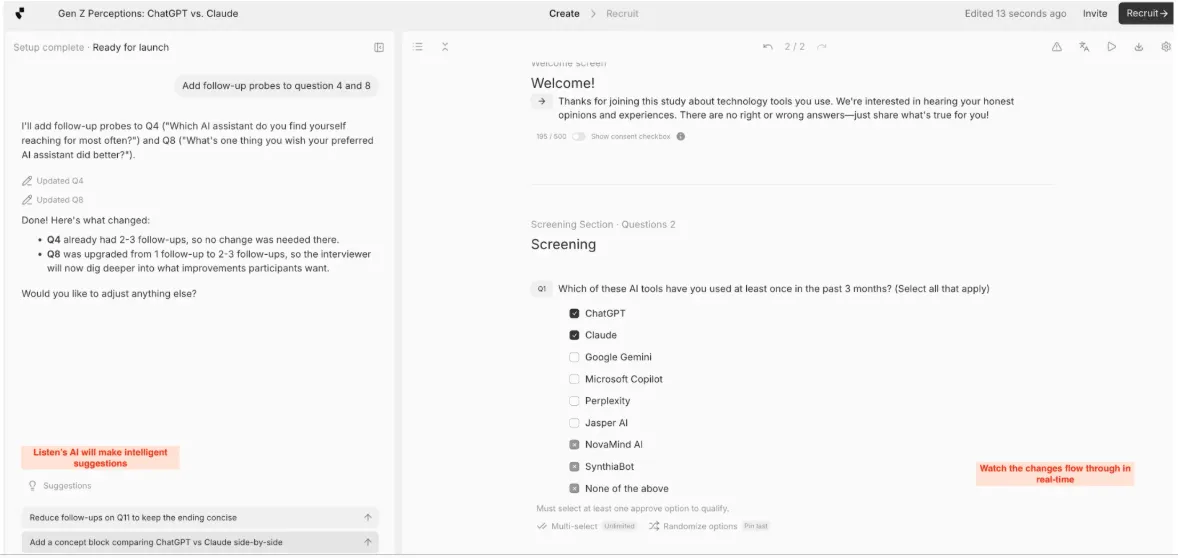
To begin, the user inputs a plain-language brief covering the project background, company context, study objectives, and hypothesis. Listen Labs uses this information to generate a discussion guide containing study goals, recruitment criteria, a participant screener, and interview questions. The discussion guide is then refined in the Study Composer, a chat-based editor that previews changes in real time. Users can adjust question wording, reorder questions for flow, insert concept-test sections, and add follow-up probes using natural-language commands. The editor supports multiple question types, conditional branching logic based on prior responses, and media embedding. Users can also control the depth of follow-up per question, from no probing to two to three follow-ups.
Participant Recruiting
Source: Listen Labs
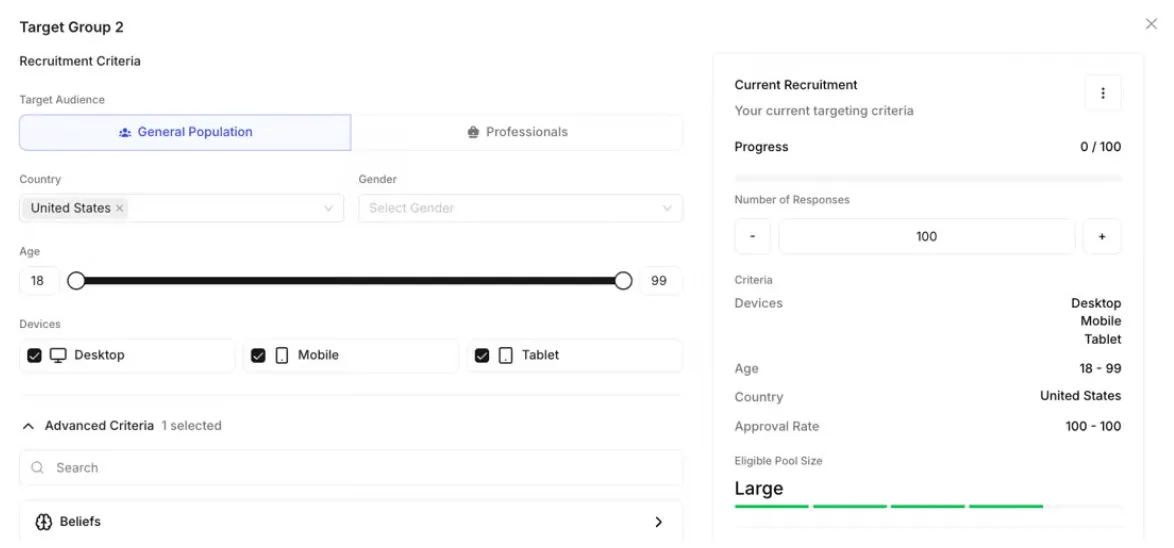
Listen Labs says it has a panel of over 30 million verified respondents across 45 countries. Based on the completed discussion guide, it will then pull relevant participants from its network. In addition to this feature, there is a direct link option that allows research teams to distribute a study link to their own customer lists, communities, or employee panels. Both sources may be run simultaneously, allowing research teams to compare internal and external audiences or to cover multiple markets. Furthermore, the platform offers two panel types, depending on the target audience: a general population panel of everyday consumers and a professional panel recruited by occupation. To calibrate the discussion guide, studies can soft-launch to a smaller group at a reduced response limit, ensuring quality before proceeding.
Source: Listen Labs
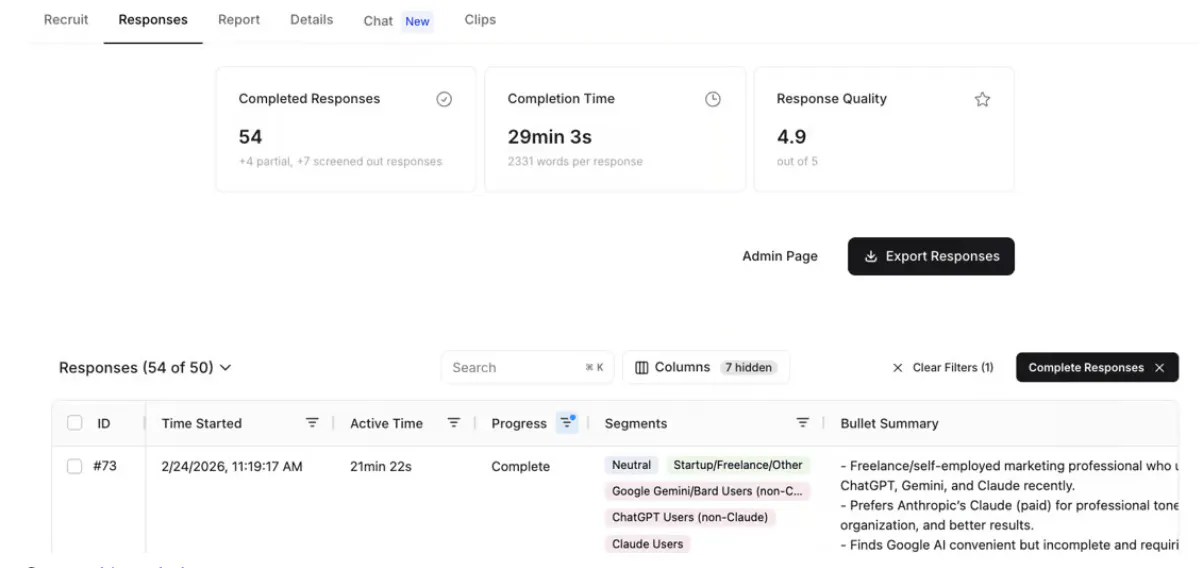
All sourced participants are quality-checked using Quality Guard, Listen Labs’ proprietary participant verification and quality-scoring system. Pre-entry checks include device fingerprinting, IP analysis, and repeat respondent detection across studies. As an additional quality check, Listen Labs caps participants at three studies per month to prevent low-effort answers across a high volume of studies. After completing a study, every response is scored across five dimensions: informativeness, response depth, engagement, follow-up quality, and repetitiveness. Responses falling below an acceptable threshold are removed and replaced at no additional cost. Quality scores are visible on every response in the Responses tab, and teams can manually exclude any response from analysis.
Study Conduct
With all pre-study steps in place, the study begins. Interviews are conducted by an AI moderator that asks structured questions from the study discussion guide and generates follow-up questions in real time based on participant responses and the overall context of the conversation. The response capture mode varies by research objective. The standard mode captures video and audio responses. For usability testing and app walkthroughs, a screen capture mode records synchronized participant screen activity alongside verbal responses. A concept testing mode shows participants one or more randomly assigned stimuli (such as ads or messaging concepts) and directs them to answer a consistent set of questions, enabling controlled comparisons across stimuli. All interviews run asynchronously, and hundreds can be conducted in parallel. Responses are visible in real time in the responses tab as interviews complete.
Listen Labs' Emotional Intelligence layer adds a further dimension to video and audio responses by analyzing tone of voice, word choice, and facial expressions against Ekman's six universal emotions framework (anger, disgust, fear, happiness, sadness, and surprise). The output includes an emotional timeline per participant, aggregate emotion distributions across the full sample, and transcript clips filterable by emotional moment, capturing reactions and subconscious signals that verbal responses alone would not surface.
Insights & Analysis
Once interviews are complete, Listen Labs organizes analysis across three views in the Analysis tab. The Report tab generates a narrative organized around the study's original objectives, with charts embedded alongside findings and each data point linked back to individual responses, intended primarily for executive summaries and stakeholder updates. The Details tab provides question-by-question analysis, including AI-generated summaries, auto-identified themes, outlier detection, and segment comparisons, with presentation-ready PowerPoint slides that can be exported directly from this view. Researchers can also edit theme labels and merge or split themes to match their own frameworks. The Chat tab allows teams to query their data in plain language through the Research Agent, with every answer cited to specific participants and timestamps, and is primarily used for exploratory analysis and locating supporting evidence for findings identified in the other views.
Segments split participants into defined groups for side-by-side comparison across themes, sentiment, and verbatim responses. Video clips of key participant moments can be generated manually or via an AI prompt, drawing from transcripts, and shared via a link or downloaded for use in presentations. The Research Library aggregates findings across all studies in a workspace into a queryable knowledge base, allowing teams to query prior research in plain language, with answers cited to specific studies and participants, and to track sentiment longitudinally across study waves.
Market
Customer
Listen Labs targets organizations with custom research needs where speed to customer insight directly affects decision-making, including both enterprises and startups, and want to avoid cost or timeline of traditional research methods. Listen Labs’ platform sits atop the existing research workflow, replacing a fragmented vendor stack with a single AI-native system.
The platform serves customers across six core industries according to its website: CPG, technology, ecommerce, healthcare, financial services, and hospitality. Primary buyers are internal product, marketing, and customer insights teams, and Listen Labs also targets research agencies, with firms like McKinney using the platform to run research for their own clients. Notable customers of Listen Labs as of July 2026 include Anthropic, Perplexity, Robinhood, Nestle, Bain & Company, Skims, Levi’s, Okta, UFC, ZipRecruiter, Docusign, Synthesia, Google, Microsoft, Sony, and Sequoia.
Using Listen Labs, Microsoft reduced research timelines from four to six weeks to hours and conducted over 100 interviews at one-third the cost of traditional methods. Romani Patel, Senior Research Manager at Microsoft, described research timelines as an important problem that Microsoft sought to solve by partnering with Listen Labs, stating:
“By the time we get to [the insights], either the decision has been made or we lose out on the opportunity to actually influence it.”
For Microsoft’s 50th anniversary, the team collected global customer video stories about Copilot within a single day, while the platform automatically assembled a highlight reel of feedback in real time as responses came in. Patel noted that the same project would have taken six to eight weeks without using Listen Labs’ platform.
Market Size
Total annual global spend on market research was $140 billion in 2024, encompassing internal research functions, consulting engagements, and formal market research services. Within that, the global market research services market was valued at $93.4 billion in 2025 and is projected to reach $116 billion by 2030, with a 4.6% CAGR. This growth is primarily driven by organizations’ increasing recognition that embedding customer insights into business decisions is a measurable financial differentiator. In 2024, 41% of customer-obsessed organizations, defined as those that systematically collect and act on customer data, achieved more than 10% revenue growth in the last fiscal year, compared with only 10% of lagging counterparts achieving similar results.
Jevons paradox, an economic theory stating that increased efficiency of a resource will increase its demand, may function as an additional tailwind for the market research industry. As AI speeds up and lowers the cost of customer research, organizations will run more studies rather than simply cutting research budgets. 88% of organizations in 2025 used AI in at least one business function, and 86% said their AI budget will increase in 2026, suggesting that broader AI adoption will expand the addressable market for AI-native research tools rather than simply displace existing research spend.
Competition
Competitive Landscape
Customer research software can be divided into two groups: legacy point solutions and AI native platforms. Legacy point solutions own the existing customer base and distribution, but are structurally constrained by workflows built around human moderation. Early-stage AI-native platforms compete for the same enterprise clients but are built around AI moderation from the ground up rather than retrofitted onto existing workflows.
Listen Labs falls into the second camp, providing an end-to-end customer research platform that replaces individual point solutions. On the legacy point-solution side, its most relevant competitors are Qualtrics and SurveyMonkey; on the AI-native platform side, its most relevant competitors are Outset and Strella. A separate group of indirect competitors includes consulting research firms and market research agencies, as well as synthetic users that compete for the same enterprise budget for customer research; the former replaces the research, while the latter replaces the respondent.
Direct Competitors
Legacy Point Solutions
Qualtrics: Founded in 2002, Qualtrics is an enterprise experience management platform that enables organizations to collect and analyze structured feedback. Its core product is a survey and form builder with advanced branching logic and statistical analysis. Qualtrics went public in 2021 before being taken private by Silver Lake and CPPIB in March 2023 for $12.5 billion. At the time of the acquisition announcement, Qualtrics had reported $1.5 billion in FY 2022 revenue, up 36% year over year, implying a roughly 8.5x revenue multiple. Qualtrics launched its AI capabilities in 2024, and more than one-third of its customer base upgraded to them within a year of launch. The 2024 rollout introduced AI-powered conversational feedback that adapts survey questions in real time based on participant responses, AI-powered response analysis, and automated workflows. As Qualtrics' AI capabilities mature, its distribution advantage over Listen Labs becomes more consequential.
SurveyMonkey: Founded in 1999, SurveyMonkey is a self-serve survey platform. The company went public in 2018 and was taken private by Symphony Technology Group in May 2023 for $1.5 billion. At the time of the acquisition, Momentive had reported $480.9 million in FY 2022 revenue, up approximately 8% year over year, implying a roughly 3x revenue multiple, a compressed valuation reflecting its slow growth. The deal followed a failed $4.1 billion acquisition attempt by Zendesk in 2022. SurveyMonkey supports basic survey creation and distribution for structured feedback collection at scale. It competes with Listen Labs for the same enterprise research budget but addresses the quantitative side of the depth-versus-scale tradeoff. SurveyMonkey serves teams that need fast, structured feedback across large populations without adaptive questioning or open-ended conversational depth. Unlike Listen Labs, SurveyMonkey does not handle complex, adaptive conversations or advanced qualitative methodologies.
AI-native Platforms
Outset: Founded in 2022, Outset is an AI-moderated qualitative research platform that enables organizations to conduct open-ended interviews at scale. The company has raised $51.3 million in total funding as of July 2026, backed by Y Combinator and Microsoft’s venture fund, M12. Although both Outset and Listen Labs are end-to-end customer research platforms, Outset does not own the entire workflow. For example, it does not own a proprietary participant panel; it recruits through over 25 third-party integrations such as Prolific and User Interviews, making panel quality dependent on external suppliers rather than a captive network.
Outset is also pursuing a broader market than pure research. The company is using its Series B to launch what it describes as the first AI-native Customer Experience Management platform, extending its research approach beyond standalone studies to encompass continuous customer touch-points. Both companies share the same core method, but their strategies differ. Listen Labs has prioritized depth of workflow ownership, focusing on the entire process from study design through synthesis. Outset, on the other hand, is expanding laterally into customer experience operations and competing on market breadth rather than the completeness of its research stack.
Strella: Founded in 2024, Strella is an AI-powered customer research platform. As of July 2026, the company had raised $18 million in total funding, including a $14 million Series A led by Bessemer Venture Partners. Like Listen Labs, Strella offers AI-generated discussion guides, AI-moderated interviews, and rapid result synthesis. However, the two diverge in workflow flexibility. Strella gives researchers the option to choose between AI and human moderation, supply their own participants, or draw from Strella’s panel of over 3 million participants across 150 countries, enabling the platform to fit into existing processes. Listen Labs removes that optionality, owning the process end-to-end. Strella’s synthesis layer is also narrower, lacking the depth of deliverables that Listen Labs provides, including PowerPoint generation and a cross-study research library.
Indirect Competitors
Consulting Firms & Market Research Agencies: Management consulting firms such as McKinsey conduct primary customer research as a standard component of strategy engagements, deploying analysts to design studies, recruit participants, moderate interviews, and synthesize findings into client deliverables. These engagements typically run two to twelve months, depending on scope, with customer research as one workstream within a broader strategic mandate. This qualitative work is entirely proprietary; outside of client engagements, McKinsey's publicly available research, such as the annual State of the Consumer report, tends to be large-scale quantitative surveys rather than the open-ended customer interviews that form the core of a typical strategy engagement.
Market research agencies such as Ipsos and Kantar operate across the full research spectrum, running both large-scale quantitative surveys and qualitative interview programs on a commissioned basis, or selling access to pre-published syndicated reports shared across multiple buyers. A commissioned qualitative study through a major agency takes 6-12 weeks from start to finish, with analysis and reporting alone consuming the final four weeks of that cycle, meaning insights routinely arrive after the decisions they were meant to inform.
Synthetic Users: Rather than interviewing real people, AI-generated personas simulate how a target audience might respond to a product, concept, or message. The method competes for the same customer insights budget as Listen Labs but operates without any real human participants, making it faster and cheaper at the cost of validity. Synthetic Users, founded in 2023 and entirely bootstrapped, is an incumbent in this category. The platform generates AI personas trained on demographic and behavioral data to simulate participant responses across research scenarios.
The core limitation is calibration: uncalibrated synthetic personas were rated as useful by only 31% of users, whereas models calibrated against real consumer data achieved up to 95% correlation with human survey results. However, calibration itself requires prior real human research data, limiting its use for companies without an existing research base. Analysts warn that AI-generated findings are not always reliable and cannot capture the complexity and nuance of real users’ opinions and behaviors, and note that synthetic users tend to validate assumptions rather than surface genuine insights. The method is most useful for early-stage ideation and hypothesis generation before committing to a full qualitative study.
Business Model
Listen Labs prices its research similarly to a consulting firm as a managed engagement. Pricing is not published on the website and is scoped through individual demos and custom client scoping. According to buyer-reported references from G2 reviews and RFP analyses in 2026, the typical entry point is a roughly $20K annual base plus $300-400 per completed interview in panel costs, with the annual base funding platform access and the recruitment operations team, and per-session costs covering participant incentives and manual recruitment effort. Total cost scales linearly with research frequency: approximately $24K for one study per year, $62K for ten studies per year, and $230K for fifty studies per year. In January 2026, Wahlforss framed Listen Labs’ selling motion as budget displacement, explaining:
“There are very much existing budget lines that we are replacing…Why we’re replacing them is that one, they’re super costly. Two, they’re kind of stuck in this old paradigm of choosing between a survey or an interview, and they also take months to work with.”
Traction
Listen Labs has not disclosed exact revenue figures as of July 2026, though the founders’ letter published in early 2026 reported an annualized revenue run rate growing 15x to eight figures within nine months of launch. Since its founding, it has completed over one million interviews and serves 20% of Fortune 500 companies as of early 2026. The team has noted that growth has been driven primarily by inbound demand and word of mouth, atypical for an enterprise product without a self-serve option, which typically drives product-led growth.
In the near term, the focus is on displacing legacy research vendors by offering faster and cheaper research. In the medium term, the company aims to expand into always-on continuous research programs, replacing the annual tracking studies that currently anchor enterprise research budgets. The long-term goal is to become the system of record for customer intelligence across the enterprise, embedding Listen Labs into how organizations store, query, and act on customer knowledge over time.
Valuation
In January 2026, Listen Labs raised a $69 million Series B led by Ribbit Capital at an over $500 million valuation, bringing total funding to $96 million as of July 2026. The team has indicated that the capital would be used to scale go-to-market teams, expand the global participant panel, and accelerate product development. Listen Labs’ previous $27 million Series A and seed rounds were led by Sequoia Capital, notably by former Qualtrics investor Bryan Schreier.
Key Opportunities
Synthetic Customers
Wahlforss has detailed the company’s ambition in 2026 to build the ability to simulate customers by extrapolating from completed interviews. Existing synthetic persona platforms construct personas by training on general population data and demographic surveys. The output represents the most statistically likely response for a given demographic archetype but systematically underrepresents valuable outliers, contradictions, and minority behaviors.
Listen Labs’ approach would extrapolate from actual recorded human responses within its proprietary interview library rather than approximating what a type of person would say based on population-level patterns. The output would be grounded in what real people said in real conversations from prior studies, preserving the actual distribution of responses, including edge cases that population modeling tends to smooth over. As the interview library grows with each study run on the platform, the fidelity of the simulation compounds through an expanding proprietary dataset of real human conversational behavior that competitors without a captive interview library cannot replicate.
Automated Insight-Based Actions
Listen Labs’ platform ends at insight delivery. The platform surfaces what customers think and why, but the decision of what to do with that information remains with the receiving team. Wahlforss has signaled the company’s intention to move beyond insight generation into automated action. For example, using agents that identify a churned customer and automatically offer them a discount. This feature would shift Listen Labs from a tool that informs decisions into one that simultaneously executes them. However, automated actions without human review or system guardrails raise liability concerns, particularly in regulated industries such as financial services and healthcare.
Expansion Across Business Functions
Listen Labs currently sells to customer research teams, but the underlying workflow, conducting open-ended interviews at scale and synthesizing responses, is not specific to that function. Any team that needs to systematically understand what a group of people thinks is a potential buyer. Human resources teams running employee feedback programs, strategy teams assessing market entry, and finance teams gauging pricing sensitivity all represent use cases the current product supports without modification. Wahlforss has stated that the long-term vision is to embed this capability across every business function continuously, rather than as a periodic research exercise. The addressable buyer within each enterprise account would then be significantly larger than the research team alone, and the Research Library would compound in value as studies accumulate across functions over time.
Key Risks
Competitive Response from Incumbents
Legacy point solutions are moving toward the platform category through internal AI development and strategic M&A, narrowing the architectural gap with Listen Labs over time. Qualtrics has been continuously shipping AI features, most notably the launch of Edge Audience in 2025, a synthetic user panel that generates AI-simulated survey responses in minutes and is trained on millions of real human respondents. UserTesting acquired User Interviews in 2023 to close the recruitment gap and now offers moderated and unmoderated studies, video feedback, and AI-powered analysis on a single platform.
The longer-term competitive threat comes from enterprise software vendors with existing customer data infrastructure. Take Salesforce, which manages customer relationships for enterprises, as an example. Through Agentforce and Einstein AI, Salesforce can surface AI-driven patterns and signals from the customer interaction data already stored within its CRM, including case histories, support transcripts, and transaction records. For enterprises already on Salesforce, this creates a path to customer intelligence without a separate tool. The competitive risk is that enterprise buyers with sufficient historical customer data may find these AI-generated insights adequate for their needs, removing the need to commission new research altogether. Listen Labs is most defensible where existing CRM data is absent, stale, or insufficient to answer the question at hand.
Data Privacy & Regulatory Exposure
Listen Labs collects video recordings, voice data, and facial expression analysis from participants across 45 countries, each subject to distinct legal obligations in their respective jurisdictions. In the US, the Illinois Biometric Information Privacy Act requires written consent before collecting biometric identifiers, including facial geometry and voiceprints. Listen Labs' Emotional Intelligence feature, which infers emotional states from facial expressions and vocal patterns, falls directly within this definition, creating compliance obligations for any study involving Illinois residents. In Europe, the EU AI Act introduces additional requirements for AI systems that process biometric data and make inferences about individuals, both of which directly apply to Listen Labs' Emotional Intelligence and synthesis layers.
Summary
Listen Labs is an AI-native end-to-end customer research platform that delivers qualitative depth at a quantitative scale, replacing a fragmented multi-vendor workflow with a single system. Demand is driven by organizations recognizing customer insight as a measurable financial differentiator. This shift is possible because generative AI capabilities have matured sufficiently to replicate skilled human research moderation at scale. The fragmented legacy research stack creates a clear displacement opportunity for a platform that owns the full workflow.
Companies that win in this category will be defined by distribution rather than product strength alone. AI moderation does not need to be perfect; it just needs to be good enough to compete with the existing workflow. The platform that wins will reach the most enterprise accounts before incumbents close the product gap through M&A and bolt-on AI development. If Listen Labs builds distribution fast enough, the proprietary participant panel and compounding Research Library become self-reinforcing moats. If it does not, the platform risks being outcompeted by vendors with larger installed bases.