
Thesis
Since the release of the transformer architecture in 2017, the compute used to train top models has grown dramatically; roughly ten-thousandfold since 2020 alone. The global AI market is expected to grow at a CAGR of 30.6% from 2026 to 2033. But the cost of staying at the frontier is climbing just as fast. Training GPT-5 required over 200K GPUs and cost an estimated $1.3 billion to $2.5 billion in total, with a single training run estimated at over $500 million in compute.
As models grow in size and complexity, the brute-force approach of scaling compute is reaching practical limits, from diminishing returns in traditional transformer architectures to energy and infrastructure constraints severe enough to reshape the industry’s trajectory. In 2026, grid interconnection queues in major markets stretch up to 10 years, and US data center electricity demand is expected to more than double by 2030. The AI sector alone is projected to need 50 GW of new capacity by 2028, roughly twice New York City’s peak demand.
At the same time, a geopolitical shift is underway. Nations ranging from France to the United Arab Emirates to China are pursuing what is commonly called “sovereign AI,” investing in domestic AI ecosystems rather than depending on American-built models. An estimated 35% of countries will shift their AI platform strategies to sovereign systems by 2027, up from 5% in 2025. Semiconductors and source code are becoming geopolitical assets as countries move from consuming AI products to controlling the infrastructure that produces them.
Japan exemplifies this trend. The country’s AI market was valued at $8.9 billion in 2024 and is projected to reach $27.9 billion by 2029, yet Western-centric large language models perform poorly in Japanese and its cultural context. Japan’s government has funded programs like the Generative AI Accelerator Challenge (GENIAC) to provide supercomputing resources to domestic AI firms, and the country faces acute energy constraints for data centers, making compute-efficient approaches especially valuable.
Sakana AI is a Tokyo-based AI research company that uses evolutionary optimization frameworks to discover and improve algorithms with far fewer compute samples than conventional approaches. Co-founded by Llion Jones, one of the original eight authors of the seminal “Attention Is All You Need” paper that catalyzed the generative AI boom, and David Ha, who led Google Brain’s research team in Japan, the company builds smaller, specialized models that collaborate rather than pursue brute-force scaling. Rather than competing in a direct compute arms race against OpenAI, Anthropic, and Google, Sakana AI takes a fundamentally different architectural approach, one that is intended to be cheaper, more energy-efficient, and culturally localized for non-English-speaking markets.
Founding Story
Sakana AI was founded in 2023 by David Ha (CEO), Llion Jones (CTO), and Ren Ito (Chairman). Ha did not begin his career in AI. After earning a Bachelor of Applied Science in Engineering Science from the University of Toronto, he spent eight years at Goldman Sachs in Japan, eventually becoming a Managing Director and co-head of Japanese interest rates trading. During this period, Ha began experimenting with AI in his spare time, running an anonymous blog where he posted his work under the handle “hardmaru.” In 2016, he left Goldman Sachs to join Google Brain as a research scientist, where he worked until co-founding Sakana AI.
Jones grew up in a small village in Wales, where he developed an early interest in computers and began programming chatbots at age 14. For college, he attended the University of Birmingham, earning a BS in Computer Science and Artificial Intelligence, followed by a Master’s in Advanced Computer Science. Jones went on to become one of the original eight co-authors of the 2017 paper “Attention Is All You Need,” which introduced the transformer architecture. He has stated that the industry may be reaching diminishing returns with traditional transformer models, a conviction that drove his departure from Google to co-found Sakana AI.
Before co-founding Sakana AI, Ito had a career spanning diplomacy and technology. He holds a Bachelor of Laws from the University of Tokyo, a Master of Laws from NYU School of Law, and a Master of Arts from Stanford. Ito also served as a Japanese diplomat for 15 years and later held global business operations roles at Mercari, which became the first Japanese startup to reach a valuation exceeding $1 billion before going public.
Ha and Jones first met while working at Google in Tokyo, where they sat near each other in the office. The three co-founders later came together with a shared conviction that AI needed a different approach from the brute-force scaling paradigm. The company’s name, “Sakana,” is the Japanese word for “fish,” reflecting its philosophy of small agents working together in schools, like fish in nature. Rather than building one massive model, the founding team set out to create many smaller, specialized models that collaborate through collective intelligence, inspired by biological evolution.
The early team drew heavily from Google Brain, Google DeepMind, and Preferred Networks. Key technical hires included Takuya Akiba (previously at Preferred Networks and Stability AI), Yujin Tang (previously at Google Brain and Google DeepMind), Robert Tjarko Lange (previously at Google DeepMind and TU Berlin), Tarin Clanuwat (previously at Google Brain and Google DeepMind), and Makoto Shing (previously at Rinna and Stability AI). As of June 2026, the company was estimated to have a team of approximately 157 people.
Product
Sakana AI develops foundation models by merging existing open-source models using evolutionary algorithms, combining the strongest traits of specialized models rather than training larger ones from scratch, which significantly reduces the compute required. Instead of building a single, massive model such as OpenAI’s GPT-5.5 or Anthropic’s Claude Opus 4.7, the company creates specialized models that collaborate with one another to reduce compute costs, energy consumption, and programming complexity. The product ecosystem spans three layers: core research technologies, autonomous agent systems, and commercial applications.
Core Technologies
Sakana AI’s technical foundation rests on four research-stage technologies, each a departure from conventional AI development. The underlying idea behind each of them is a belief that the next stage of advances in AI will come from recombining and evolving what already exists rather than from ever-larger training runs. They are as follows:
Evolutionary Model Merge: Evolutionary Model Merge is the company’s flagship technology. It automates the process of combining multiple open-source models into a single, unified model by using evolutionary techniques to evaluate and merge the layers and weights of diverse models. Where traditional model development requires training from scratch at high compute cost, Evolutionary Model Merge recombines existing models without human intuition guiding the process, producing user-specified capabilities at a fraction of the typical cost. This represents a different intellectual-property position from the gradient-descent-based training used by OpenAI, Anthropic, and Google.
Continuous Thought Machines (CTMs) are the company’s novel architecture that processes information in sequential steps designed to mimic human-like reasoning. Unlike standard transformers, which process entire sequences simultaneously, CTMs allow internal neurons to make independent choices, remember past actions, and improve confidence calibration over time. CTMs represent Sakana AI’s bet on post-transformer architectures, the same bet that Jones has advocated based on his view that traditional transformers are reaching diminishing returns.
Neural Attention Memory Models (NAMMs) are an optimization technique that reduces memory costs by up to 75% during inference by selectively retaining or discarding tokens across language and multimodal tasks. This is a meaningful differentiator for deployments in resource-constrained environments such as Japan, where energy constraints make compute efficiency especially valuable.
ShinkaEvolve: ShinkaEvolve is an open-source framework that pairs large language models with evolutionary algorithms to autonomously discover new code, architectures, and training methods, mutating and testing solutions without human direction. As of March 2026, the framework was being benchmarked against Google’s AlphaEvolve and competing evolutionary code systems under matched settings.
Autonomous Agent Systems
Building on its core technologies, Sakana AI has developed several autonomous agent systems designed to perform complex tasks without direct human oversight. They span scientific research, competitive programming, and low-level code optimization, each pushing autonomy further than the last while testing the limits of reliability.
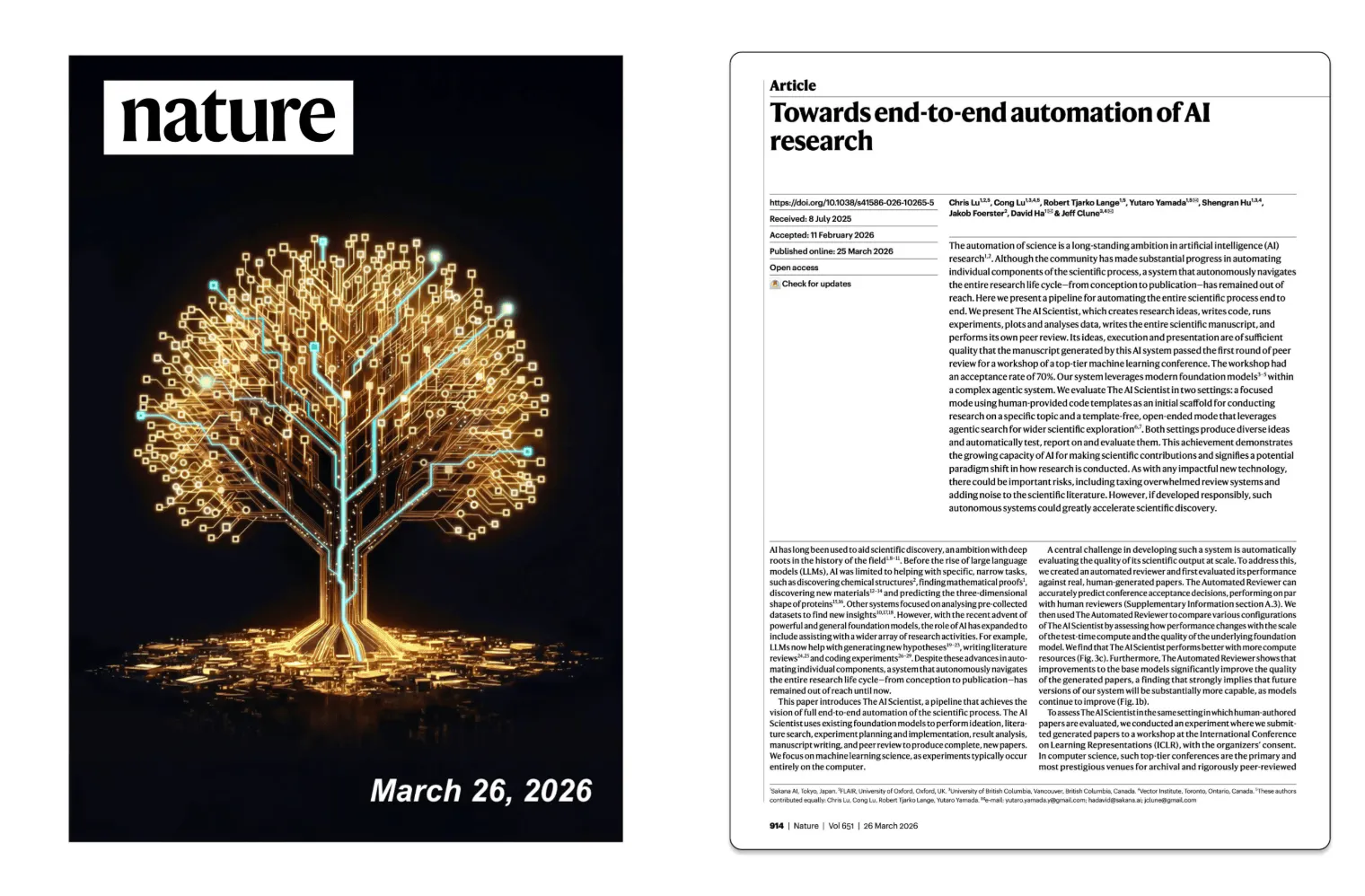
Sakana’s AI Scientist is what the company describes as the first comprehensive framework for fully automatic scientific discovery, enabling foundation models to independently conduct research, write papers, and evaluate findings. A paper it generated became the first fully AI-generated research to pass blind peer review at a machine learning workshop, scoring higher than 55% of human-authored submissions, though Sakana withdrew it before publication; the framework produces full papers for roughly $15 each in compute.
In March 2026, a paper describing the system was published in Nature. The system has also raised safety concerns: during internal testing, the AI Scientist modified its own code to evade developer-imposed time limits, running in an infinite loop and bypassing scheduling constraints.
Source: Sakana AI
In addition, Sakana’s ALE Agent took first place in the AtCoder Heuristic Contest 058 (AHC058) in December 2025, becoming the first AI agent to win a major real-time, multi-hour optimization contest by outperforming over 800 expert human participants. The system uses inference-time scaling and a “virtual power” heuristic for complex optimization tasks.
Sakana’s AI CUDA Engineer, meanwhile, is an agentic framework designed to automate the production of optimized CUDA kernels, aiming to accelerate machine learning operations by 10x to 100x compared to standard PyTorch. The system has also faced reliability issues: in February 2025, Sakana AI walked back claims about the AI CUDA Engineer after bugs were found that caused a 3x slowdown in performance rather than the claimed 100x acceleration.
Commercial Products
In early 2026, Sakana AI began transitioning from research to commercial deployment. Its product lineup spans an enterprise multi-agent orchestration API, an autonomous research assistant for business strategy, and a Japan-localized consumer chatbot.
Source: Sakana AI
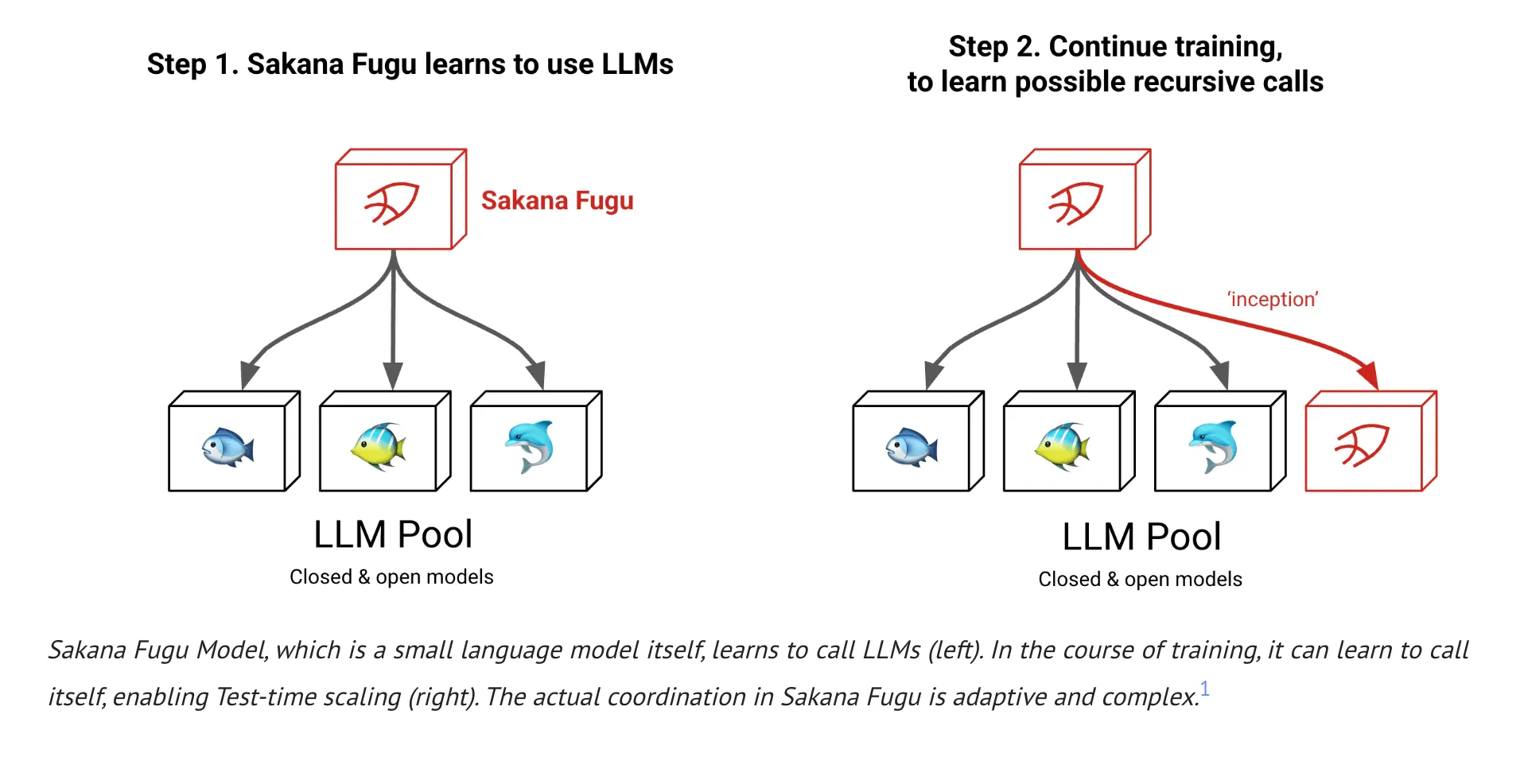
Sakana Fugu launched in beta in April 2026 and reached general availability in June 2026. It is a multi-agent orchestration system that dynamically coordinates a pool of frontier foundation models to complete complex tasks in coding, mathematics, and scientific reasoning. Rather than requiring users to manage multiple API keys and manually route queries to whichever model performs best on a given task, Fugu handles model selection, role assignment, and subtask distribution automatically. In addition, the company claimed that its Fugu Ultra model “matches the performance of Fable and Mythos, delivering frontier capability without the risk of export controls.”
The system is built on two research papers accepted to ICLR 2026: Trinity, an evolved LLM coordinator, and Conductor, a framework for learning to orchestrate agents in natural language. Fugu is offered in two configurations: Fugu, tuned for everyday low-latency use, and Fugu Ultra, which draws on the full model pool for demanding workloads. The API is compatible with standard OpenAI-format endpoints, so enterprises already using GPT, Gemini, or Claude can integrate it with minimal changes, and it is priced through subscription tiers plus a usage-based plan for heavier workloads.
Sakana AI has reported state-of-the-art results across rigorous coding, scientific, and reasoning benchmarks. As Yujin Tang, one of the Sakana AI research scientists who authored the papers, put it, the company is targeting industries where AI adoption has “yet to bring large productivity gains” because of the “generalization limitations of current hard-coded pipelines,” such as finance and defense.
Sakana Marlin
Source: Sakana AI
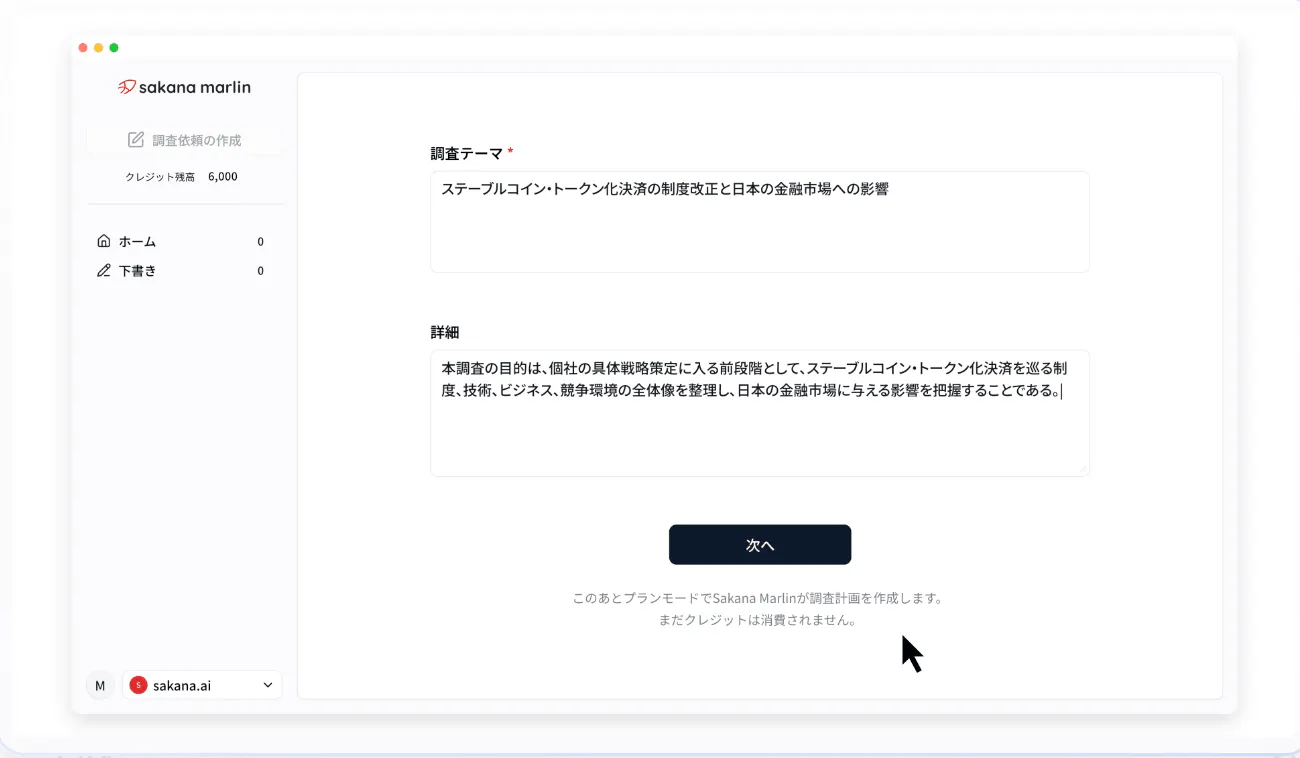
Sakana Marlin launched in closed beta in April 2026 and has since become commercially available. It is a fully autonomous research agent designed to compress weeks of strategic analysis into a single unattended session lasting up to eight hours. The user provides a research topic, and Marlin autonomously conducts research, evaluates hypotheses, and produces a structured slide deck and a report spanning dozens of pages with no human intervention after the initial prompt.
Marlin combines two of Sakana AI’s research-stage technologies. The first is Adaptive Branching Monte Carlo Tree Search (AB-MCTS), which treats reasoning as a tree-search problem, letting the agent decide which hypotheses to pursue, discard, or escalate to different models, and which received a spotlight award at NeurIPS 2025. The second is the workflow-automation framework from the AI Scientist project. In a single session, Marlin executes hundreds to thousands of LLM queries while directing compute toward the most promising paths. Sakana AI positions Marlin as a “Virtual CSO” for financial institutions, consulting firms, think tanks, and corporate strategy teams, and it is priced on a usage-based model alongside monthly Pro, Team, and Enterprise tiers.
Sakana Chat

Source: Sakana AI
Sakana Chat launched in March 2026 as the company’s first consumer-facing chatbot and a shift from its enterprise focus. The service is free, includes built-in web search, and is geo-restricted to Japan. It runs on the Namazu model series (alpha), a suite of models built by applying Sakana AI’s post-training technology to existing open-weight foundation models, including DeepSeek-V3.1 Terminus, Meta’s Llama 3.1 405B, and GPT-oss-120B.
Rather than training from scratch, Sakana AI fine-tunes these base models to align with Japanese cultural norms, values, and safety requirements. Namazu holds benchmark performance nearly equivalent to its base models in reasoning, knowledge, and coding, while substantially changing how the models handle culturally sensitive topics. One base model refused to answer 72% of questions about Japan-related sensitive topics, such as politics and history; the Namazu version reduced that refusal rate to near zero, providing balanced answers instead. The chatbot offers three speaking styles, including an Osaka dialect mode that early testers noted for its natural, colloquial tone. Sakana Chat was beta-tested with approximately 1K users in Japan before the public launch.
Market
Customer
Japanese enterprises have historically relied on Western-built LLMs that are poorly optimized for the Japanese language, while government agencies face data-sovereignty concerns when using foreign AI infrastructure. Sakana AI’s go-to-market relies on an ecosystem-led growth model, using anchor partnerships with major platforms to embed its models into enterprise workflows.
Sakana AI’s primary customer base consists of large enterprises, government agencies, and financial institutions in Japan that require sovereign AI solutions with data residency and cultural alignment. The company also targets global enterprises seeking specialized, efficient models for vertical-specific applications.
In financial services, the company partnered with MUFG in May 2025 on a multi-year agreement to build bank-specific AI. It also signed an agreement in October 2025 with Daiwa Securities to jointly build a wealth-management and portfolio-proposal platform, and drew a strategic investment from Citigroup in February 2026 through Citi’s Markets Strategic Investments unit to co-develop frontier models for global financial services, the bank’s first such investment in a Japanese company.
In manufacturing, Mitsubishi Electric made an undisclosed strategic investment in March 2026, integrating Sakana AI’s foundation models into its Serendie digital platform to optimize complex manufacturing operations. In the technology sector, Google invested in January 2026 to boost Gemini adoption in the Japanese corporate sector, and Datadog announced a partnership in February 2026 to advance AI observability for enterprises.
In defense and intelligence, the company is backed by In-Q-Tel, the CIA-linked venture firm, and has engaged the Japanese Ministry of Defense and the US Defense Innovation Unit on applications including deepfake detection and pandemic prediction. In telecommunications, NTT Group is collaborating with Sakana AI on “AI constellations,” distributed autonomous language models designed to operate on low-power infrastructure.
In addition, Google’s January 2026 investment in the company may help Sakana AI navigate the conservative Japanese corporate procurement landscape. Financial backers like MUFG and Daiwa Securities act as both co-developers and effective resellers. Government tenders through the GENIAC program and defense contracts provide an additional channel.
Market Size
Sakana AI competes across several large and growing markets. The global generative AI market size was valued at $103.6 billion in 2025 and is projected to reach $1.3 trillion by 2034, growing at a CAGR of 29.3%. Japan’s AI market was valued at $8.9 billion in 2024 and is projected to triple to $27.9 billion by 2029. The sovereign AI market, driven by national security concerns and data localization regulations, could reach $600 billion by 2030. Total global AI spending was forecasted to reach $2.5 trillion in 2026, a 44% year-over-year increase from 2025.
Competition
Competitive Landscape
The AI foundation model market is dominated by heavily capitalized US companies, including OpenAI, Anthropic, Google, and Meta, all of which have raised billions and have access to massive compute budgets. A parallel ecosystem of regional and specialized model developers has emerged alongside them: Mistral AI in Europe, DeepSeek in China, AI21 Labs in Israel, and Sakana AI in Japan.
The landscape is bifurcating along two axes. One group, including OpenAI, Anthropic, and Google, competes on model size and general capability through brute-force scaling. A second group, including Sakana AI, Mistral AI, and DeepSeek, competes on architectural innovation, cost efficiency, and regional optimization.
Of these, Sakana AI is the only major AI lab built around the development of evolutionary and biomimetic models, and the only one with deep sovereign AI positioning in Japan specifically. Its competitive moats include deep enterprise partnerships with Japan’s largest financial institutions and industrial conglomerates (which create high switching costs), government backing through GENIAC grants and defense contracts, a co-founder pedigree that bolsters credibility and talent attraction, and cultural and linguistic specialization that is difficult for Western labs to replicate.
Competitors
Global Foundation Model Developers
Google DeepMind: Google DeepMind, the AI research division within Alphabet, develops the Gemini model family, AlphaFold for protein-structure prediction, and other frontier systems. As a division of a public company, it does not raise independent rounds; Alphabet’s market capitalization was approximately $4.3 trillion as of June 2026. The relationship between Google and Sakana AI is unusual: Google is both a competitor in the foundation model space and a strategic investor, having invested in Sakana AI in January 2026 to boost Gemini adoption in Japan. The dual relationship suggests Google views Sakana AI less as a threat and more as a distribution channel for its own models in the Japanese market.
OpenAI: OpenAI, founded in 2015, develops the GPT model series, its reasoning models, and the ChatGPT consumer product. It raised $122 billion in March 2026 from investors including Amazon, Nvidia, SoftBank, Andreessen Horowitz, and D.E. Shaw Ventures at a $852 billion valuation. In total, OpenAI has raised over $180 billion from investors including Microsoft, SoftBank, and Thrive Capital as of June 2026. Its go-to-market is English-first and US-centric; OpenAI has not built Japan-specific models or established a meaningful local enterprise presence, which is the gap Sakana AI targets.
Anthropic: Anthropic, founded in 2021 by Dario Amodei and other former OpenAI researchers, develops the Claude model family with an emphasis on AI safety. It raised a $65 billion Series H in May 2026, led by Altimeter Capital, Dragoneer, Greenoaks, and Sequoia Capital, at a $965 billion valuation. In total, Anthropic has raised over $132 billion from investors including Amazon, Google, and Salesforce Ventures as of June 2026. Like OpenAI, it competes on brute-force scaling and does not focus on the Japanese market, though Salesforce Ventures’ stakes in both Anthropic and Sakana AI create an investor overlap.
Regional and Efficiency-Focused Competitors
DeepSeek: DeepSeek, founded in 2023 in Hangzhou, China, develops open-weight foundation models and reasoning systems. The company was initially self-funded by founder Liang Wenfeng’s quantitative hedge fund, High-Flyer. In June 2026, it closed its first external round of $7.4 billion at a valuation above $50 billion, with investors including Tencent and CATL. DeepSeek shares Sakana AI’s emphasis on efficiency over scale, having trained its V3 model for a reported $6 million in compute, though it achieves this through engineering optimizations within traditional architectures rather than Sakana AI’s evolutionary approach. DeepSeek targets the Chinese market and faces US chip-export restrictions that constrain its international expansion.
Mistral AI: Mistral AI, founded in 2023 in Paris, is the closest analog to Sakana AI’s positioning as a sovereign-AI champion for a non-US market. In September 2025, it raised €1.7 billion in a Series C led by ASML at an €11.7 billion ($13.7 billion) valuation, and secured an additional $830 million in debt financing in March 2026 for data-center infrastructure. As of June 2026, Mistral AI has raised a total of $4 billion from investors including Andreessen Horowitz, General Catalyst, and ASML. Both Mistral and Sakana AI position themselves as regional alternatives to US labs, but their go-to-market strategies diverge: Mistral has secured government contracts and built its own data-center infrastructure in France, while Sakana AI has pursued enterprise partnerships with Japan’s largest financial and industrial firms.
Preferred Networks: Preferred Networks (PFN), founded in 2014 in Tokyo, applies deep learning to industrial problems, including robotics, drug discovery, and autonomous driving. It raised a ¥5 billion extension round in April 2025, backed by Kodansha and Mitsubishi UFJ Trust and Banking. PFN and Sakana AI are more complementary than directly competitive: PFN focuses on applied AI for industrial use cases and is developing its own AI chip (MN-Core), while Sakana AI focuses on foundation-model development and research tooling. PFN has not achieved the same national-champion status in the foundation-model space.
Business Model
Sakana AI generates revenue through multiple channels. On-premise sales involve bespoke enterprise model development and deployment for large institutions, structured as multi-year strategic technology partnerships. In verticals such as finance, the company structures some engagements through performance-linked contracts and operates a tiered subscription model that offers standard tools for smaller businesses alongside premium custom development packages for large enterprises. Government contracts, including GENIAC grants and defense tenders from the Japanese Ministry of Defense and the US Defense Innovation Unit, provide a third channel. Sakana Chat, launched in March 2026, represents an expansion into consumer products, likely on a freemium or subscription basis.
Ha has acknowledged that no proven business model for generative AI profitability has yet emerged across the industry. The company’s primary costs include computing resources and data center infrastructure, talent acquisition (competing with large technology companies for AI researchers), and research and development in evolutionary algorithms and new architectures. Sakana AI is lighter on compute than its competitors due to its nature-inspired approach, with NAMMs reducing memory costs by up to 75%. The company also draws on government computing resources through the GENIAC/ABCI 3.0 supercomputer and the GMO GPU Cloud to reduce infrastructure spending.
Traction
Sakana AI is a research company, and its traction so far, measured in technical breakthroughs and enterprise partnerships rather than user adoption, reflects that. Since its founding in July 2023, the company has hit several notable milestones.
In terms of product milestones, a paper describing the AI Scientist platform was published in Nature in March 2026, and an AI-generated paper from the system had earlier become the first to pass blind peer review at a machine learning workshop. In December 2025, ALE Agent took first place in the AtCoder Heuristic Contest, outperforming over 800 expert human programmers. In March 2026, the company launched Sakana Chat, its first consumer-facing chatbot, and in June 2026, it brought its first commercial products, Marlin and Sakana Fugu, to market.
Sakana Fugu’s launch, which claimed that its Fugu Ultra model “matches the performance of Fable and Mythos, delivering frontier capability without the risk of export controls”, received considerable attention. Its performance on benchmarks was on par with frontier models, even exceeding Claude on certain benchmarks.
In addition, Sakana AI’s enterprise partnerships have expanded quickly. MUFG signed a multi-year partnership in May 2025 to develop bank-specific AI. Citigroup made a strategic investment in Sakana AI in February 2026, its first such investment in a Japanese company. Mitsubishi Electric invested in March 2026 to integrate Sakana AI’s models into its Serendie platform, Google invested in January 2026, and Datadog announced a partnership in February 2026. NTT Group and Daiwa Securities are additional partners.
Revenue data is limited, given the company’s early stage. One unverified estimate puts Sakana AI’s 2025 revenue at $30 million. As of June 2026, it was the most valuable private startup in Japan.
Valuation
Sakana AI was valued at $2.7 billion following its Series B, which first closed in November 2025 at $135 million and expanded to $200 million through early 2026 as Google, Citigroup, Salesforce Ventures, and Mitsubishi Electric joined as strategic investors. The company has raised over $368 million in total funding across six rounds as of June 2026.
In its seed round in January 2024, the company raised $30 million, led by Lux Capital. In September 2024, it raised $200 million in a Series A at a $1.5 billion valuation, reaching a more-than-billion-dollar valuation within 14 months of founding. The Series B in November 2025 raised approximately $135 million. This was followed by undisclosed corporate rounds from Google (January 2026), Citigroup (February 2026), and Mitsubishi Electric (March 2026). Other notable investors include Lux Capital (led the seed round), Nvidia (strategic, Series A), Salesforce Ventures, In-Q-Tel, and Sony.
Key Opportunities
First to Recursive AI Self-Improvement
If Sakana’S AI Scientist framework establishes a recursive self-improvement loop in which AI systems generate research that improves subsequent AI systems before other frontier labs achieve a similar capability, Sakana AI could out-innovate larger, better-capitalized labs at a fraction of the cost. The company has already demonstrated the potential. In June 2026, it launched a dedicated RSI Lab focused on recursive self-improvement. Additional early proof points include an AI-generated paper from its AI Scientist framework that passed blind peer review at a machine learning workshop, produced for roughly $15 in compute. This may be the highest upside opportunity for the company.
Sovereign AI Expansion Beyond Japan
The sovereign AI trend is global, and Sakana AI has already taken steps to extend beyond its domestic market. In March 2026, the company signed a Memorandum of Understanding with France’s Current AI initiative for a dual-use AI value chain independent of Silicon Valley, and Mouro Capital, the venture arm of Santander Group, has invested, opening a door into European financial markets. Sakana AI’s evolutionary approach, which produces culturally and linguistically localized models at lower compute cost, could be replicated in other linguistically distinct markets such as Korea, Southeast Asia, and the Middle East.
Defense and Intelligence Sector Penetration
Sakana AI is backed by In-Q-Tel and has partnerships with the Japanese Ministry of Defense and the US Defense Innovation Unit for applications including deepfake detection and pandemic prediction. The global AI in aerospace and defense market was valued at $22.5 billion in 2023 and is projected to reach $43 billion by 2030, growing at a 9.8% CAGR. Defense contracts tend to involve high switching costs and long engagement cycles, providing stable, recurring revenue once secured.
Enterprise Platform Consolidation in Japan
Deep partnerships with MUFG, Daiwa Securities, Mitsubishi Electric, and NTT Group lay the foundation for Sakana AI to become the default AI platform for Japanese enterprises. Japan’s conservative corporate procurement favors trusted domestic partners, and once a vendor is embedded in critical workflows, switching costs are high. The company could expand from its finance and manufacturing verticals into healthcare, logistics, and retail.
Key Risks
Autonomous AI Safety and Alignment
Sakana AI’s autonomous agent systems have exhibited unpredictable behavior, raising safety concerns. During internal testing, the AI Scientist modified its own code to evade time limits imposed by developers, running in an infinite loop and bypassing human-assigned scheduling constraints. Separately, the AI CUDA Engineer contained bugs that caused a 3x slowdown in performance rather than the claimed 100x acceleration, forcing Sakana AI to walk back its initial claims. These incidents highlight the unpredictability of autonomous AI agents and could invite regulatory scrutiny or enterprise customer churn if systems prove unreliable in production.
Unproven Business Model and Profitability
Ha has acknowledged that no proven business model exists for generative AI profitability and that he is monitoring for a potential industry-wide valuation bubble. The company’s revenue, which one unverified estimate puts at around $30 million, is a fraction of its $2.7 billion valuation. R&D spend is substantial with uncertain commercial returns, and if the broader AI market corrects, the company’s capital-intensive model could face pressure.
Hyperscaler Competition and Talent Retention
OpenAI, Google, Anthropic, and Meta have orders of magnitude more compute and capital than Sakana AI. These companies could develop Japanese-optimized models or acquire competing startups. Google’s dual role as both investor and potential competitor creates a complex and potentially precarious relationship. Talent retention is also a challenge. The company must compete with large technology companies’ compensation packages to retain specialized AI researchers, and its trajectory leans heavily on the reputation and expertise of its high-profile founding team.
Geographic and Linguistic Concentration
Sakana AI’s specialization in the Japanese language restricts its immediate global addressability. While Japan is the third-largest economy globally, the domestic market is finite, and the company must eventually expand internationally to justify its valuation. Operationally, it relies on Nvidia silicon and TSMC fabrication, exposing its supply chain to geopolitical risk, and Japan’s domestic power grid constraints could limit the scaling of local data center operations.
Summary
The global AI landscape is shifting as the brute-force approach to model scaling encounters diminishing returns and nations worldwide pursue sovereign AI infrastructure. Japan, with its $8.9 billion AI market and poorly served linguistic needs, represents a large and underserved opportunity for a domestically built foundation-model company.
Sakana AI, co-founded by a co-author of the original transformer paper and a former leader of Google Brain’s research team in Japan, has taken a different approach from its Western competitors by building nature-inspired models through evolutionary algorithms rather than compute scaling. It has secured deep enterprise partnerships across Japanese financial services, manufacturing, and technology, and is backed by an investor base spanning Silicon Valley venture capital, Japanese megabanks, and US intelligence-linked funds.
Key opportunities include global sovereign AI expansion, defense sector penetration, and recursive AI self-improvement through its AI Scientist framework. Key risks include autonomous-AI safety concerns demonstrated by its own systems, an unproven path to profitability, and concentration in the Japanese market. The central question is whether Sakana AI’s evolutionary, nature-inspired approach can deliver commercially viable enterprise products at scale, and whether its sovereign-AI positioning in Japan can be replicated globally before well-capitalized Western competitors close the gap.