Perspective

Cheap Power, Expensive Wires

By Kyle Harrison

Tags

Updated

November 23, 2024

Reading Time

4 min

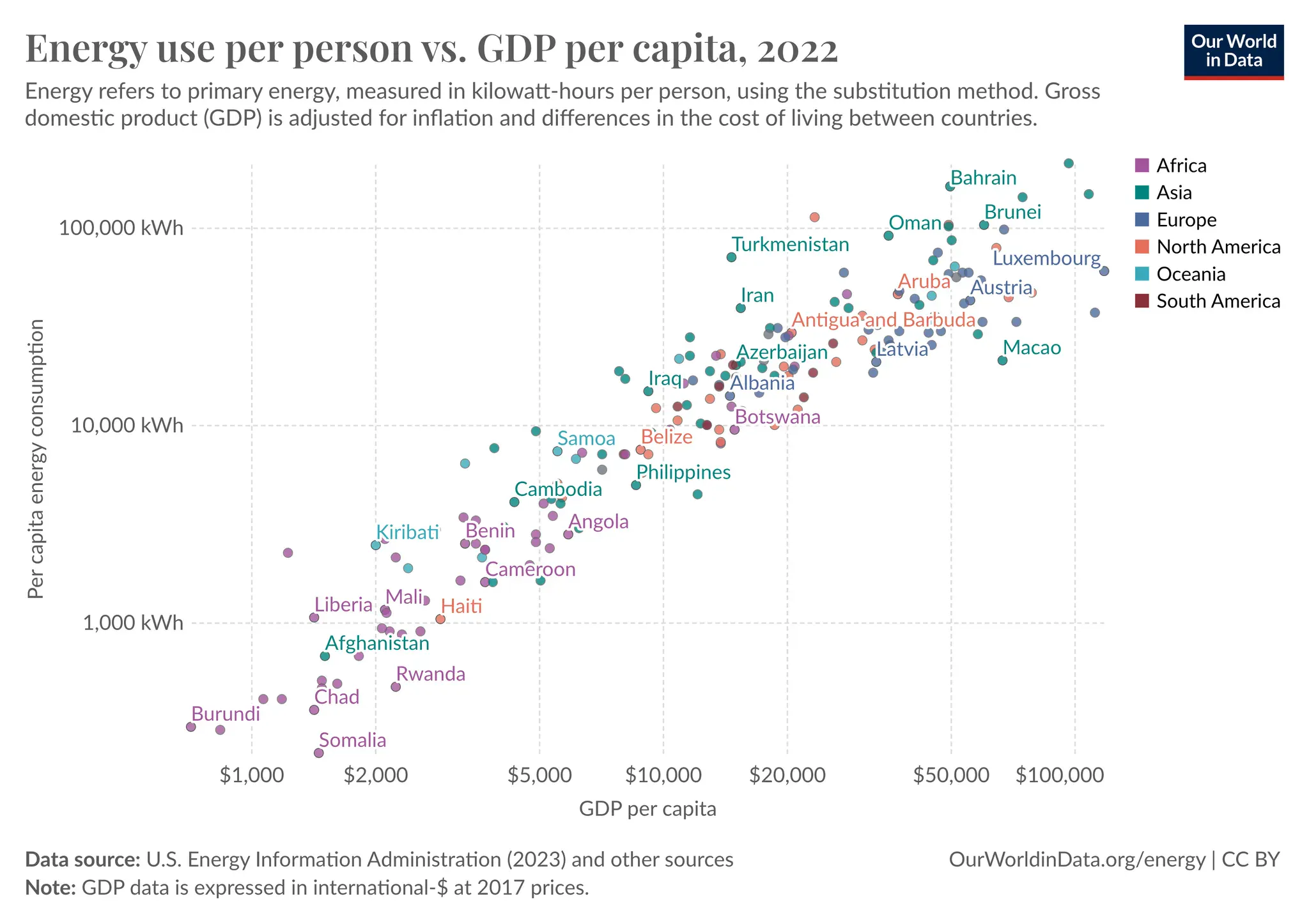
Energy abundance has always been inextricably linked with human prosperity, and that remains true today. A 2022 graph that compared the GDP per capita of all the countries on Earth against their per capita energy consumption shows a very strong correlation: there are no countries with high energy consumption that are poor, and there are no countries with low energy consumption that are rich.
The good news is that energy production costs are quickly decreasing, particularly because of the extremely rapid decline in the cost of renewable energy sources like solar and wind. But energy consumption is not growing apace, held back by the fact that the price of electricity in the US, adjusted for inflation, has barely changed over the last twenty years.

The reason? Although generating electricity has gotten a lot cheaper, transmitting that energy from the place where it was generated (a power plant, wind farm, offshore solar farm, etc.) to where it’s needed (your house or office) has gotten more expensive. The cost of delivering electricity increased significantly in the 2010s, despite cheaper generation costs from renewables and natural gas, because of the grid.

The US electrical grid — which is actually made up of four independent grids — is a marvel of engineering. However, as Base Power CEO Zach Dell noted in a just-released podcast episode of Contrary Research Radio, “it’s very old, and it’s not sized for modern demand.” Compounding this problem is the fact that energy supply is increasingly coming from renewable sources with outputs that vary throughout the day, creating additional load on the grid.

So, although the cost of generating energy is collapsing, supply is becoming increasingly volatile. Meanwhile, energy demand is set to surge. As Zach Dell pointed out on our podcast, if the grid is struggling today, it’s definitely “not sized for where modern power demand is going.”

EV adoption is going to be one driver of the rapid increase in energy demand. EVs accounted for 7.5% of all vehicles sold in the US in 2023, but that number is expected to rise to 29% by 2030. Another driver will be the increased energy demand of AI data centers. The power they consume will double by 2026, by which point data centers globally will consume the same amount of energy as the country of Japan.

The electric grid is not prepared for this increased power demand and an increasingly volatile supply of energy from renewables. It was built to balance a stable supply of electricity to meet a predictable demand. As a result, customers are already suffering higher prices and more outages — problems that will only worsen if nothing changes.

The average length of electricity outage per customer increased from about 210 to over 400 minutes per year between 2013 and 2021. Texas faces a particularly acute distribution problem, as its grid relies heavily on renewables. After a historic winter storm in 2021, more than 4.5 million homes, approximately a quarter of all residences, were without power for several days. Texas utility operators allowed the price of electricity to go up to $9 per kilowatt-hour, resulting in electricity bills of thousands of dollars for many Texans.

This week, in combination with our podcast episode, we published a report on a company that is trying to solve this problem: Base Power, also known as Base, aims to relieve pressure on the grid by installing residential batteries at scale. Placing batteries next to homes solves both the supply volatility and demand volatility problems of the grid by allowing homes to store energy when demand and prices are low, and discharge when demand and prices are high, reducing stress on the transmission lines. Read more about Base Power in our full company breakdown here.

Important Disclosures

This material has been distributed solely for informational and educational purposes only and is not a solicitation or an offer to buy any security or to participate in any trading strategy. All material presented is compiled from sources believed to be reliable, but accuracy, adequacy, or completeness cannot be guaranteed, and Contrary LLC (Contrary LLC, together with its affiliates, “Contrary”) makes no representation as to its accuracy, adequacy, or completeness.

The information herein is based on Contrary beliefs, as well as certain assumptions regarding future events based on information available to Contrary on a formal and informal basis as of the date of this publication. The material may include projections or other forward-looking statements regarding future events, targets or expectations. Past performance of a company is no guarantee of future results. There is no guarantee that any opinions, forecasts, projections, risk assumptions, or commentary discussed herein will be realized. Actual experience may not reflect all of these opinions, forecasts, projections, risk assumptions, or commentary.

Contrary shall have no responsibility for: (i) determining that any opinions, forecasts, projections, risk assumptions, or commentary discussed herein is suitable for any particular reader; (ii) monitoring whether any opinions, forecasts, projections, risk assumptions, or commentary discussed herein continues to be suitable for any reader; or (iii) tailoring any opinions, forecasts, projections, risk assumptions, or commentary discussed herein to any particular reader’s objectives, guidelines, or restrictions. Receipt of this material does not, by itself, imply that Contrary has an advisory agreement, oral or otherwise, with any reader.

Contrary is registered with the Securities and Exchange Commission as an investment adviser under the Investment Advisers Act of 1940. The registration of Contrary in no way implies a certain level of skill or expertise or that the SEC has endorsed Contrary. Investment decisions for Contrary clients are made by Contrary. Please note that, although Contrary manages assets on behalf of Contrary clients, Contrary clients may take any position (whether positive or negative) with respect to the company described in this material. The information provided in this material does not represent any investment strategy that Contrary manages on behalf of, or recommends to, its clients.

Different types of investments involve varying degrees of risk, and there can be no assurance that the future performance of any specific investment, investment strategy, company or product made reference to directly or indirectly in this material, will be profitable, equal any corresponding indicated performance level(s), or be suitable for your portfolio. Due to rapidly changing market conditions and the complexity of investment decisions, supplemental information and other sources may be required to make informed investment decisions based on your individual investment objectives and suitability specifications. All expressions of opinions are subject to change without notice. Investors should seek financial advice regarding the appropriateness of investing in any security of the company discussed in this presentation.

Please see www.contrary.com/legal for additional important information.

Authors

Kyle Harrison

General Partner @ Contrary

Kyle leads Contrary’s investing efforts for companies from seed to scale. He’s previously worked at firms like Index and Coatue investing in companies like Databricks, Snowflake, Snyk, Plaid, Toast, and Persona.

See articles

© 2026 Contrary Research · All rights reserved

Privacy Policy

By navigating this website you agree to our privacy policy.