Yesterday, we saw the first IPO of a truly AI-centric company amidst a seemingly endless demand for AI-everything. CoreWeave went public at $39, ending its first day at $40, with an $18 billion market cap, below the $35 billion where the stock had initially priced. In a world of massive of private and public capital being thrown at businesses across the hardware, infrastructure, and application layers of AI it raises a question of why this IPO didn’t reflect the exuberance people are feeling about AI?
First, it’s important to understand that many view CoreWeave as having a fundamentally flawed business which has been shaped as a response to a fervent moment in AI.
Second, CoreWeave’s success is tied directly to an overarching question about the durability of AI demand. And people are feeling cautiously nervous about that question.
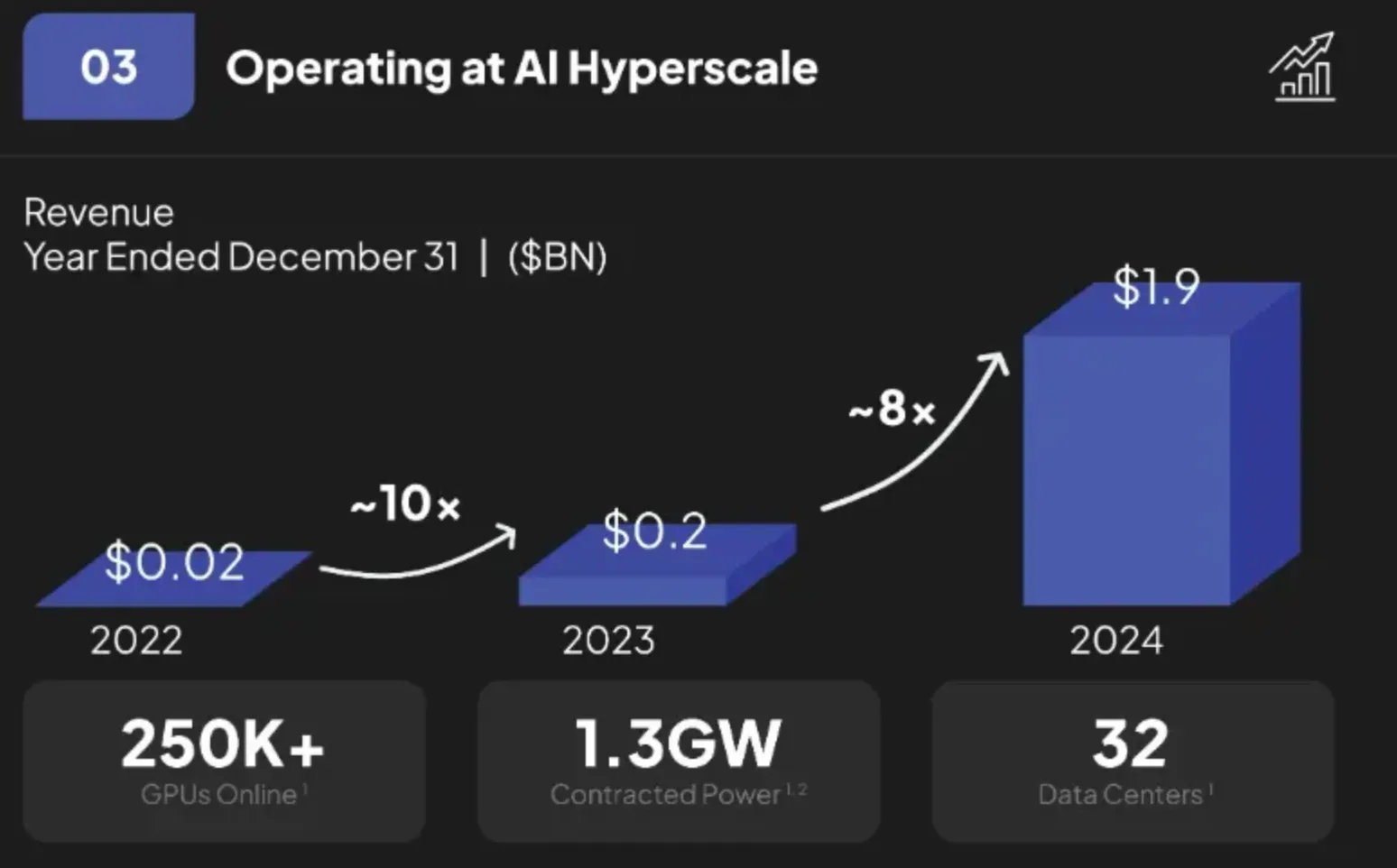
To understand CoreWeave’s business, you can look back at the history we unpacked in our memo here. The origins of the business began in 2016 when the co-founders began buying GPUs for crypto mining. Over time, the team began renting GPUs out for crypto mining as well. They pivoted to cloud infrastructure in 2019, and suddenly grew 271% within the first three months after the pivot. Fast forward to the spark that was ChatGPT and the race was on. From 2022 to 2024 the company grew from $20 million to $1.9 billion in revenue.
At its core, CoreWeave’s business is buying Nvidia GPUs and renting them out for AI-specific workloads. CoreWeave’s biggest customer? Microsoft. Most companies look to diversify their customer base ahead of an IPO, but CoreWeave has taken a real contrarian approach and actually seen its revenue concentration increase. Microsoft, as a percentage of CoreWeave’s revenue, has increased from 35% in 2023 to 62% in 2024.
In order to service customers, CoreWeave has an incredibly CapEx-heavy business model. Because CoreWeave’s core value proposition is providing access to cutting edge GPUs for AI workloads, it means that every time the company spends money on hardware, it starts the clock on when that hardware will become obsolete. As a result, CapEx represents 400% of CoreWeave’s revenue.
With the massive capital expenditures on hardware comes a lot of depreciation. Because the company is so focused on the cutting edge, its assets depreciate quickly. One report ahead of the IPO expressed some raised eyebrows about where depreciation is accounted for. While clearly a cost of doing business, CoreWeave indicates ~75% gross margins. But adding depreciation back into COGS would bring those margins down to ~30%.
The takeaway is that you have a business with a complex financial profile that is very much held up by exorbitant demand for computing resources. Which brings us to the second question of CoreWeave’s business, and what it means for the durability of AI. One question you might be asking is why is Microsoft expected to spend $10 billion on CoreWeave by the end of the decade if Microsoft is also set to spend $80 billion on AI data centers this year alone?
In an earnings call in November 2024, Microsoft explained how it was struggling “to have enough GPU servers online to meet customer demand.” CoreWeave represents one way to augment that demand. But at the same time, you have Microsoft walking away from some new data center projects, as one report indicates that the move “points to data center oversupply relative to its current demand forecast.”
So the question is whether there is an oversupply or undersupply of computing resources for what AI demand will look like at steady state? And, more specifically, is the current rate of AI infrastructure spend a bubble? Or sustainable? While CoreWeave’s business is dependent on these heightened levels of spend being the status quo, the behavior of the founders and investors doesn’t seem to indicate that they buy into that. Ahead of the IPO, CoreWeave’s co-founders sold nearly $500 million of their stake.
Some argue that CoreWeave isn’t indicative of the broader AI market because of all these aspects of its business — it’s built on debt, high CapEx, massive depreciation, not to mention the more than $5 billion in cash the company burned, even on $2.8 billion of revenue. All fair points. But fundamentally, CoreWeave’s business is tied directly to the crux of the question for AI. Is the heightened volume of hardware, infrastructure, and application demand indicative of a new normal? Or a feverish oversupply that will taper over time?
Time will tell, but it seems clear that there are cracks in the narrative arguing in favor of this being a sustainable “new normal.”