
Thesis
Legal services was a $1 trillion global industry as of 2024, built on an intellectual labor model that has remained fundamentally unchanged for generations. Attorneys bill by the hour for work that is, in large part, structured, repetitive, and deeply dependent on the processing of language, which is precisely the task category where AI has made its most dramatic gains. The adoption of AI into legal workflows is no longer speculative. As of Q3 2025, 80% of legal professionals believed AI would have a high impact on their work within five years, and 53% of legal professionals were already seeing a return on AI investments.
However, the legal industry faces a dilemma. Because law firms are relatively undifferentiated by brand in most practice categories, firms that deploy AI to deliver faster, higher-quality work at lower cost force competitors to follow suit. Nevertheless, average firm profit grew 13% in 2025, amidst the strongest demand growth in the industry since the Global Financial Crisis, driven partly by regulatory shifts and geopolitical instability.
What matters most going forward is the gap between what AI can theoretically do in legal work and what lawyers actually use it for. Roughly 80% of legal tasks were within reach of AI models available in early 2026, yet observed adoption, i.e., the share of lawyers actively using AI in their daily work, sat at just 15%. However, this lack of adoption doesn’t seem to stem from fear of job loss. 90% of legal revenue still flows through hourly billing arrangements, and practitioners generally believe that AI will expand capacity rather than displace jobs. Overall, law firms are increasing technology adoption, evidenced by a 9.7% increase in technology spending from 2024 to 2025.
Legora describes its product as an operating system for legal work, built to automate the repetitive and “thankless” tasks that consume a lawyer’s day, from mass document review to drafting and deep research, freeing attorneys to focus on the analytical, client-facing work that commands premium fees. Rather than acting as a chatbot that answers questions, Legora is building a platform that executes complex legal workflows from start to finish using agentic AI, embedded directly into the tools lawyers already use.
Founding Story
Legora was founded in 2023 in Stockholm, Sweden, by Max Junestrand (CEO), Sigge Labor (President, former CTO), and August Erséus. The spark that ultimately led to the company occurred in 2020, when co-founders Labor and Erséus began using Google BERT for legal tech applications. In doing so, they ran into the era's central limitation, which was that early pre-LLM AI tools couldn't handle the nuance and complexity of legal text, particularly in non-English languages. As a result, they shelved the project.
However, in 2023, when GPT-3 demonstrated it could handle unstructured text, the founders returned to the project and built a prototype that worked “flawlessly.” After that, the two co-founders called Max Junestrand, a software engineer and professional gamer, and asked him to join as CEO. Leya, renamed Legora in February 2025, was incorporated shortly thereafter.
With no legal background, the co-founders learned the industry from the inside. Junestrand began cold-messaging lawyers on LinkedIn, offering to buy them lunch and pay their hourly rate in exchange for an hour of their expertise to understand their business. Within one month of starting full-time, the team won their first major client engagement with Mannheimer Swartling, one of the largest firms in the Nordics, and worked inside a conference room in the firm’s Stockholm office for nine months.
In late 2023, Legora was accepted into the Winter 2024 batch of Y Combinator with its initial product, a “GPT wrapper” that served as a private alternative to ChatGPT with better retrieval-augmented generation (RAG) capabilities. Unwilling to wait on the funding timeline, the team took out a loan against the YC investment before it had been wired, using the proceeds to hire four engineers.
While other companies in the YC cohort were still in development, Legora was running sales calls to European law firms at night. By the time Legora finished YC in March 2024, it had reached nearly $1 million in ARR with a 100% pilot conversion rate and had not lost a single competitive deal. Benchmark led a seed round shortly after, in March 2024, and the founders deliberately paused sales for six months to invest in product reliability before scaling. The company reached general availability in October 2024.
In the twelve months following general availability, the team grew from 40 to over 400 employees while maintaining a product cadence fast enough to take capabilities from ideation to launch in 48 hours. Headcount reached roughly 700 as of August 2026, against a stated target of 1.5K by year-end. The one senior addition outside the founding team came in January 2026, when Legora appointed David Eckstein as CFO. Eckstein joined from Vanta, where he was CFO, and had previously held the same role at Menlo Security after earlier stints at OpenDNS and Box.
Legora is a globally dispersed organization that maintains its core engineering and product teams in Stockholm, Sweden, while expanding its commercial presence through major international hubs. In March 2025, Legora expanded to the US, with offices in New York, Chicago, Houston, and Denver. Globally, Legora was represented in over 50 markets as of March 2026, including London, Sydney, and Bengaluru.
Product
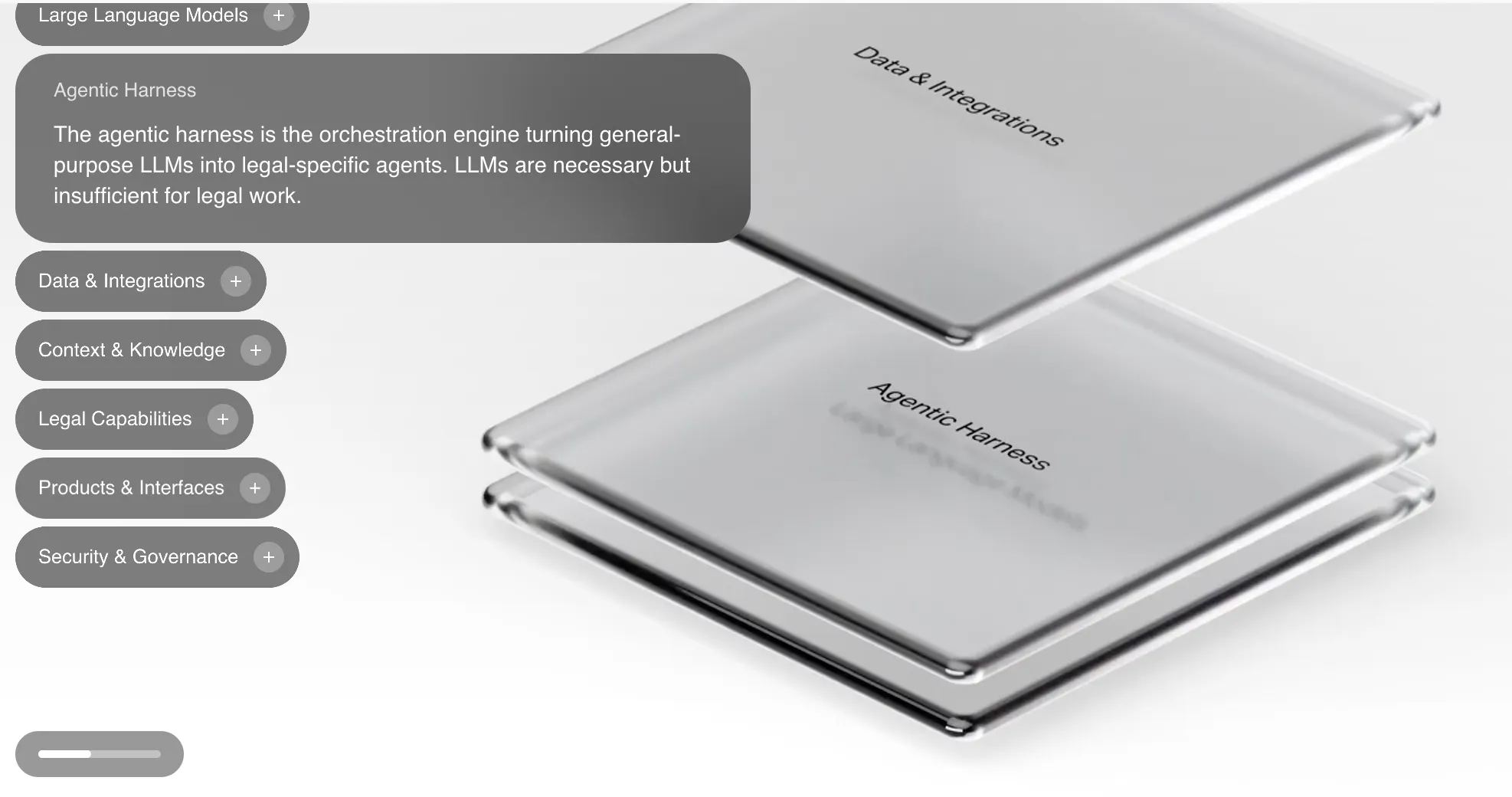
Legora describes its platform as “collaborative AI for exceptional lawyers”. It is an AI-powered legal operating system and collaborative workspace designed to automate legal research, contract review, and drafting for law firms and legal teams. Legora’s platform is organized as a layered stack it calls the Legora aOS, short for agentic operating system. The company’s core product offerings fit within that stack, including model selection, orchestration, integrations, and the firm knowledge fed into every task.
Legora’s platform product offerings can be organized into four groups. Legora aOS is the “agentic operating system” that Legora provides. Legora’s Agent is its execution engine. Tabular Review, Legal Research, and Workflows are the legal-specific capabilities the Agent draws on. Editor, the Word and Outlook add-ins, and the mobile app are the interfaces for the end users — lawyers who use Legora. Lists, Monitors, and Portal handle the coordination and delivery around the work, covering task tracking, regulatory watch, and the client-facing layer.
Legora aOS
Source: Legora
Legora describes aOS as “the agentic operating system for legal work”, which can be thought of as breaking into seven layers. Large language models sit at the base. Above them is the agentic harness, which is the orchestration layer that turns a general-purpose model into something that behaves like a legal specialist. The harness handles tool routing, control flow, memory, model selection, and guardrails, and it can dispatch specialist sub-agents in parallel to work through a multi-step task.
The data layer connects the aOS to where a firm's material lives, spanning document management systems, ingested files, licensed content sources, third-party legal services, and MCP connectors, which are a standard way for AI systems to call external tools and data. Legora has leaned on this layer publicly when, in August 2026, it deepened its NetDocuments partnership with an MCP connection that lets the Agent find and use documents while respecting the access controls a firm already has in place. The same month, joined Google Cloud's Gemini Enterprise for Legal launch as a legal AI partner.
Above the data layer sits context and knowledge, which is where the aOS layers in firm playbooks, precedent libraries, clause banks, negotiated positions, and matter history. Security and governance apply across the stack. The aOS enforces ethical walls, which are the internal barriers firms erect so that a team acting for one client cannot see material from a matter involving an adverse party, along with cross-matter isolation to stop information bleeding between matters, users, or time periods. Every tool call, file access, and agent action is written to an audit trail. Legora holds SOC 2 Type II, ISO 27001, ISO 42001, GDPR, and HIPAA compliance, and does not train models on customer data.
Agent
Source: Legora
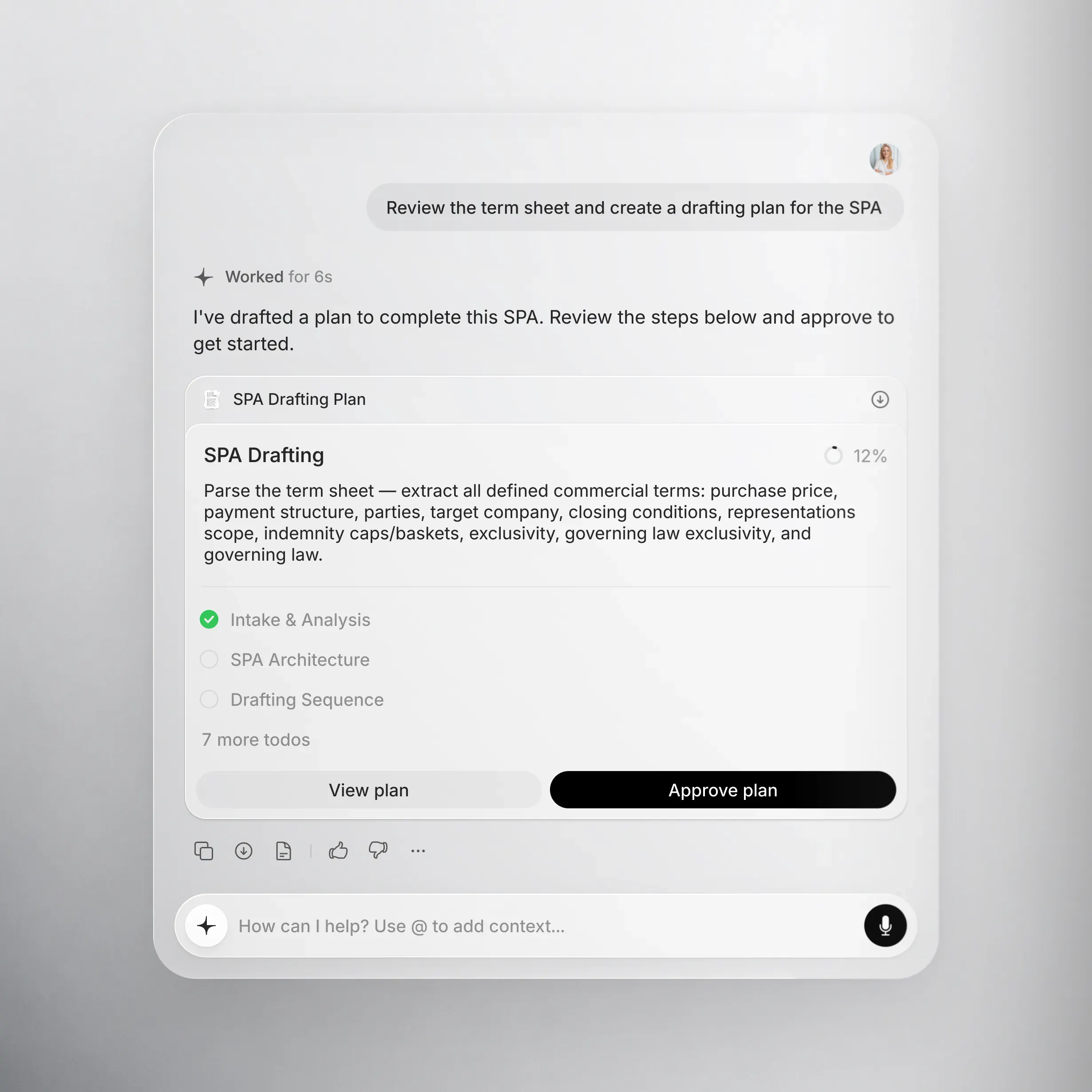
Legora describes its Agent as the execution engine of the aOS that “sits at the heart of Legora’s agentic operating system and is purpose-built for the depth and rigor of professional legal work” that “plans, executes, reviews, and delivers complex legal work end-to-end”.
The Agent runs a four-stage loop. It plans by analyzing the task, choosing the tools it needs, and proposing an approach for the lawyer to approve. It executes across documents, data sources, and tools. It reviews its own output against the original goal, then loops back and adjusts. Finally, it delivers finished work product into the project workspace for review.
Tabular Review
Source: Legora
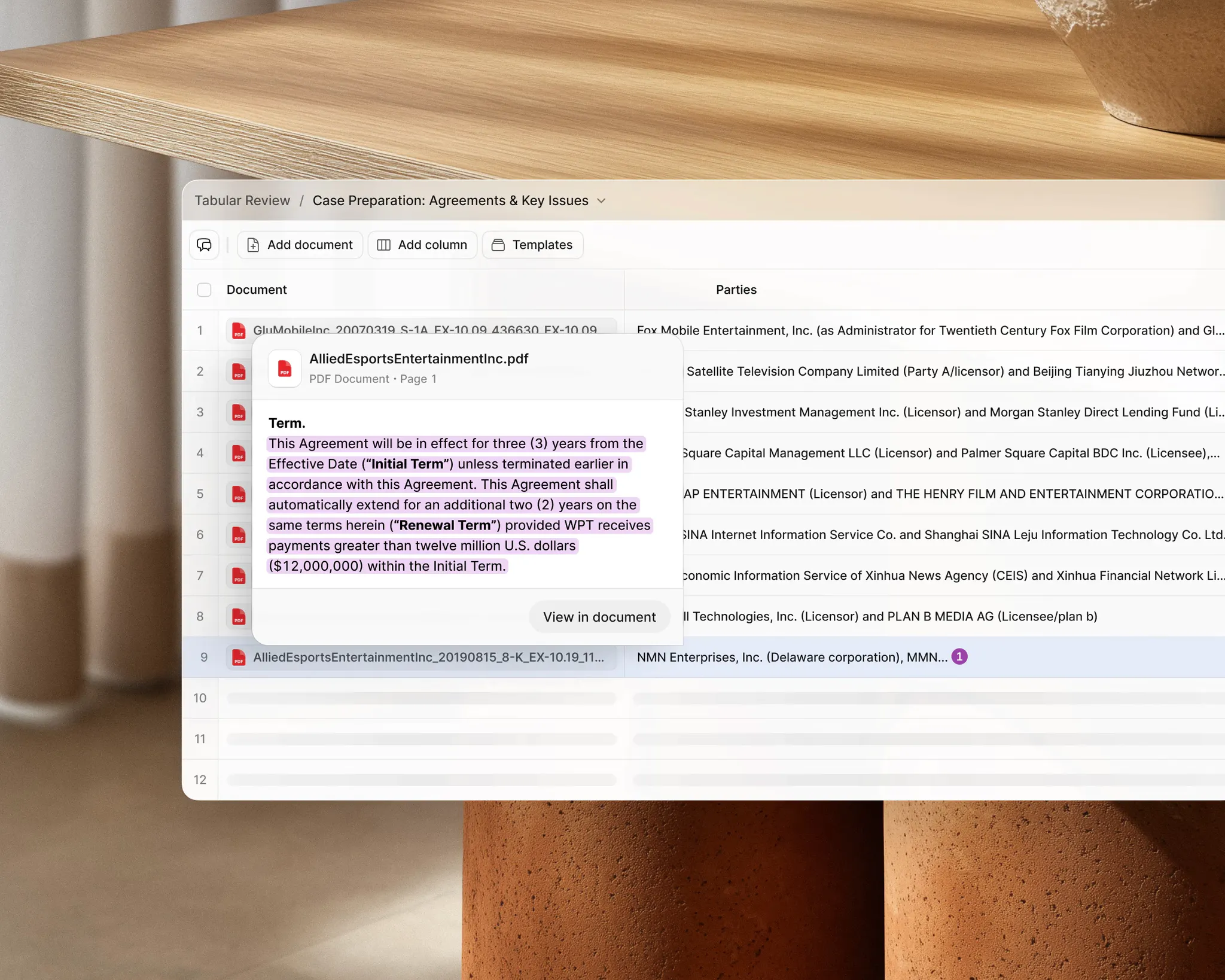
Legora describes Tabular Review as an “AI-powered spreadsheet that pulls key insights instantly from large document sets” intended to “turn document chaos into insights.” Each document becomes a row, and each question the lawyer wants answered becomes a column. Documents come in from a firm's document management system, its databases, or a virtual data room, which is the secure file repository used to host diligence materials in a transaction. The lawyer can then specify output formats, filter, and sort the results like any other table.
Tabular review is designed for verifiability. Every cell expands to show the reasoning behind the answer and the source document it came from, so a lawyer can check any individual extraction rather than trusting the table wholesale. Reviews are collaborative in real time, with a Mark as Reviewed status, cell locking, and a dedicated Review Mode. Firms can also save their question sets as reusable templates and share them across the team.
The obvious use cases are diligence and disclosure review, where the underlying task is finding the same handful of provisions across hundreds or thousands of near-identical agreements. Bird & Bird legal director Jennifer McBride described the benefit of Tabular Review as reaching an initial view much faster and spending the recovered time on deeper analysis.
Legal Research
Source: Legora
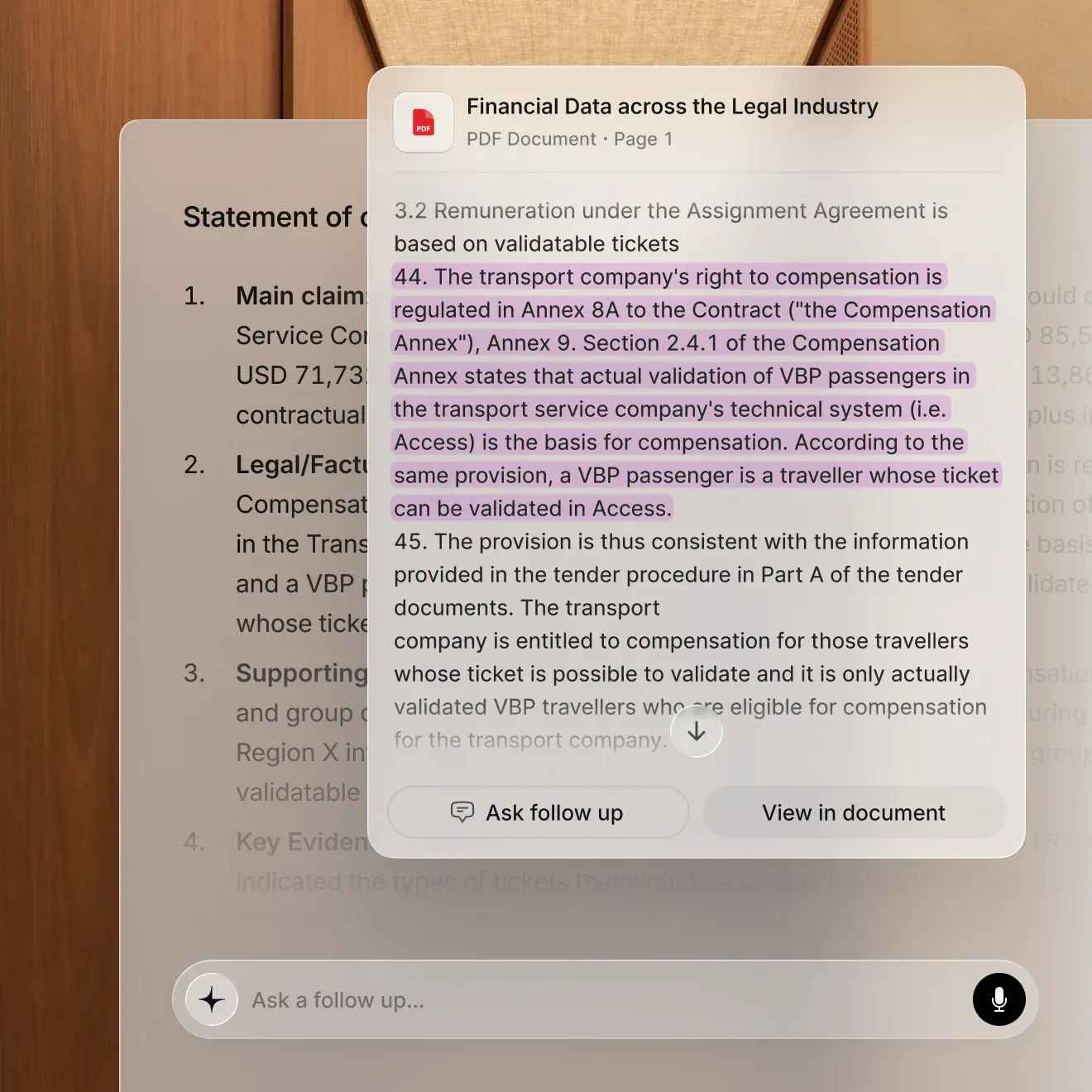
Legal Research is Legora's answer to the incumbent research databases. As Legora describes it, this offering “investigates several sources in parallel across different jurisdictions, ranks sources by authority, and verifies each finding against primary law”.
Rather than returning whatever looks relevant to a query, the system plans the research, investigates several angles across jurisdictions in parallel, ranks what it finds by authority, and checks each finding against primary law before surfacing it. Primary law means the statutes and decided cases that bind, as opposed to the commentary and practice notes written about them. Every finding links to the source behind it, hosted on Legora's own platform and shown in context rather than as a standalone snippet, and the system checks that a source still holds before relying on it.
Coverage comes from a mix of Legora's own hosted primary law and content partnerships. The company claims comprehensive US coverage across federal law and all 50 states, and it lists partners including Wolters Kluwer, EDGAR, FromCounsel, Jus Mundi, Tirant lo Blanch, Manupatra, USPTO, and the Singapore Academy of Law. It also indexes national primary sources directly, among them France's Cour de cassation, German federal law, Sweden's court portal, Norway's Lovdata, Denmark's Retsinformation, and Portugal's official gazette, which enables firms advising on cross-border matters.
Workflows
Source: Legora
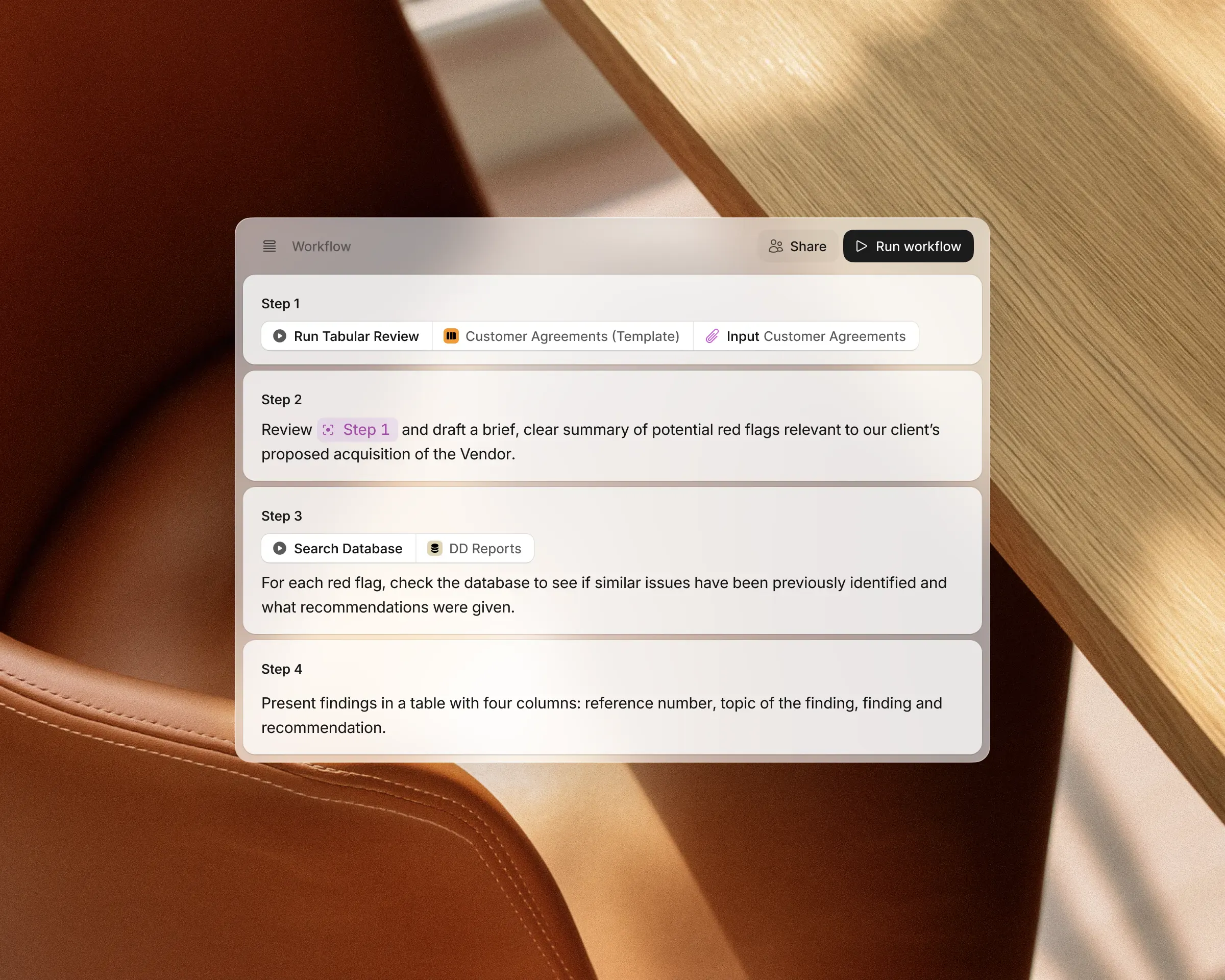
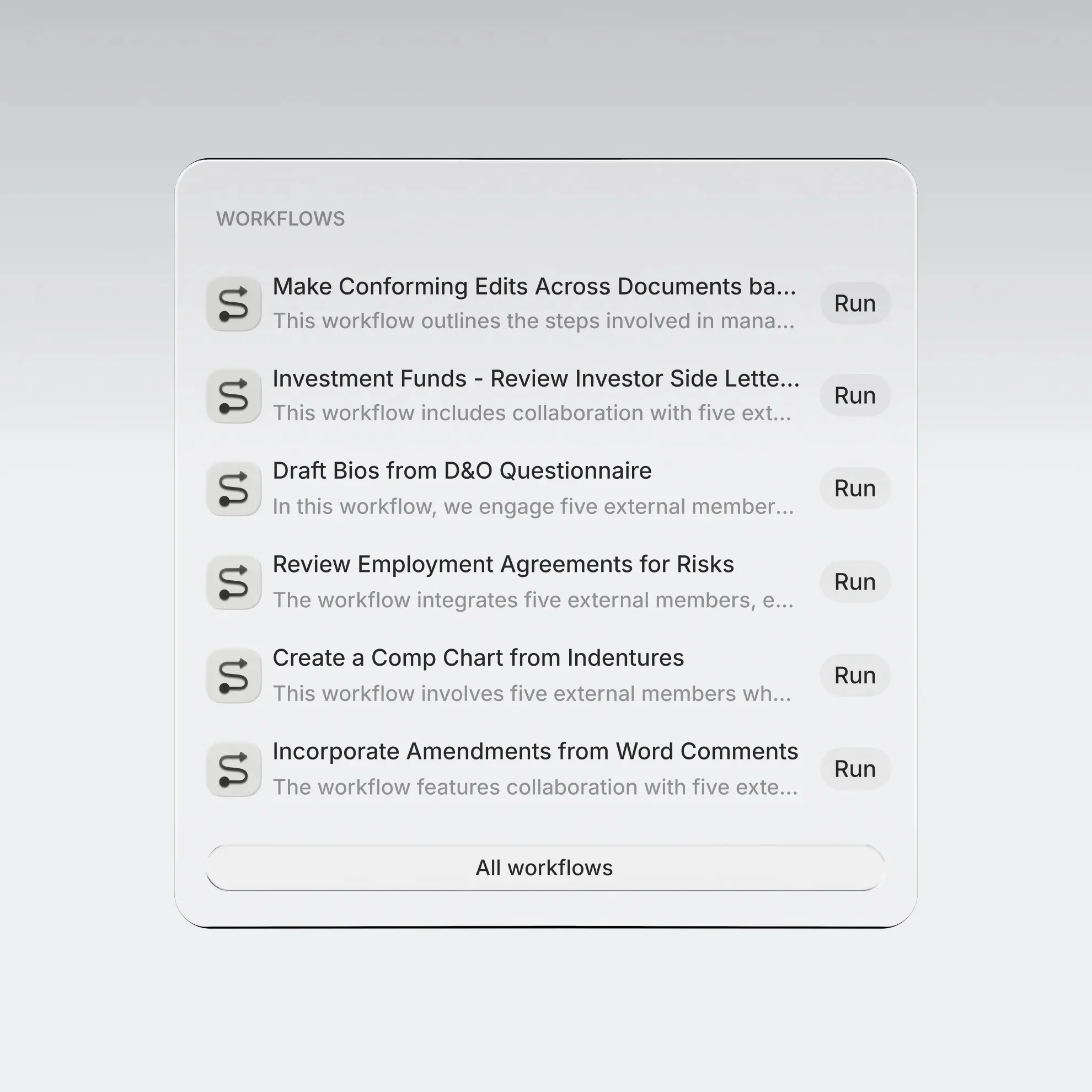
Legora’s Workflows product is intended to help firms “orchestrate complex legal tasks” by allowing users to build, automate, and refine legal tasks. It enables firms to chain Legora's capabilities into repeatable multi-step processes. A workflow can call Tabular Review, Legal Research, translation, drafting, and database search in sequence, with each step feeding the next. Workflows can be built with natural language rather than code so that users don’t have to rely on engineers to create them. Firms draw on their own workflow library alongside a set Legora ships pre-built, and access is governed by role-based permissions.
Editor
Source: Legora
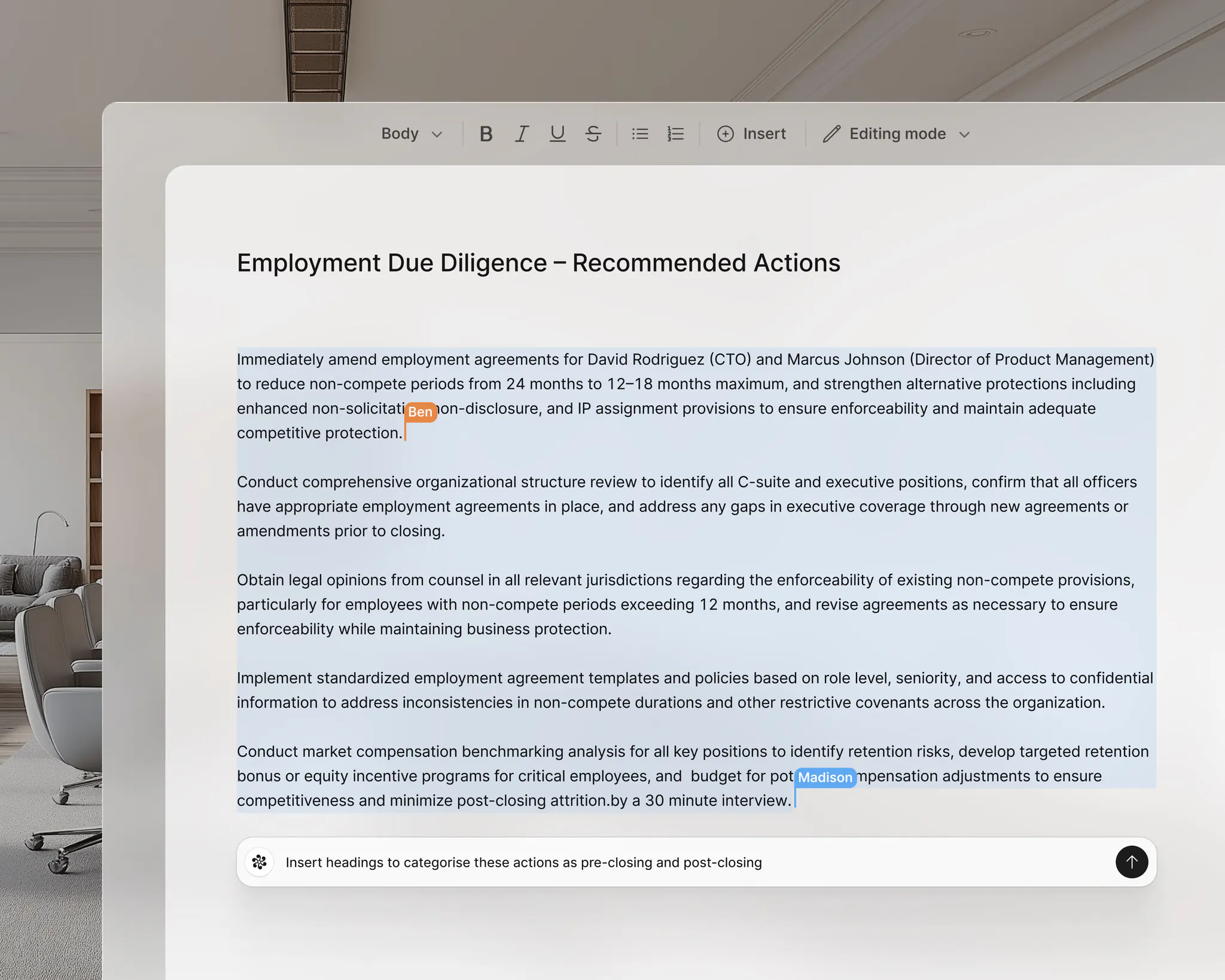
Legora describes its Editor offering as an “AI-native drafting environment built for lawyers, enabling document creation using the full capabilities of the Legora platform.” Its purpose is closing the gap between analysis and finished work product. Output from Tabular Review, the Assistant, or research done elsewhere in the platform flows into a document with citations back to the underlying data intact, which removes the copy-paste step where context and sourcing usually get lost.
Drafts support real-time collaboration, with colleagues editing alongside AI-suggested improvements that a lawyer accepts or rejects individually. When the document is finished, Editor exports straight to Word in a chosen style, including firm house styles, so the formatting work does not have to be redone after export.
Word Add-in
Source: Legora
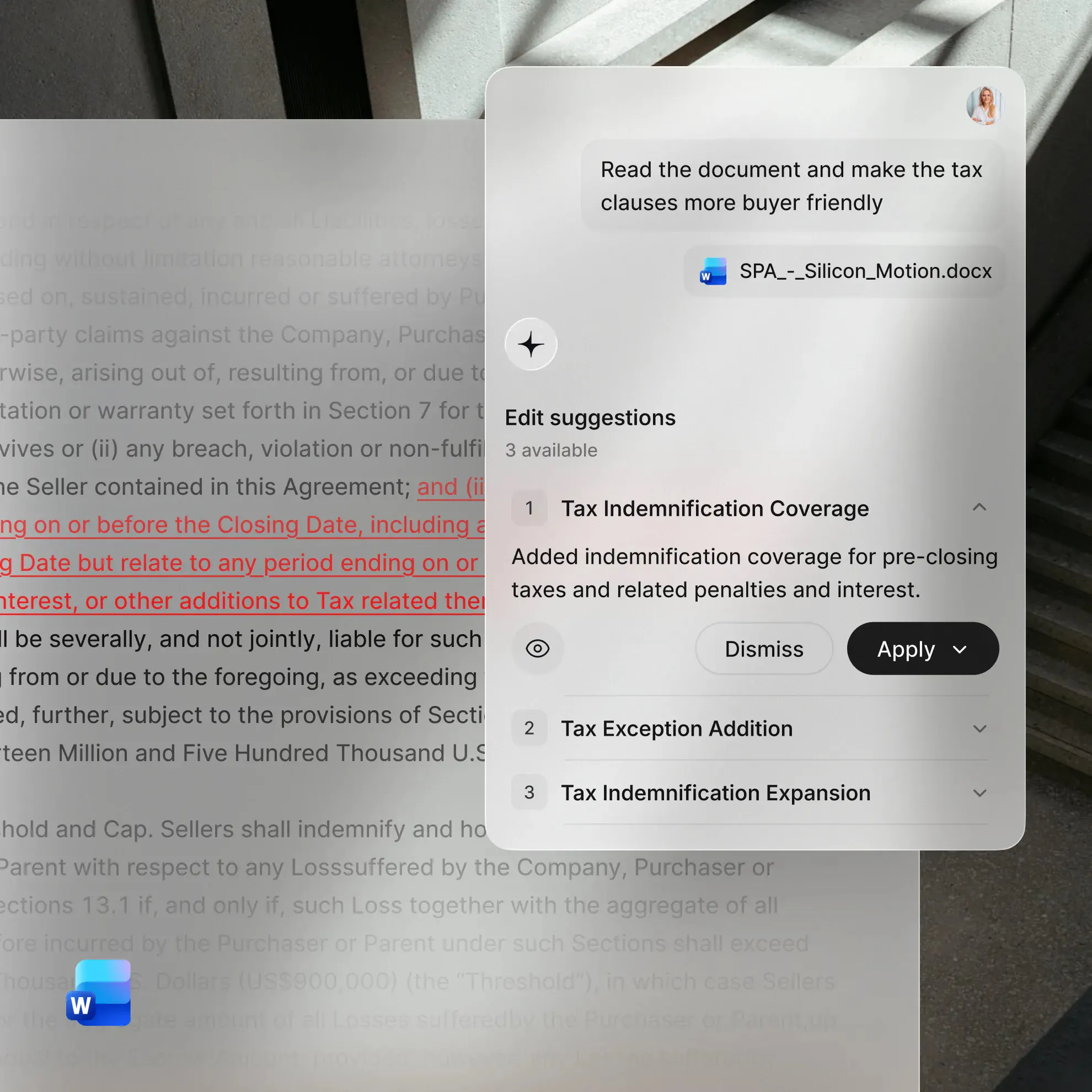
Much legal drafting still occurs in Microsoft Word, and Legora’s Word add-in puts the Agent inside it so lawyers can draft, redline, and review without leaving Word. Lawyers can ask the Agent to draft a clause, proofread a section, or flag risks, drawing on hundreds of saved prompts.
A distinctive feature of the offering is Playbooks. A playbook is a set of rules encoding an organization's negotiating standards, specifying its opening positions, its non-negotiables, and its acceptable fallbacks on each issue. A firm or in-house team defines the playbook once in Legora, then runs it against an incoming NDA or services agreement in Word, and the add-in marks up the document against those standards.
The add-in also bundles a set of narrower actions. Fill Template populates a document from a related one, such as completing a loan agreement from the terms in a term sheet. Anonymize replaces names, addresses, dates, and locations with placeholders. Improve Writing rewrites a highlighted passage without changing its meaning. Translate handles documents while preserving formatting, powered by DeepL.
Outlook Add-in
Source: Legora
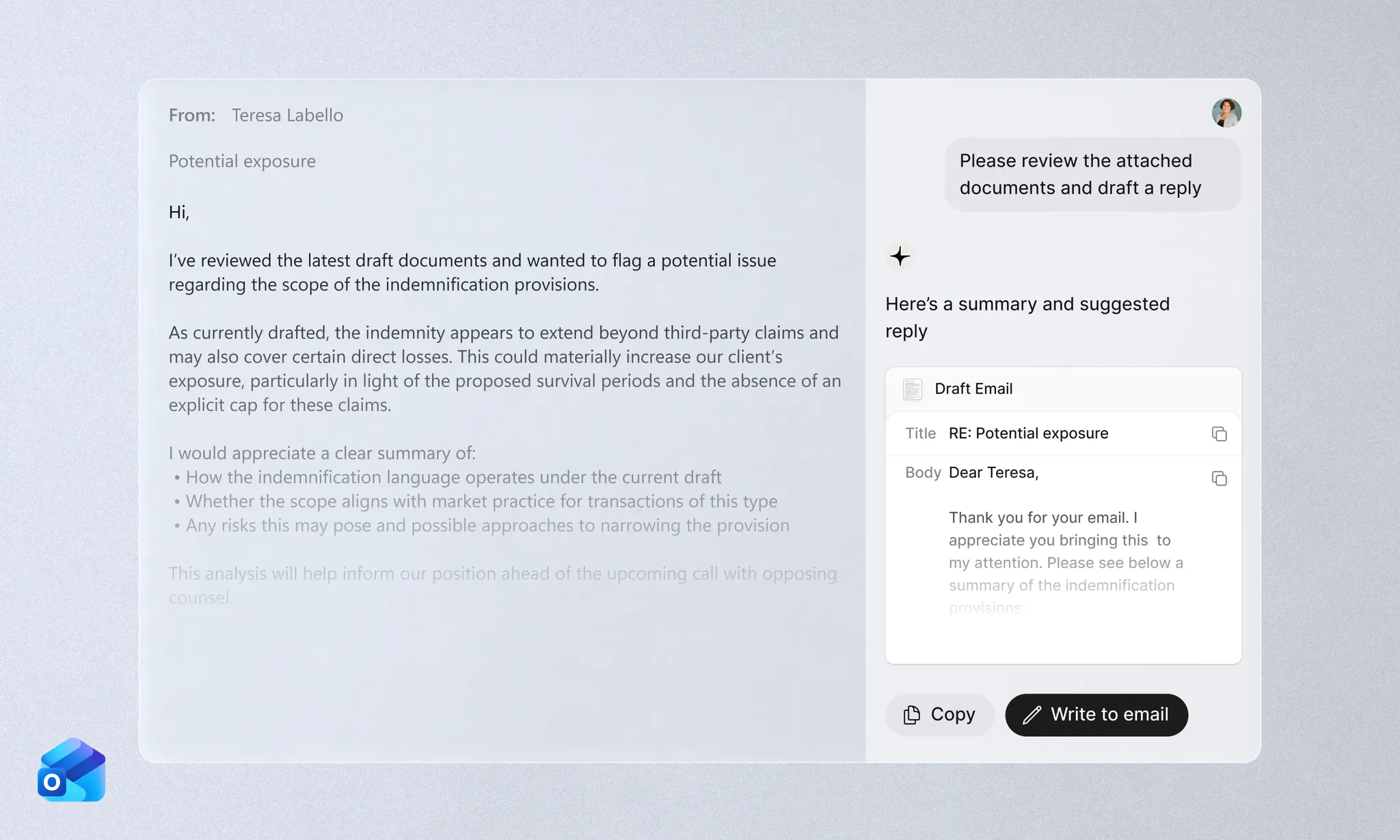
The Outlook add-in lets lawyers summarize long threads and draft replies without leaving their Outlook inbox. It also lets them save documents and entire threads into Legora with one click. Mannheimer Swartling CIO Peter Coyet framed the intent of the integration as not just saving users time, but improving decision quality across the workflow.
Mobile App
Source: Legora
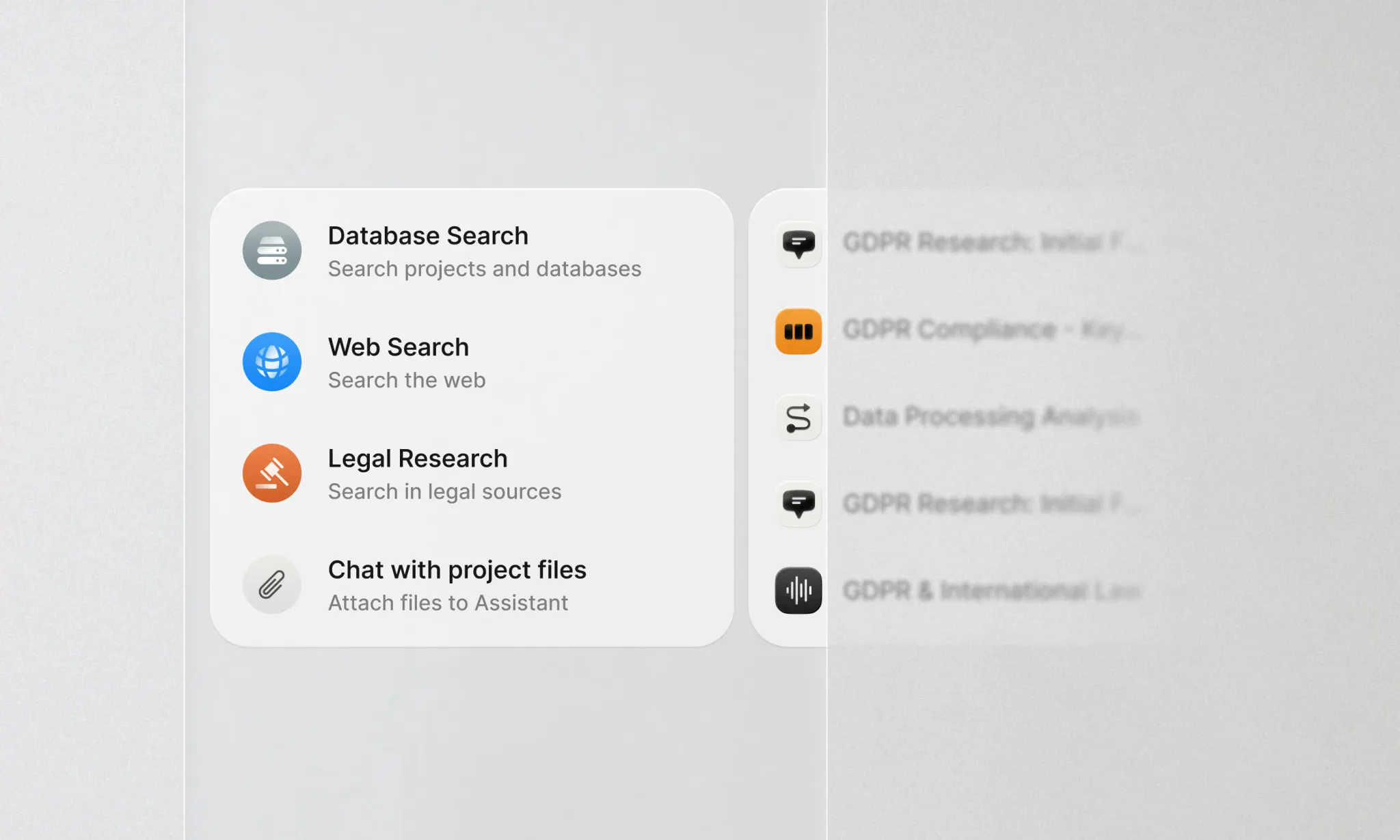
Legora’s mobile app, available on iOS and Android, allows users to work if they’re not at their desktop. It syncs across desktop and mobile so a conversation started at a desk continues on a phone without losing context. Lawyers can access documents, ask questions of them, generate summaries, and pull key points from contracts and briefs, with citations attached.
Lists
Legora’s “Lists” functionality allows users to “organize, assign, and execute inside Legora aOS.” The Agent reads a set of transaction documents and generates a draft closing checklist, extracting each condition precedent along with its description, the clause it came from, a suggested owner, and a due date. Each item becomes a structured row linked back to its source clause, with columns customizable to the matter. From there, it behaves as a project tracker. Owners get assigned, statuses get updated as work progresses, and every edit and sign-off is logged, which gives a partner an activity trail to review before signing.
Monitors
Source: Legora
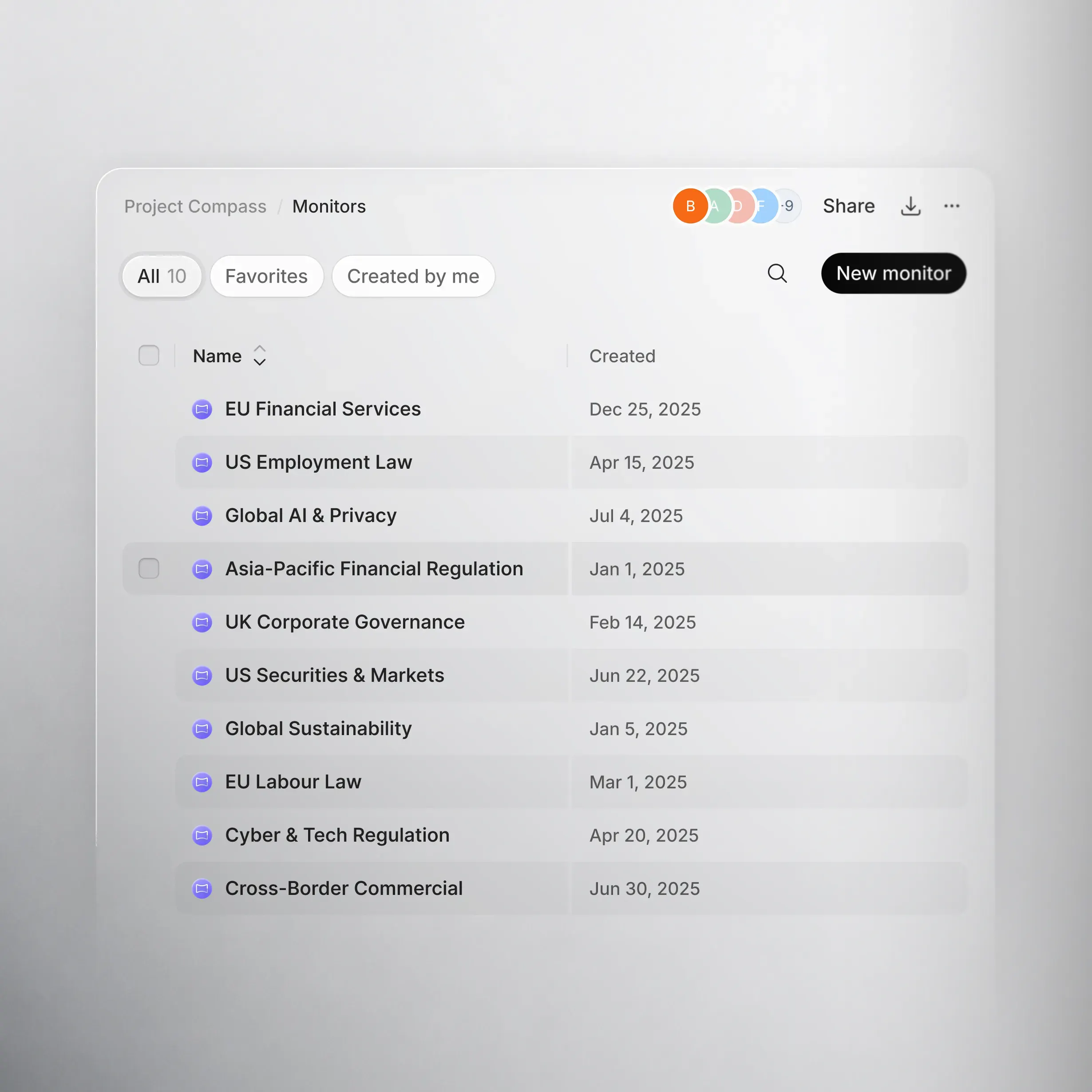
Legora’s Monitors product is intended to help users “stay ahead of regulatory change” by “continuously” scanning global regulation for changes that might affect a client or a business. A team defines its regulatory perimeter by choosing jurisdictions, topics, and the sources behind the coverage. Legora then produces a single feed scoped to that perimeter, with each item carrying a summary, metadata, and a link to the original source. Items can be filtered, prioritized, and assigned to owners.
Portal
Source: Legora
Portal is Legora’s client-facing layer, which it describes as an “AI-native workspace for law firms and in-house teams” that lets users “share files and collaborate with clients and colleagues under your brand” without a guest license. It is a white-labeled workspace intended so that a firm’s clients see the firm rather than Legora at any given touchpoint.
Beyond file sharing, a firm can publish its own workflows for clients to run directly using Portal. Those workflows are grounded in the firm's precedents and databases, and the underlying prompts, logic, and firm knowledge stay hidden from the client. This allows firms to deliver their accumulated expertise as a self-serve product. Clients can also query the shared document set and get answers grounded only in what has been shared, cited to the source.
Collaboration runs in real time, with both sides working in a shared space governed by role-based access controls and audit trails, and the host choosing exactly which files, tabular reviews, and workflows a guest can see. Linklaters partner Tom Quoroll described Portal as the firm's best route to delivering AI-enhanced services to clients who are asking for them.
Market
Customer
Legora serves two primary customer segments: law firms and in-house legal departments. For law firms, the value proposition is that Legora does not reduce billable hours, but rather reduces write-offs and the non-billable time that silently drains attorney capacity. Legora estimates that it saves lawyers more than four non-billable hours per week and projects $6.4 million in potential additional billing per 100 lawyers annually as of August 2026. Notable clients of Legora include White & Case, Cleary Gottlieb, Linklaters, Bird & Bird, Dentons, Goodwin, and Husch Blackwell, alongside Mannheimer Swartling. As of July 2026, the company served more than 1.5K customers across 50 markets.
For in-house legal departments, Legora’s value proposition is productivity. Legora cites a 30% measured productivity improvement per user, with partners including Erste Group and major corporate legal departments such as Barclays, which joined Legora’s cap table as an investor in April 2026. Crowell & Moring offers the most detailed public account of what Legora’s adoption led to inside a firm. Six months after a January 2026 firmwide launch, Crowell & Moring reported more than two million interactions on the platform, with 82% of the firm and 91% of its more than 700 attorneys registered as users, and nearly 70% of those attorneys using Legora at least weekly. Weekly use by most of a firm’s attorney base is the metric that separates a deployed platform from a purchased one, and it is the pattern Legora’s per-seat pricing depends on.
An additional vector for customer acquisition is Legora’s Legal AI Scholars Program, launched in March 2026 with nine US law schools, including Stanford, Cornell, Northwestern Pritzker, UCLA, the University of Chicago, Vanderbilt, and Boston University. The program gives participating institutions access to the same enterprise platform Legora deploys commercially, alongside faculty training and curriculum development support.
Lawyers who train on Legora in law school enter firms with platform familiarity, reducing the adoption friction inherent in enterprise software sales. Legora plans to expand the program to additional schools and jurisdictions throughout 2026 and beyond. Legora also began buying awareness directly. In April 2026, the company launched a global brand campaign fronted by the actor Jude Law under the line “Law just got more attractive,” running across the US, Canada, the UK, and the EU.
Market Size
The global legal technology market was estimated at $31.1 billion in 2026, up from $28.7 billion in 2025 and growing at a 12.2% CAGR through 2033, with North America accounting for 49% of 2025 revenue. The growth has several factors. For one, law firms dramatically increased tech spending in 2025, growing 9.7%, largely fueled by AI integration. At the same time, the profession is growing, with the US lawyer population rising 1.4% to 1.4 million in 2025, its first significant increase since 2020, and billable hours increasing 2.5% over the same time period, underlining continued demand for legal services even as AI tools proliferate.
The 100 largest firms in the US, AmLaw 100 firms, spend $15K-$30K or more per lawyer on technology annually. Applied against a base of approximately 124K lawyers, this represents at least a $1.8 billion opportunity in just one core customer segment. AmLaw 100 lawyers represent less than 10% of the 1.4 million lawyers in the US, and even assuming a lower average per-lawyer technology spend of $10K, the US market, Legora’s largest and most attractive, is at least a $10 billion opportunity.
The more significant opportunity, however, arises from pricing model shifts. CEO Max Junestrand has stated that Legora intends to move from per-seat subscription pricing to consumption-based and ultimately outcome-based structures. That reframes the addressable market from legal IT spend to a share of professional services spend, which is an opportunity approximately ten times larger than the traditional software market.
Competition
Competitive Landscape
Legora faces two different categories of competition that threaten its existence. On one hand, the legal space is widely described in 2026 as a “two-horse race” between Legora and its closest competitor, Harvey. Junestrand sees value in being the second mover to Harvey, since Legora avoided spending time fine-tuning models that foundation models later made unnecessary. However, Junestrand also predicts a winner-take-all race, with the leader eventually holding 90% of the legal AI market.
At the same time, the threat from foundation model providers became more serious in 2026. Anthropic launched Claude for Legal in May 2026, and OpenAI has been building toward a legal offering of its own. Both companies control the underlying model infrastructure that platforms like Legora depend on, while having significantly more capital. Anthropic raised $65 billion in a single round in May 2026, against the $865 million Legora had raised in total as of August 2026. The central question for Legora is whether it can integrate deeply enough into a law firm’s systems to make the workflow layer worth paying for separately from the model underneath it.
Competitors
Harvey: Founded in 2022, Harvey is an AI platform for legal professionals that uses generative AI to automate tasks and provide specialized workflows for law firms and corporate legal departments. Harvey’s value proposition and target customer are virtually identical to those of Legora, marking it as a clear direct competitor.
Harvey’s annualized revenue grew from $190 million in January 2026 to more than $350 million by July 2026. As of August 2026, the platform was used by over 142K lawyers across more than 1.5K customers in over 60 countries, including 50% of AmLaw 100 firms. Customers are sticky, evidenced by the company’s 98% logo retention rate across its customer base. Harvey raised $1.2 billion as of August 2026 from investors including Andreessen Horowitz, Sequoia Capital, and Kleiner Perkins, most of it in a $200 million round co-led by GIC and Sequoia in March 2026 that valued the company at $11 billion. In August 2026, Harvey was reported to be in talks to raise at least $500 million at a $15.5 billion valuation.
Luminance: Founded in 2015, Luminance provides an AI platform for contract generation, negotiation, and post-execution analysis for law firms. Unlike Legora, the company stays within one vertical use-case and does not pose a significant level of threat as a platform competitor. Luminance is based in the United Kingdom and raised $165 million as of August 2026, most of it in a $75 million Series C in February 2025 led by Point72 Private Investments. Luminance has not publicly disclosed a valuation for that round.
Spellbook: Founded in 2018, Spellbook offers a suite of AI legal tools that assist commercial lawyers with drafting, reviewing, and analyzing contracts. Similar to Legora, the company integrates directly into Microsoft Word to surface redlines, clause suggestions, and comparative benchmarks without leaving the document. In March 2026, Spellbook launched an AI agent for transactional law called Associate. Spellbook has over 4K customers, with a focus on in-house law teams. The company had raised $122 million in equity and debt as of August 2026, including a $50 million Series B in October 2025 led by Khosla Ventures that valued it at $350 million post-money.
Anthropic: Founded in 2021, Anthropic had raised $132 billion as of August 2026, including a $65 billion Series H in May 2026 at a $965 billion post-money valuation, and filed a confidential S-1 in June 2026. Anthropic stopped being an upstream supplier alone in May 2026, when it launched Claude for Legal with more than 20 connectors into law firm systems and 12 plugins covering specific practice areas, then hired a dedicated head of the legal business in August 2026. Legora contributes skills to that ecosystem rather than standing outside it, which is the position most of the application layer has taken.
OpenAI: Founded in December 2015, OpenAI had raised over $200 billion as of August 2026, closing a $122 billion round in March 2026 at an $852 billion post-money valuation. In enterprise settings, ChatGPT has trailed Claude, despite its lead in consumer use. OpenAI moved on legal in 2026, hiring Ironclad co-founder Jason Boehmig to lead the vertical and preparing an offering reported as “Codex for Legal,” and signed a firmwide partnership with Willkie in July 2026.
Other Competitors: Other competitors address specific use-cases within legal AI, such as EvenUp for personal injury law, Eve for plaintiff law firms, and EverLaw for document analysis. Each company’s narrow application renders it less of a threat to Legora than horizontal legal platform competitors like Harvey.
Business Model
Legora charges customers on a per-seat subscription basis, which Junestrand describes as “the easiest way for law firms to buy today.” The company has not publicly disclosed pricing, though a competitor’s published comparison puts Legora’s pricing at $3K per seat with a 10-seat minimum per firm. Junestrand admits that margins in late 2025 were “okay” but “not SaaS margins,” reflecting the inference cost of running AI workflows at scale and the deliberate prioritization of market share over near-term profitability. Unlike traditional “self-serve” SaaS, Legora utilizes a “forward-deployed” model that employs a team of legal engineers who embed with clients to solve the “last-mile” problem of AI adoption and implementation.
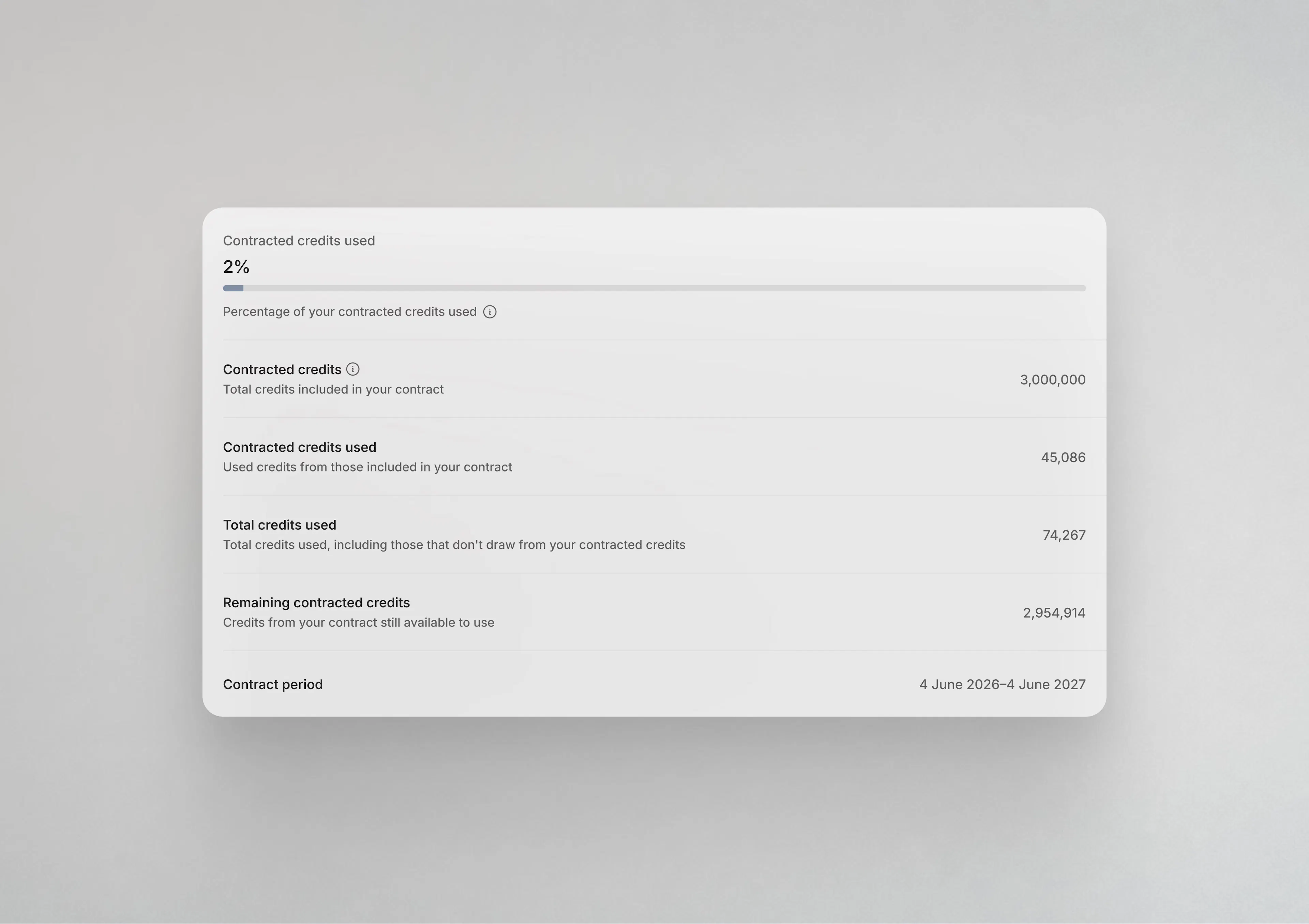
Legora is explicit that per-seat pricing is temporary. As Legora’s platform handles end-to-end legal workflows autonomously, the logical pricing shift is to consumption-based or outcome-based structures, where the platform is compensated proportionally to the value of the legal work it delivers rather than the number of seats assigned. This transition parallels the pressure as of 2026 on the billable hours model used by most law firms, which faces increasing threat from firms that embrace value-based pricing.
Source: Legora
The company began this transition in June 2026 when it introduced consumption-based pricing for its “most capable product”, Agent Pro, following the launch of the Legora Agent. The new pricing comes with real-time dashboards, notifications, and spending controls.
Traction
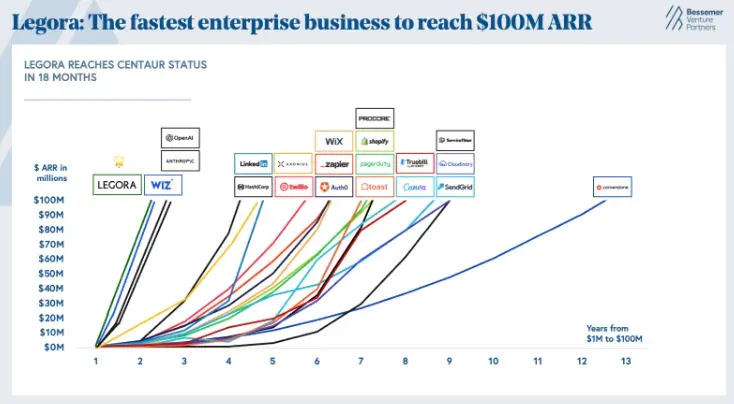
Legora surpassed $100 million in annual recurring revenue in April 2026, 18 months after its public launch, placing it among the fastest-scaling enterprise software companies in the post-generative AI era. ARR reached $150 million in Q2 2026, up 50% quarter over quarter. Revenue doubled every quarter for six consecutive quarters, adding $7 million in ARR in a single day in December 2025. Junestrand estimated in early 2026 that revenue would reach at least $200 million by the end of 2026. One unverified estimate puts the earlier trajectory at roughly $3 million in ARR at the end of 2024 and $50 million at the end of 2025.
Source: Bessemer
As of July 2026, Legora was used by over 100K legal professionals across more than 1.5K organizations in over 50 markets, up from 10K lawyers across 800 organizations in March 2026. The US became Legora’s largest single market by revenue in Q1 2026, following a US launch in March 2025 that began with a New York office and has since expanded to Denver, Chicago, and Houston. Despite the focus on the US since 2025, Legora still has a significant presence in Europe, with many of its customers in the Nordics.
Valuation
As of August 2026, Legora had raised $866 million across six rounds. Its most recent round, a Series D, occurred in two tranches. Accel led a $550 million first close in March 2026 at a $5.6 billion valuation, and a further $50 million followed in April 2026, taking the round to $600 million at the same valuation. The extension added Nvidia’s venture arm NVentures, in what was its first legal AI investment, alongside Atlassian, Insight Partners, Barclays, Adams Street Partners, Airtree, Geodesic Capital, and Liberty Global.
Prior to this, Legora raised a $150 million Series C at a $1.8 billion valuation in October 2025 led by Bessemer Venture Partners, an $80 million Series B in May 2025 led by ICONIQ and General Catalyst, a $25 million Series A in July 2024 led by Redpoint, and a $10 million seed round in May 2024 led by Benchmark. Valuations for the rounds preceding its Series C were not publicly disclosed. The Series D tripled the company’s valuation within five months, and took the company from $0 to $5.6 billion within three years since it was initially founded.
The company’s fundraising momentum seems set to continue. In August 2026, four months after the extension closed, Legora was reported to be in early talks to raise at a valuation of $10 billion or more, a round that would roughly double the company’s mark again. Harvey was in concurrent talks at $15.5 billion, indicating the rapid growth of the market both companies operate in.
Key Opportunities
Expansion in the US Market
Legora launched in the US in early 2025 and made it the company’s largest single revenue market within a year. The US accounts for nearly half of global legal tech spend, and Legora’s early progress, including an 85% claimed win rate in head-to-head evaluations against competing platforms and customer wins at White & Case, Cleary Gottlieb, and Goodwin, suggests it is competing seriously for the clients that matter most.
The Legal AI Scholars Program, placing Legora inside law school curricula at Stanford, Cornell, Northwestern, and UCLA, is a longer-term play on the pipeline. Lawyers who graduate trained on Legora enter firms with platform familiarity that reduces the adoption friction inherent in enterprise sales. Following its Series D, the team opened a Manhattan hub with 150 employees committed in March 2026, with a target of 300 US employees by year’s end. The US is also the market where Harvey has established the strongest position, with 50% of AmLaw 100 firms on its platform as of August 2026. Winning in the US is both a revenue growth opportunity for Legora and an opportunity to displace the category leader.
Repricing From Seats to Legal Work Delivered
Legora’s per-seat subscription pricing is appropriate for the environment in 2026, since it is how law firms are accustomed to buying software, but it leaves substantial value on the table. When a legal AI system executes an end-to-end due diligence process autonomously, the value created is measured in attorney hours displaced and quality improved, not in software seats consumed. Although firms are feeling pressured to switch from billable hours to outcome-based pricing, with some firms embracing the transition, 90% of law firm revenue still flowed through billable hours as of early 2026.
Junestrand has stated that outcome-based pricing is where the business is headed. One displaced Big Law senior associate frees approximately $250K in annual labor spend. Outcome-based pricing applied at even a fraction of that displacement value would expand per-customer revenue dramatically, aligning Legora’s incentives with those of its customers, since the platform wins when legal work actually gets done.
Key Risks
Harvey’s Lead in the US Installed Base
Harvey’s lead in the US market is formidable. As of August 2026, it had more than 142K lawyers on the platform, a 98% logo retention rate across its customer base, representation at eight of the ten highest-grossing US law firms in 2025, and more than $350 million in ARR against Legora’s $150 million. Harvey has also raised $1.2 billion against Legora’s $865 million, roughly 1.4 times the capital to spend on product development, sales, and market presence, backed by Sequoia, a16z, Kleiner Perkins, and Coatue, among many others. The product differentiation between the two platforms is narrow, since both offer document review, legal research, drafting, and workflow automation.
The head-to-head competition with Harvey may follow a similar dynamic as Lyft and Uber, where both the earlier and later entrant establish themselves as durable players. However, Junestrand frames the race for dominance as existential, predicting that the legal AI market will converge toward a winner holding 90% of the market. In that outcome, Legora has a formidable struggle ahead to displace Harvey as the market leader.
Model Providers Moving Into the Application Layer
The bigger risk to Legora is not necessarily direct competitors like Harvey as much as the companies whose models Legora is built on. Anthropic’s release of Claude for Financial Services in 2025 demonstrated a willingness to build vertically specific AI products that displace specialized application-layer companies in professional services. In May 2026, it did the same in law, launching Claude for Legal with more than 20 connectors into the document management, email, and billing systems firms already run, and 12 practice-area plugins spanning litigation, corporate, employment, privacy, and AI governance. Anthropic hired a dedicated head of the legal business in August 2026. OpenAI has moved in the same direction, recruiting Ironclad co-founder Jason Boehmig to build its legal vertical.
Legora and its direct competitors are sophisticated workflow and integration layers built on top of foundation model capabilities. The value they add is real, spanning workflow design, enterprise integration, security architecture, legal knowledge management, and client relationships. However, those contributions are not permanent moats if model providers decide the application layer is where they want to compete. Legora’s response so far has been to contribute skills into the Claude ecosystem rather than stand outside it, which preserves distribution but concedes that the intelligence layer belongs to someone else.
Sanctions Pressure Capping How Much Work Firms Delegate
Legora’s growth thesis rests on firms handing over more of the work, not less. Agentic Workflows execute multi-step matters end to end, and the move to outcome-based pricing only pays off if the platform is trusted with tasks nobody re-checks line by line. Courts are pushing the other way. A public database of AI hallucination cases tracked 1.6K decisions worldwide as of June 2026 in which a party relied on AI-fabricated material and a court responded, and US courts imposed over $145K in penalties in Q1 2026 alone. A federal court in Pennsylvania suspended an attorney for six months in June 2026 over hallucinated citations.
None of those sanctions involved Legora, and its Legal Research product is built specifically to ground outputs in primary sources. The risk is not that Legora hallucinates more than its competitors. It is that every sanction order raises the verification burden a firm’s risk committee imposes on any AI output, and verification is the cost that autonomous execution is supposed to remove. A market where partners review every agent-generated document buys seats, not outcomes, and seats are the pricing model Legora has said it intends to leave behind.
Summary
Legora is a Stockholm-based legal AI platform founded in 2023, offering document review, drafting, research, and workflow automation tools to law firms and in-house legal departments as of August 2026. The company reached $100 million in ARR in April 2026, roughly 18 months after general availability, and $150 million by Q2 2026, serving over 1.5K customers across 50 markets as of July 2026. A $600 million Series D completed in April 2026 valued the company at $5.6 billion, and in August 2026 it was reported to be in early talks at $10 billion or more. The legal AI market sits within a broader $31.1 billion legal technology market growing at 12.2% annually, with a tailwind from rising firm technology budgets and an observed gap between AI capability and actual lawyer adoption.
The central competitive question is whether Legora can close the gap with Harvey, which held more than $350 million in ARR, over 142K users, and penetration at 50% of AmLaw 100 firms as of August 2026, an entrenched position in Legora’s most important target market. Beyond Harvey, the longer-term risk is that model providers move down the stack into legal-specific applications, which Anthropic began doing in May 2026. Taken together, Legora’s near-term trajectory depends less on product differentiation, which is narrow across the category, and more on whether it can win enough of the US market before competitive and platform pressures narrow its options.