
Thesis
For American adults, metabolic dysfunction is the norm. From 2009 to 2016, only 12.2% of US adults met optimal targets across blood glucose, triglycerides, high-density lipoprotein cholesterol, blood pressure, and waist circumference without medication. The clinical population of patients with metabolic dysfunction is also large, and it is growing. As of 2024, 97.6 million US adults had prediabetes and 38.4 million had diabetes, and diagnosed diabetes carried a total US economic cost of $412.9 billion. The standard of care addresses this downstream by supplying insulin the body has stopped responding to or by suppressing appetite pharmacologically, but the problem remains prevalent despite such interventions.
The arrival of GLP-1 agonists changed what consumers understand about metabolic dysfunction. 12% of American adults had used a GLP-1 drug as of a survey conducted in 2025, and the drug class reached $66.4 billion in global revenue in 2025. That created something no amount of nutrition messaging had managed, which is a mass consumer audience fluent in the language of a specific gut hormone and willing to pay monthly for something that acts on it. The drugs supply the hormone from outside the body. They do not restore the biological machinery that produces it, and the question of why that machinery stopped working remains open.
Pendulum sells probiotics built on the gut bacteria that trigger GLP-1 production naturally, aimed at the same metabolic problem that GLP-1s treat. Its products, which range in function from improving metabolism to glucose control, are aimed at making the microbiome a third category of metabolic intervention alongside drugs and diet. The probiotic strains its products are built on are strict anaerobes that die on exposure to oxygen. Pendulum has built its own oxygen-free manufacturing facility to grow and package them, and pairs them with an enteric-coated, time-delayed capsule intended to carry them past stomach acid into the lower intestine.
Founding Story
Pendulum was founded in 2013 as Whole Biome by Colleen Cutcliffe (CEO), John Eid (CSO), and James Bullard (former CTO), scientists who had worked together at genomics company Pacific Biosciences. The company took the Pendulum name in 2019.
Cutcliffe holds a PhD in biochemistry and molecular biology from Johns Hopkins University and studied biochemistry at Wellesley College, and she completed postdoctoral research at Northwestern Medicine's Lurie Children's Hospital of Chicago. She worked as a scientist in the Parkinson's disease group at Elan Pharmaceuticals before becoming senior manager of biology at Pacific Biosciences, the role she left to start the company. Eid is a biophysicist whose work covered single-molecule detection and genome sequencing applications, and Bullard is a computational biologist and biostatistician who was a senior staff scientist at the same company until 2013. Bullard served as chief technology officer from the founding until September 2023. As of September 2026, Pendulum had not publicly named a successor. The founding team’s experience was mostly in sequencing and computational biology rather than clinical medicine, which likely informed the company’s approach in identifying strains by genomics before it grows them.
The origin of the company was rooted in Cutcliffe's personal history. Cutcliffe described reading work from New York University microbiologist Martin Blaser showing that infants exposed to heavy antibiotic courses in their first six months were more prone to obesity and diabetes later in life. Her own daughter, Annabella, was born eight weeks premature and received multiple antibiotics in the neonatal intensive care unit. She was in elementary school with food sensitivities when Cutcliffe encountered the research. As she put it in a February 2026 interview, "this is the march towards diabetes," and, "we could start a company to help millions of people, including my own daughter." She has said she knew little about the microbiome before reading that paper, and she began the company without prior business or executive experience.
The company has had two significant appointments since its founding. Actor Halle Berry took an equity stake and became chief communications officer in February 2023, an unusual title for a celebrity endorsement arrangement and one that put a consumer-brand apparatus around a company that had historically prioritized clinical language. Adam Perlman joined as chief medical officer in January 2024 from Mayo Clinic, where he had been director of integrative health and wellbeing, and had previously been executive director of Duke Integrative Medicine. Perlman had used the products in his own practice and initiated the Mayo Clinic trial of Glucose Control before joining, obtaining an investigator-initiated investigational new drug approval for it.
Product
Source: Pendulum
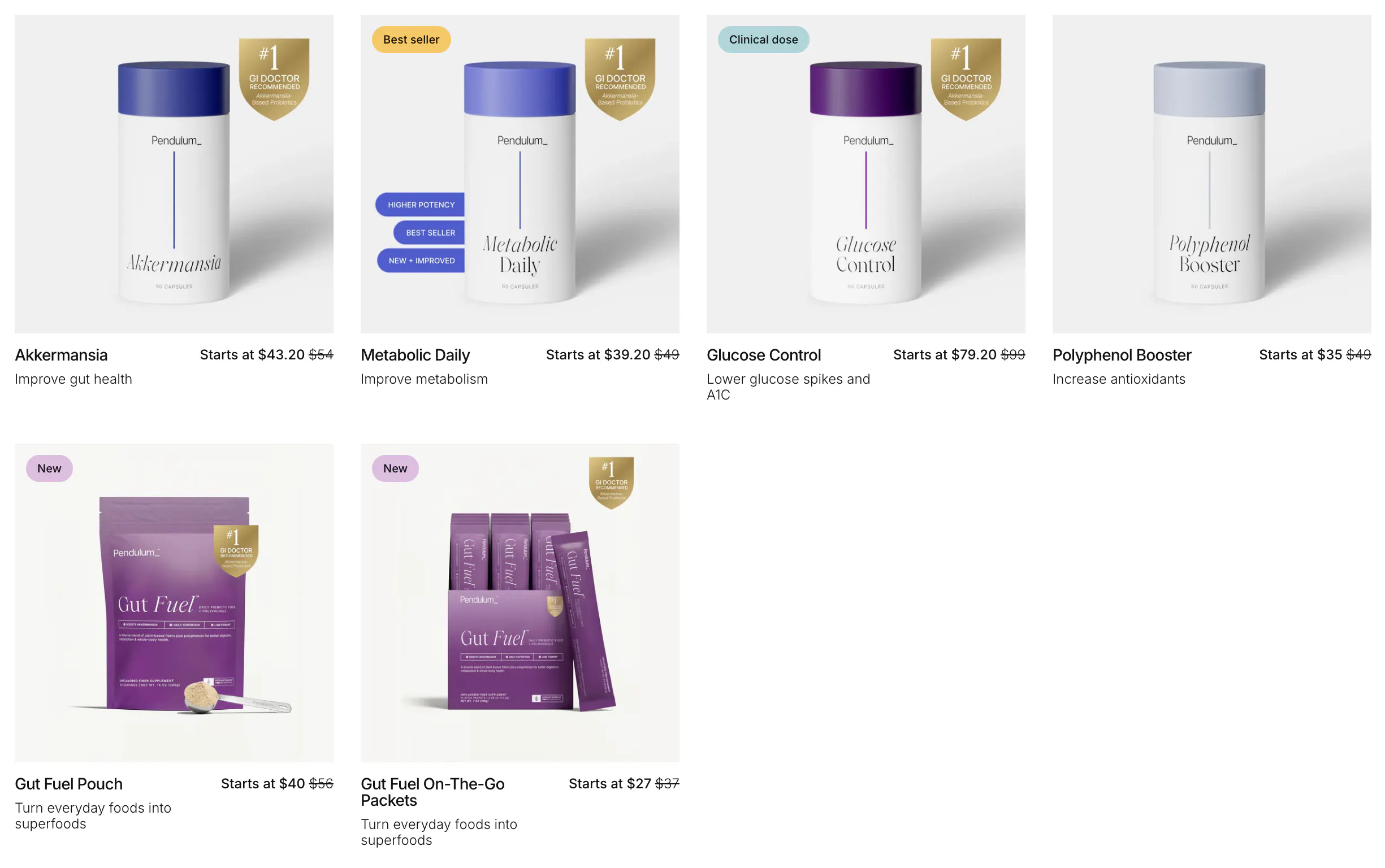
Pendulum sells capsule and powder supplements containing live gut bacteria, sold direct to consumers on a monthly subscription. The job the products are meant to do is replacement rather than supplementation. The company's argument is that people with metabolic disease are depleted in or entirely missing specific strains that ferment dietary fiber into short-chain fatty acids, and that restoring those strains restores a signaling pathway rather than adding a nutrient. Cutcliffe has explained that when people with obesity, prediabetes, and type 2 diabetes are examined, they are low in or missing the microbes that stimulate GLP-1, losing both the insulin signal and the satiety signal to the brain.
The company's manufacturing processes are designed around two key engineering challenges. First, the lead strain, Akkermansia muciniphila, is a strict anaerobe that cannot survive exposure to oxygen, so Pendulum operates its own oxygen-free manufacturing facility to grow and fill it. Cutcliffe claimed in June 2022 that Pendulum was "the only company that has created the manufacturing process to grow these anaerobic strains." Delivery is the second problem, and the company addresses it with an enteric-coated, time-delayed capsule intended to survive stomach acid and release in the distal colon. Cutcliffe has acknowledged that the capsule is a deliberate cost decision, saying, "we pay more for the capsule."
Glucose Control

Source: Pendulum
Glucose Control is Pendulum's clinical product and the most expensive, starting at $99 per month on subscription, or $139 per order. It contains five strains, Akkermansia muciniphila, Clostridium butyricum, Anaerobutyricum hallii, Clostridium beijerinckii, and Bifidobacterium infantis, alongside a prebiotic fiber. Pendulum markets it as a medical food for the dietary management of type 2 diabetes, a category that carries no requirement for pre-market approval, and states that it reduced A1C by 0.6 percentage points and cut post-meal glucose spikes by 32.5% against placebo in trial. Those figures come from one 12-week study of 76 participants.
Metabolic Daily & Akkermansia
Metabolic Daily is the company's general-purpose formulation, a five-strain product starting at $49 per month against a $69 list price. Akkermansia is the single-strain version, starting at $54 against a $75 list price, and is sold on gut-lining rather than glucose claims. Cutcliffe has described Akkermansia muciniphila as the strain that maintains the mucus layer of the gut lining and one of the strains most reliably lost with age. She has also said that a Cornell professor sequenced competing Akkermansia products bought on Amazon and reported back that Pendulum is the only product that had Akkermansia
GLP-1 Probiotic
Pendulum launched the GLP-1 Probiotic in March 2024 at $65, a three-strain formulation of Akkermansia muciniphila, Clostridium butyricum, and Bifidobacterium infantis intended to raise the body's own GLP-1 rather than deliver the hormone. It is the product aimed most directly at the drug-driven consumer wave, and it is supported by consumer research rather than a clinical trial. The launch announcement reported that 91% of participants described reduced overall food cravings and 88% of participants described reduced sugar cravings after six weeks, without stating a sample size, and cited preclinical studies alongside the standard disclaimer that the statements have not been evaluated by the Food and Drug Administration.
Gut Fuel & Polyphenol Booster
Pendulum's two newest products are prebiotics rather than probiotics, intended to feed the strains the capsules deliver. Polyphenol Booster starts at $35 per month against a $49 list price. Gut Fuel, a flavorless fiber and polyphenol powder meant to be mixed into food, launched in March 2026 and sells in a pouch starting at $40 and in single-serve packets starting at $27. Cutcliffe has framed the combination as a "one-two punch," on the argument that delivered strains need substrate to establish, which also has the effect of raising the monthly basket.
Market
Customer
Pendulum's core customer is an adult managing diagnosed metabolic disease, and its secondary customer is the larger population of consumers who believe their metabolism is impaired without a diagnosis. Glucose Control is sold specifically to people with type 2 diabetes, and the trial behind it enrolled participants already taking metformin, which is the population the National Advertising Division later required the company's claims to be restricted to. Metabolic Daily and the GLP-1 Probiotic address the broader group, and Cutcliffe has pitched that group directly, arguing that "88% of people are metabolically unhealthy" and that "you might be thin, but you're actually metabolically unhealthy."
Pendulum's customer acquisition costs are high, but it has strong retention. In April 2021, Pendulum reported that 74% of its subscribing customers with type 2 diabetes were still active after five months, and that among surveyed customers, 86% of respondents described lower A1C, 86% described improved gut health, and 79% of respondents described lower glucose levels. Those are self-reported survey figures rather than measured outcomes.
Another Pendulum customer is the clinician who recommends the product without prescribing it. As of April 2026, Pendulum described itself as the most recommended brand of Akkermansia-based probiotics among gastroenterologists, with more than 30K medical professionals recommending its products to patients.
Market Size
Pendulum competes in the probiotic supplements market, which was $15.1 billion in 2025, while addressing a US metabolic-health population of 97.6 million prediabetic adults. The global probiotics market, which spans functional foods, beverages, and supplements, was valued at $76.6 billion in 2025 and is projected to reach $115 billion by 2030, growing at an 8.5% CAGR over that period. Growth in both markets is attributed to rising consumer awareness of gut health, demand for functional foods, and broader adoption of preventive healthcare spending.
In the US alone, 97.6 million adults had prediabetes and 38.4 million had diabetes as of a 2024 statistics report, against 12.2% of adults meeting optimal metabolic targets in survey data spanning 2009 to 2016. Converting even a low single-digit share of the prediabetic population to a $49 monthly subscription would imply a business several times the size of the largest independent probiotics brands, the largest of which, Seed Health, was reported at around $200 million in 2024 revenue.
The adjacent pool is the metabolic drug market, which indicates what consumers will pay when they believe a product works. GLP-1 receptor agonists generated $66.4 billion globally in 2025. Pendulum is not competing for that revenue directly, but the drugs establish the price anchor and the category vocabulary that its GLP-1 Probiotic is sold into.
Competition
Competitive Landscape
Pendulum's competitors split into three groups that compete for the same consumer on different bases. Venture-backed consumer microbiome brands, including Seed Health, Viome, ZOE, and Ritual, compete on brand, formulation, and in some cases diagnostic testing, and the largest is, reportedly, Seed Health at around $200 million in 2024 revenue. Established probiotics manufacturers, including publicly traded BioGaia and Novonesis, hold the clinical-evidence and ingredient-supply positions and reach consumers through retail and through other brands rather than directly. Pharmaceutical GLP-1 agonists are not probiotics, but they address the same consumer intent with far stronger evidence, at $66.4 billion of global revenue in 2025.
Pendulum's claimed advantage against all three is manufacturing rather than formulation. Growing strict anaerobes at commercial scale requires an oxygen-free production line that most supplement contract manufacturers do not operate, which is why the company built its own. That advantage is a process rather than composition-of-matter intellectual property on a naturally occurring organism, though the company had 18 issued patents and 66 pending as of March 2023. Cutcliffe has acknowledged that "now there's a lot of copycats" selling products labeled as Akkermansia. The durability of the position depends on whether competitors can replicate the process and whether consumers can tell the difference. As of September 2026, that difference was hard to detect without sequencing the capsule.
Competitors
Novonesis: Formed in 2024 through the merger of Novozymes and Chr. Hansen, Novonesis supplies enzymes and microbial cultures, including probiotic strains sold into other companies' consumer products. It held a market cap of $32.7 billion as of September 2026 on trailing twelve-month revenue of $4.9 billion. Unlike Pendulum, it sells ingredients to brands rather than finished products to consumers, which makes it a supplier to the category and a potential acquirer of strain technology rather than a shelf competitor.
BioGaia: Founded in 1990, BioGaia develops and sells clinically documented probiotics built on patented Limosilactobacillus reuteri strains, sold through pharmacies and distribution partners. It traded at a market cap of $1.2 billion as of September 2026 on trailing twelve-month revenue of $163.1 million. BioGaia is the closest public analog to Pendulum's strategy of building a brand on strain-specific clinical evidence, which makes its revenue multiple the most relevant public comparison for pricing Pendulum.
Viome: Founded in 2016, Viome sells at-home microbiome and gene-expression tests and uses the results to recommend personalized supplements, pairing diagnostics with a subscription product in a way Pendulum does not. It raised an $86.5 million Series C in August 2023, co-led by Khosla Ventures, and subsequently raised a $25 million Series D in September 2024 at an undisclosed valuation, bringing its total funding to $301 million.
ZOE: Founded in 2017, ZOE sells a personalized nutrition program combining gut microbiome analysis, blood fat testing, and continuous glucose monitoring, priced at an upfront testing fee plus an app subscription. It raised £25 million in December 2022 at a valuation of $250 million, bringing total funding to about $105 million as of that date. ZOE competes for the same metabolically anxious consumer but sells measurement and dietary guidance rather than strains, which makes it a substitute for the diagnosis rather than the intervention.
Seed Health: Founded in 2016, Seed Health sells the DS-01 daily synbiotic, a 24-strain capsule marketed on clinical documentation and delivered through a distinctive brand and retail presence. It closed a $40 million Series A in April 2021 led by The Craftory, with ARTIS Ventures and GISEV participating. Seed Health was reported in June 2024 to be exploring a sale above a $1 billion valuation, though as of September 2026 nothing had materialized. The company was reportedly expecting around $200 million in 2024 revenue against $140 million the prior year, and to be profitable. Seed competes on breadth of strains and brand rather than on a single hard-to-manufacture organism.
Ritual: Founded in 2015 by Katerina Schneider, Ritual sells subscription vitamins and a two-strain synbiotic, competing on ingredient traceability and design rather than on strain-specific clinical outcomes. It raised a $25 million Series B in February 2019 with Founders Fund, Norwest Venture Partners, and Forerunner Ventures participating, bringing total funding to $40.5 million as of that date. Ritual's synbiotic is priced well below Glucose Control, which makes it the volume alternative for a consumer who wants a gut-health subscription without a clinical claim.
Thorne: Founded in 1984, Thorne sells practitioner-channel supplements and at-home health tests, reaching the same clinician-recommendation channel Pendulum has been building. L Catterton completed an acquisition of Thorne HealthTech in October 2023, taking the company private for a ~$500 million valuation. Subsequently, it was reported in August 2026 that Procter & Gamble would be acquiring the company for $3.8 billion. Thorne's scale in the practitioner channel is the most direct threat to Pendulum's clinician-recommendation strategy, though it does not sell a live Akkermansia product.
Business Model
Pendulum sells directly to consumers on a monthly subscription, with a secondary wholesale channel through Amazon, iHerb, and, as of April 2026, Sprouts Farmers Market. Subscription is the primary pricing mechanism and carries a consistent discount to one-time purchase. Across the line, subscription prices run roughly 28% below the list price of each product on the company's own store, at $99 against $139 for Glucose Control, $49 against $69 for Metabolic Daily, and $35 against $49 for Polyphenol Booster. The prebiotic products are structured as basket expanders on top of a capsule subscription rather than standalone purchases.
The cost structure is heavier than a typical supplement brand in two specific places. Manufacturing is asset-heavy because strict anaerobes cannot be produced by standard contract manufacturers, so Pendulum runs its own oxygen-free facility, which converts what is usually a variable cost into fixed capacity that has to be filled. Packaging is a deliberate premium as well, given the enteric-coated, time-delayed capsule Cutcliffe has said the company pays more for. Against those costs, Pendulum carries clinical research spending that a supplement brand would not, including the company-run trial behind Glucose Control and its share of the Mayo Clinic collaboration.
The long-term question is whether that clinical spending is a cost of goods or a marketing expense. Every trial that supports a claim also widens the population that can be sold to, but trials price in the millions and the products they support sell at supplement margins rather than pharmaceutical ones.
Traction
Pendulum's Glucose Control formulation was tested in a multicenter, double-blind, randomized, placebo-controlled proof-of-concept trial published in BMJ Open Diabetes Research & Care in 2020, enrolling 76 participants with type 2 diabetes over 12 weeks and reporting a 0.6% reduction in A1C and a 32.5% reduction in participants' post-meal glucose area under the curve against placebo. In March 2021, the National Advertising Division reviewed the claims built on that trial and found them supported by competent and reliable scientific evidence, while recommending the company restrict them to people already taking metformin and drop references to percentage reductions in glucose spikes.
The clinical program has since widened beyond the company's own trials. Pendulum lists active studies run by outside institutions, including a Phase 2 trial at Mayo Clinic Florida evaluating Glucose Control against bone loss in women receiving breast cancer treatment, a study at Ohio State University's Wexner Medical Center on the gut and vaginal microbiome of ovarian cancer patients undergoing platinum chemotherapy, and a Massachusetts General Hospital study combining fecal microbiota transplantation with Metabolic Daily. In April 2026, Pendulum expanded a Mayo Clinic collaboration that began in 2013 into women's health and dermatology, covering bone health during breast cancer treatment, the gut-skin axis, and the menopause transition.
Commercial traction has come through channel expansion. Pendulum launched the GLP-1 Probiotic in March 2024, added Gut Fuel in March 2026, and in April 2026 went nationwide at Sprouts Farmers Market, its first broad brick-and-mortar distribution after more than a decade selling primarily direct. The same announcement put the clinician-recommendation base above 30K medical professionals. Headcount stood at 113 full-time employees as of September 2026.
Valuation
Pendulum had raised a total of $121.2 million as of September 2026. In April 2021, the company raised a $54 million Series C led by Meritech Capital, with Sequoia Capital, True Ventures, and Khosla Ventures participating, at an estimated $300 million valuation. That announcement put total funding at $111 million as of April 2021 and described the round as nearly doubling everything the company had raised before it. In July 2023, Fonterra invested $10 million alongside a partnership to co-develop microbiome products, this time at an estimated $175 million valuation.
Key Opportunities
Retail Distribution After a Decade Direct
Pendulum sold primarily through its own website for more than ten years before going nationwide at Sprouts Farmers Market in April 2026 with five products. Comparatively, Viome put its kits into roughly 200 CVS locations under a revenue-sharing agreement in August 2023, and Seed Health built to a reported $200 million in 2024 revenue with a substantial retail presence. Retail addresses the acquisition-cost problem that constrains a direct-to-consumer subscription business, and for a product whose differentiation is invisible on a shelf, the natural-grocery channel supplies credibility that packaging cannot. The opportunity is to convert clinician recommendation into retail pull-through in a channel where the shopper is already primed for a premium claim.
Indications Beyond Metabolic Health
The Mayo Clinic expansion announced in April 2026 moved the research program into women's health and dermatology, adding studies on bone health during breast cancer treatment, the gut-skin axis, and the menopause transition to a relationship that began in 2013. Independent investigators are already running trials in adjacent areas, including the Phase 2 bone-loss study at Mayo Clinic Florida and the ovarian cancer study at Ohio State listed on the company's research page. Each indication that produces a defensible result creates a new population and a new recommending specialty, and it does so without new manufacturing, because the same strains address the new claims. Menopause in particular maps onto a consumer segment with high willingness to pay and few evidence-backed products.
Ingredient & International Channels Through Fonterra
Fonterra invested $10 million in July 2023 alongside a partnership to co-develop and commercialize microbiome products, covering immunity, mental health, cognitive health, and aging. Fonterra is a dairy nutrition company with global distribution, which gives Pendulum a route into food formats and international markets its own direct model does not reach. Novonesis demonstrates the scale available on the supply side of this category, at $4.9 billion in trailing revenue as of September 2026, selling strains into other companies' products. If Pendulum's manufacturing capability is the real asset, licensing it into partners' formats monetizes that asset without absorbing consumer acquisition costs.
Key Risks
Evidence Base Thinner Than the Product Line
Pendulum's entire clinical claim rests on one small study. The trial behind Glucose Control enrolled 76 participants for 12 weeks, was described by its own authors as proof-of-concept, and was authored by company employees including co-founder Bullard. A registered dietitian reviewing the product noted that a 12-week study with 76 participants is limited in both duration and sample size and that longer studies are needed. No trial of that exact five-strain blend has been published since.
The products carrying the company's growth have less than that. The GLP-1 Probiotic, sold into the largest consumer wave in metabolic health as of 2026, is supported by a six-week consumer survey in which 91% of participants reported reduced overall cravings and 88% of participants reported reduced sugar cravings, with no stated sample size, no control arm, and no published trial. The single-strain Akkermansia product is sold on general research about the organism rather than trials of Pendulum's own formulation.
Cutcliffe has been candid about where the line sits, saying in February 2026, "here's my caveat with regulatory. We have not done a clinical trial on this, but we do have customers who have, with the help of their physicians, reduced how much drugs they're on." A company whose differentiation is scientific rigor is describing medication reduction on the strength of customer anecdote, and that gap between the marketing and the evidence is the central risk in the business.
Medical Food Is a Self-Designation
Glucose Control is sold as a medical food, a category that requires no pre-market FDA review, which means the classification is Pendulum's own assertion rather than an approval. That assertion has been tested once already. In March 2021, the National Advertising Division, while finding the core claims supported, recommended the company restrict them to individuals already taking metformin, clarify that the product is part of dietary management rather than a standalone treatment, and stop citing percentage reductions in glucose spikes without evidence of clinical relevance. A regulator revisiting the medical-food designation would strike at the highest-priced SKU, and the clinician channel at once, and separately, marketing that implies drug reduction without a trial is the specific pattern that draws Federal Trade Commission attention in the supplement category.
GLP-1 Drugs As a Substitute
GLP-1 receptor agonists generated $66.4 billion globally in 2025 on randomized outcome trials measured in tens of thousands of patients, against the 76 participants in Pendulum's. 12% of American adults had already used one as of 2025. A consumer weighing a $99 monthly probiotic against a drug with documented weight and glycemic outcomes is making a comparison Pendulum loses on evidence, and generic entry and compounded supply have been pushing the drugs' price toward the supplement range. Cutcliffe's counterargument is durational rather than clinical: that she "would be nervous to be on a drug for decades and decades," which she offered in February 2026 and which is not supported by outcome data either.
Durability of a Manufacturing Advantage
Pendulum's competitive differentiation is the ability to grow strict anaerobes at scale rather than ownership of the organism, because Akkermansia muciniphila occurs naturally in the human gut and cannot be patented as a composition of matter. The company held 18 issued patents as of March 2023, which cover process and formulation rather than the species. Cutcliffe has said that "now there's a lot of copycats" and that a Cornell professor who sequenced competing Amazon products found only Pendulum's contained live Akkermansia.
However, that defense rests on a private communication the company has not published. If competitors solve anaerobic manufacturing, the differentiation could disappear. If they do not, but consumers cannot tell the difference, cheaper products labeled Akkermansia still take the shelf and the search result. Well-capitalized incumbents have an obvious reason to close the gap, with Novonesis holding a $32.7 billion market cap as of September 2026 and existing industrial fermentation capability.
Summary
Pendulum sells consumer probiotics built on gut bacteria that are difficult to manufacture and that the company argues restore the body's own GLP-1 production. It was founded in 2013 by three Pacific Biosciences scientists, raised $121.2 million across more than a decade, and sells a number of products priced between $27 and $99 per month through subscription, Amazon, and, since April 2026, Sprouts Farmers Market nationwide. Its distinguishing assets are an oxygen-free manufacturing facility, a clinician-recommendation base the company puts above 30K medical professionals, and a research relationship with Mayo Clinic that has widened from metabolic health into women's health and dermatology.
The company sits between two categories and carries the weaknesses of both. It is priced and marketed like a clinical product but regulated like a supplement, and the evidence supporting it is one 76-person, 12-week company-run trial, with the fastest-growing products in the line supported by consumer surveys rather than trials at all. Two questions remain open: (1) whether the outside trials running at Mayo Clinic, Ohio State, and Massachusetts General produce results strong enough to convert the medical-food positioning into something a regulator and a physician would both defend, and (2) whether retail distribution can lower acquisition costs enough to scale a subscription priced near $50 per month.