
Thesis
Global M&A deal value reached $4.8 trillion in 2025, up 36% from 2024 and the second-highest annual total on record. Yet the workflows supporting these deals, from financial modeling to pitch-deck creation to due-diligence compilation, still largely rely on manually pulling data, building spreadsheets, and formatting slides. Junior analysts have long executed this repetitive, high-stakes work over punishing hours. After several publicized deaths and mental-health crises, bank executives have faced growing pressure to cap those hours and rethink how the work gets done. As of 2025, generative AI had permeated enterprise applications broadly, but its adoption in finance lagged: nearly two-thirds of organizations remained in the experimentation or pilot phase, not yet scaling it across the enterprise.
That gap is closing as the labor impact of AI becomes measurable. A 2025 study found that AI could already substitute for 11.7% of the US workforce, and job postings for structured, repetitive roles have declined by 13% since the launch of ChatGPT in November 2022. In financial services specifically, 65% of finance professionals said in early 2026 that their company is actively using AI, up from 45% a year earlier. Agentic AI is climbing too: 42% of finance professionals are using or assessing it, and 21% say they have already deployed AI agents.
In investment banking specifically, analysts project that AI will deliver productivity gains of 25% to 40%, with sector revenues rising 4% in 2024. In 2025, JPMorgan signaled it would begin reducing the ratio of junior analysts to managers from 6:1 to 4:1 as AI assumes more foundational work, and JPMorgan Chase CEO Jamie Dimon acknowledged that the technology will likely eliminate some jobs. Banks are explicitly planning to run deals with fewer junior analysts, and that analytical work is exactly what Rogo automates.
Rogo automates analysis for investment banks, private equity firms, and hedge funds, running financial models, drafting IPO documents, and building slide decks in a fraction of the time it would take a junior analyst. The platform integrates directly into the tools bankers already use, including Excel and Word, and differentiates through end-to-end workflow automation rather than point-solution chat interfaces. Rogo’s mission is to build Wall Street’s first AI analyst and believes that finance will adopt a system purpose-built for its reasoning and data rather than a general-purpose chatbot.
Founding Story
Rogo was founded by Gabriel Stengel (CEO) and John Willett (COO) in 2022. The founders met as undergraduates at Princeton University, where Stengel studied computer science, and Willett studied economics. The duo collaborated on their senior thesis in 2020, an econometrics chatbot that let peers with limited technical fluency query economic data in natural language. The initial product was narrow, focused only on structured data and Python code generation, but it pointed toward the problem both founders would eventually address with Rogo.
The insight came from a chance encounter Stengel had with Peter Orszag, who would later become CEO of Lazard. Orszag described an emerging need for a “data translator,” a professional who could bridge the gap between Lazard’s bankers and its data scientists. The idea stayed with Stengel, who joined Lazard after graduating, first as an analyst and then as a data and software tooling specialist. Willett went on to junior banking positions at Barclays and JPMorgan. The two maintained a collaborative partnership across institutions, gaining firsthand experience of junior-banking workflows and where they were most inefficient.
Both founders left their roles in late 2021 to formally launch the current iteration of Rogo, with Tumas Rackaitis joining as a third co-founder and its founding chief technology officer. Rackaitis brought a background in software engineering and finance, having previously worked as a research and software engineer at Gilder Gagnon Howe & Co. Core to Rogo’s identity is a team of ex-finance professionals who understand the complexity of high-finance workflows, and where generic AI chatbots break down.
The financial market was initially skeptical that AI could handle complex financial workflows. Stengel has recalled that for Rogo’s first two years, “nobody wanted to talk to us,” and the company did not sign real paying customers until late 2023. The turning point came when the team began incorporating unstructured data, like earnings-call transcripts, analyst reports, and internal deal documents, alongside structured databases. Before the shift, the product was essentially a sophisticated econometrics tool. After it, Rogo incorporated large language models to become an evolving research and workflow-automation engine capable of addressing the full scope of an analyst’s daily work.
The product publicly launched and scaled in 2024. As the company grew, it deepened its senior bench. It hired Rahul Rekhi, a former Lazard managing director and US Treasury counselor, as President in October 2025, and in July 2026 named Joe Xavier, formerly chief technology officer of Grammarly, as its chief technology officer to scale engineering and open a San Francisco office.
Product
Rogo is an AI analyst for finance, built to handle high-volume research and analytical tasks that traditionally require 80-hour workweeks from junior bankers. Its core product is built around three pillars: firm-specific agentic workflows, deep data integration, and enterprise-grade security.
Agentic Workflows
Source: Rogo
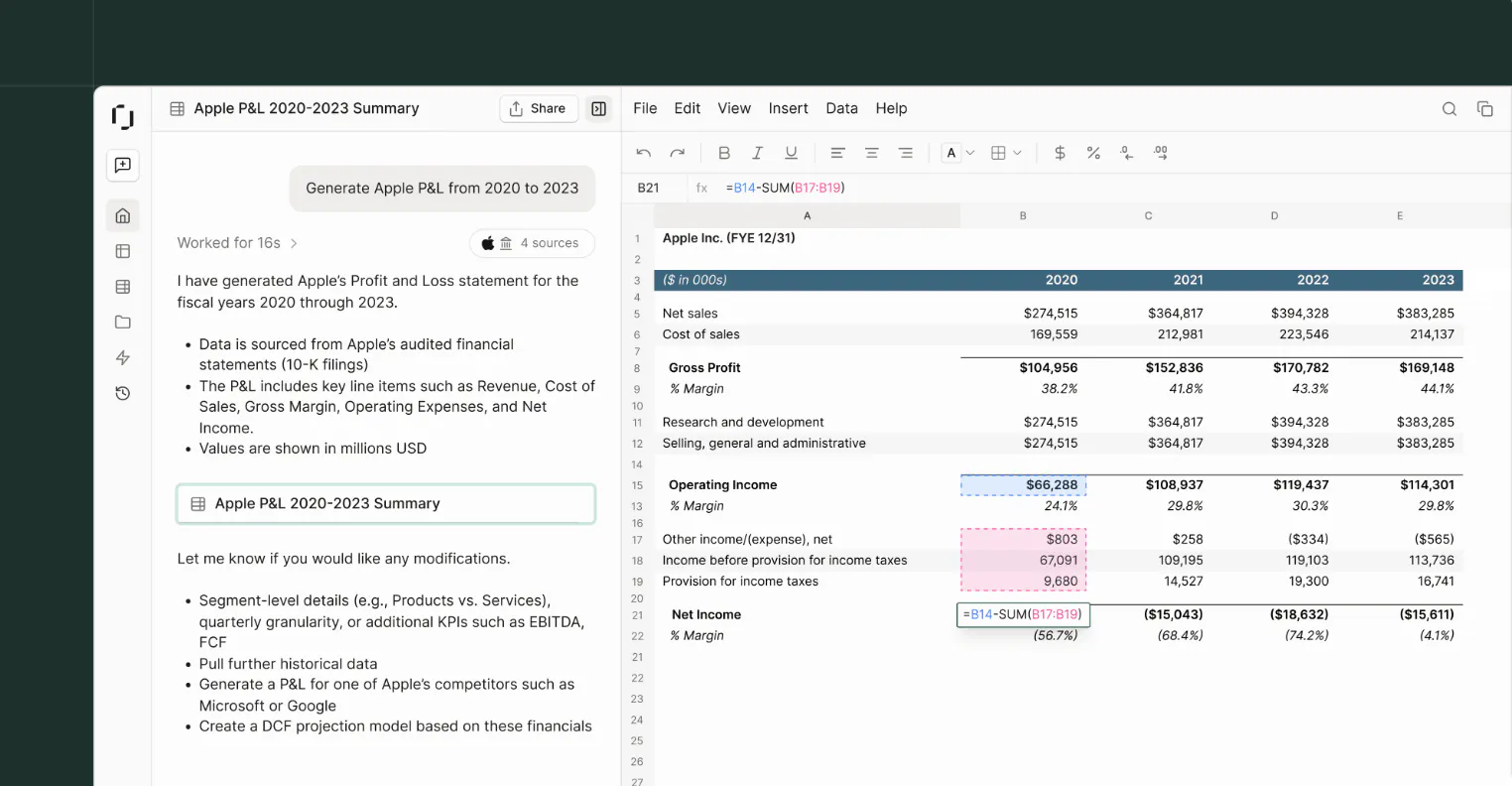
Rogo’s central product capability is its suite of financial agents, built on top of frontier models from OpenAI and Anthropic. Rogo develops its agents through post-training and reinforcement learning to reason like an investor, embedding the financial reasoning patterns that distinguish expert analysis from surface-level summarization. These agents are designed to handle complete workflows out of the box: PowerPoint creation, Excel modeling, research compilation, private-company screening, benchmark analysis, and public-information-book (PIB) drafts.
Rather than building every capability in-house, Rogo has an ecosystem-integration model that accelerates development through acquisitions and partnerships. In September 2025, Rogo acquired Subset, an AI-native spreadsheet startup, extending its workflow automation into the spreadsheet environment bankers use as a primary interface. In June 2026, Rogo became a launch partner for Microsoft Copilot in Excel, embedding its workflows directly in the tool. And in July 2026, it introduced Rogo Intelligence, a product that builds a firm’s institutional memory into a queryable asset.
Data Integration
Source: Rogo
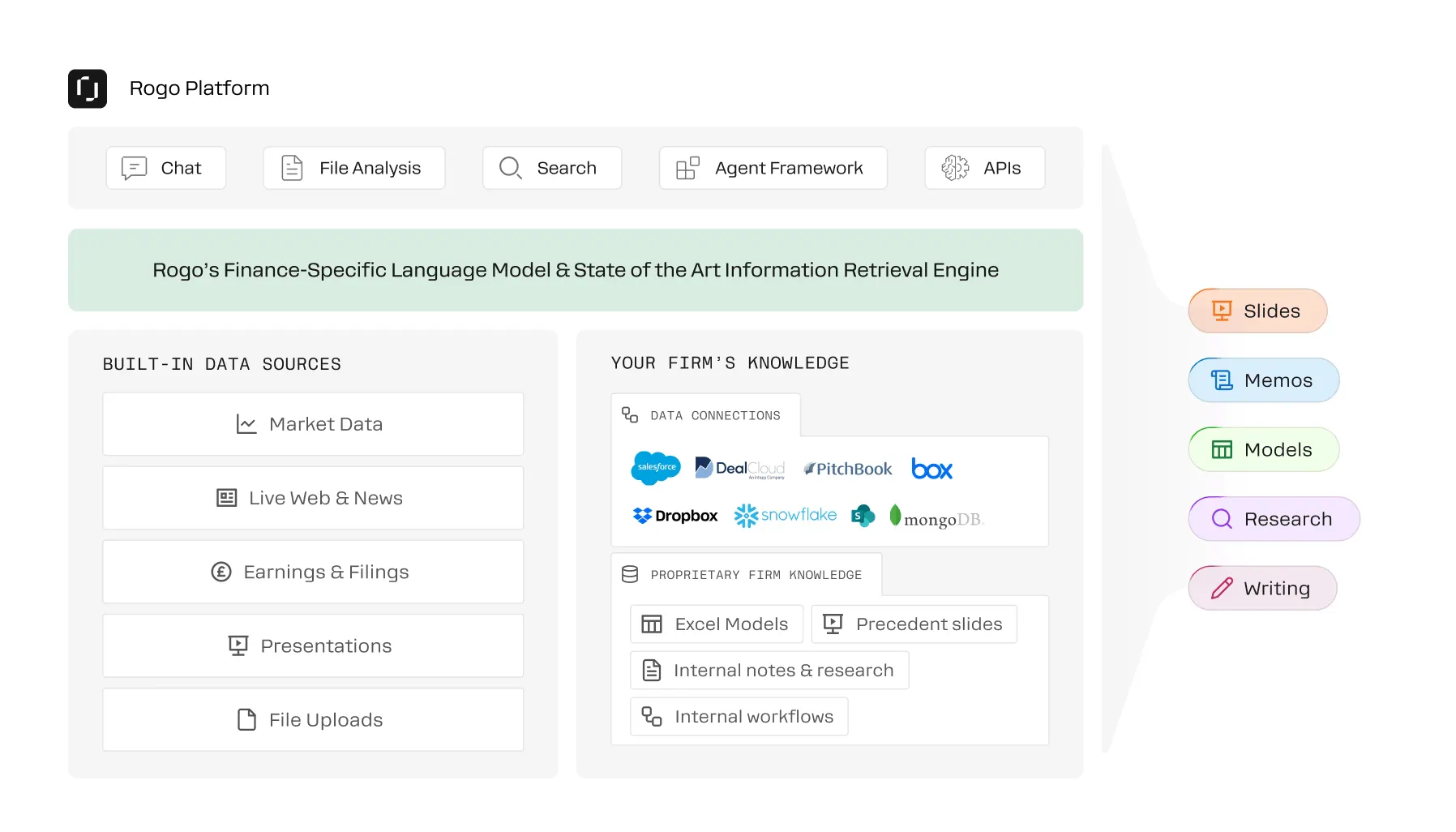
A key differentiator for Rogo is how it handles data across two dimensions: a firm’s internal repositories and the premium third-party data that financial institutions license at substantial cost.
On the internal side, Rogo connects to an institution through secure plugins, gaining access to CRMs, SharePoint environments, and prior transaction databases. The data, both structured and unstructured, includes deal memos, research notes, and historical filings, allowing Rogo to surface institutional context that general AI models cannot reach. Externally, Rogo integrates with the major premium data providers that financial institutions already pay for, including Capital IQ, Preqin, PitchBook, Crunchbase, the London Stock Exchange Group, and Dow Jones Newswires. This lets firms operate within their existing data infrastructure without migrating to new systems.
Security
Security is a core product feature for Rogo rather than a compliance add-on. Rogo offers both multi-cloud and on-premises deployment options, a critical capability for the large financial institutions it targets. Many of these organizations operate in restricted InfoSec environments that prohibit data from transiting third-party cloud infrastructure. As an added measure of internal expertise, Rogo maintains a Security Advisory Board that includes CISO and CTO leaders from financial organizations such as Goldman Sachs, Lazard, and Morgan Stanley.
Market
Customer
Rogo’s ideal customer is a high-stakes financial institution, primarily an investment bank, that requires specialized intelligence to handle complex financial data and workflows. These organizations typically operate in restricted environments, manage data silos that blend expensive third-party licenses with proprietary internal content, and run deal-centric workflows where the stakes of an error are significant. For these customers, the value of faster, higher-quality analysis scales directly with the size of the deals they execute, so even incremental gains in analyst throughput can justify significant spend.
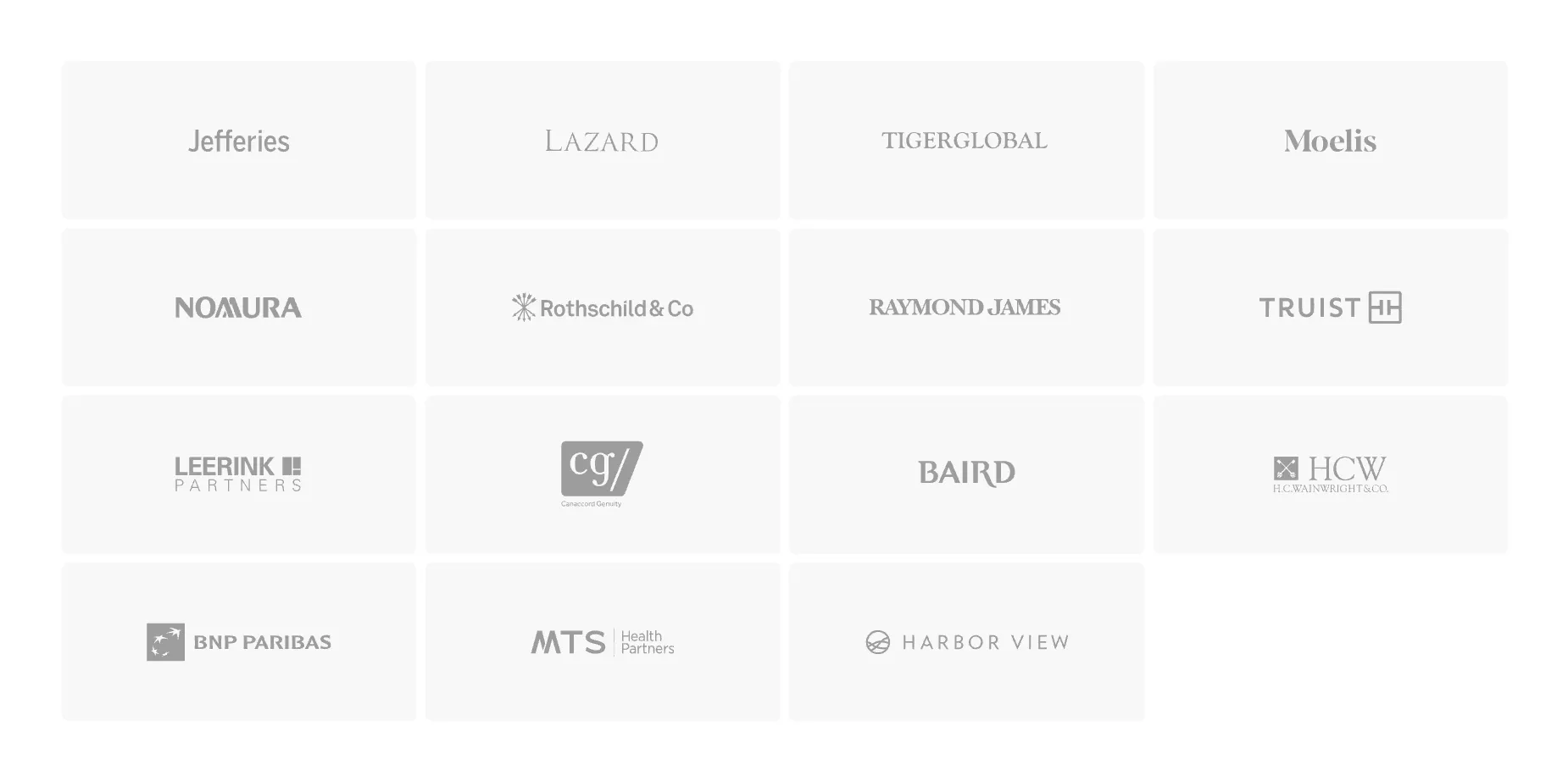
While Rogo primarily targets investment banks, it also works with private equity firms and hedge funds, which run similar deal-making workflows. Among its publicly named customers as of July 2026 are Jefferies, Lazard, Moelis, Rothschild & Co, Nomura, Tiger Global, Truist, and Baird.
Source: Rogo
Market Size
The global market for generative AI in financial services was valued at $1.9 billion in 2025 and is projected to reach $7.2 billion by 2030, growing at an estimated CAGR of 30.7%. That market sits within the far larger flow of M&A activity Rogo targets by automating workflow-heavy roles: global M&A deal value reached $4.8 trillion in 2025.
It benefits from substantial potential tailwinds. Generative AI could add $200 billion to $340 billion in annual value to the banking sector through efficiency improvements, and investment-banking wallets are expected to expand by more than 30% by 2030 as AI-enabled productivity increases transaction capacity.
The institution-level savings that result could be quite substantial. A bank like JPMorgan, an investor in Rogo, might spend $370 million annually on junior-analyst compensation, and one analysis estimates that automating 60% of that output would imply savings above $200 million per year. Adoption momentum is building: roughly 20% of financial-services firms were deeply integrating generative AI as of 2024, with 60% of banks planning to use it for up to 20% of daily tasks, and 84% of financial-services leaders anticipating increased investment in generative AI.
Competition
Competitive Landscape
Rogo faces pressure from frontier-model developers moving aggressively into financial services, as well as other AI-native finance tools competing for the same enterprise buyers. As of early 2026, the threat from frontier models grew especially acute, as finance-specific plugins from the model labs began to overlap directly with Rogo’s product. Beyond these, incumbent data platforms are another source of potential competition. Kensho, S&P Global’s AI unit, and Bloomberg’s terminal AI both hold proprietary-data and distribution advantages that make them build-versus-buy alternatives for the same analyst workflows.
AI-Native Financial Tools
Hebbia: Founded in 2020, Hebbia is one of Rogo’s most direct competitors, with its core product Matrix letting finance professionals ask complex queries answered by reasoning across company datasets and financial filings. Hebbia has a narrower product focus than Rogo, centered on research and analysis rather than agentic workflows. It has raised over $160 million in total as of 2026; its 2024 Series B, led by Andreessen Horowitz, set a $700 million valuation.
Model ML: Founded in 2024, Model ML builds AI workflow automation for finance pitched explicitly at replacing junior-banker grunt work, a near-direct analog to Rogo. It raised a $75 million Series A led by FT Partners, among the largest fintech Series A rounds on record as of 2026.
Brightwave: An AI financial-research platform that synthesizes filings, transcripts, and deal documents for analysts. It has raised about $21 million as of 2026, including a $15 million Series A.
Finster AI: Founded in 2023 by a former Google DeepMind researcher, Finster builds an AI-native research platform for investment banks and asset managers and has raised about $58 million as of 2026.
AlphaSense: Founded in 2008, AlphaSense is an AI-powered market-intelligence platform that has raised more than $1.4 billion and reached a $7.5 billion valuation in a June 2026 round. While not a direct competitor on workflow automation, it poses a different threat through its data moat: a proprietary content library of expert-call transcripts, broker research, and filings that competing platforms cannot replicate.
Frontier Labs
Anthropic: Founded in January 2021, Anthropic raised $30 billion in February 2026 at a $380 billion post-money valuation. In July 2025, it launched Claude for Financial Services, and in October 2025 introduced Agent Skills with finance-specific functions including comparable-company analysis, discounted-cash-flow models, due-diligence data packs, and initiating-coverage reports. Anthropic also released Claude for Excel, an add-in that lets users work with Claude inside the spreadsheet, and announced integrations with many of the same data providers as Rogo, including Capital IQ and Morningstar. As of October 2025, banks such as Citi had begun using Claude to build in-house platforms, a threat to bypass application-layer companies like Rogo and integrate directly with frontier models.
OpenAI: Founded in December 2015, OpenAI closed a March 2026 round at an $852 billion valuation, having raised more than $122 billion as of that round. As of October 2025, OpenAI was developing an internal project called Mercury, designed to train models on investment-banking workflows, and had hired more than 100 former investment bankers to develop the training data, signaling a direct and well-resourced push into the space Rogo occupies.
Business Model
Rogo monetizes its platform with a per-seat SaaS subscription. The company does not publicly disclose pricing, but one unverified estimate puts it at $3.3K per seat annually, above typical SaaS pricing and in line with specialized financial software. Because its customers are institutional buyers deploying the tool across analyst teams, even modest per-seat pricing at enterprise scale creates a meaningful revenue base, and Rogo’s motion is land-and-expand: as of mid-2026 it serves over 300 institutions, and its widening set of data partnerships (LSEG, PitchBook, Dow Jones, and Microsoft’s Copilot-in-Excel among them) deepens workflow integration and raises switching costs. Newer product surfaces such as Rogo Intelligence point toward monetization beyond the per-seat model.
Traction
Although Rogo was formally founded in late 2021, it had very little traction for its first two years, as risk-averse institutions were skeptical of AI in the pre-ChatGPT era. The company signed its first real customers in late 2023. Once Rogo shifted from structured data alone to both structured and unstructured, revenue grew from $2 million in 2024 to more than $15 million in 2025, a more than 7x increase in a single year, and the company reported over 50% quarter-over-quarter growth in ARR entering mid-2026. As of July 2026, more than 35K bankers and investors across more than 300 institutions use the platform, sending over 50K queries daily.
Valuation
Rogo raised a $160 million Series D in April 2026 at a $2 billion valuation, led by Kleiner Perkins with participation from Sequoia, Thrive Capital, Khosla Ventures, and J.P. Morgan Growth Equity. That marked a 2.7x step-up from the $750 million valuation Rogo reached only three months earlier, in its January 2026 Series C, which raised $75 million led by Sequoia Capital and brought in Henry Kravis as a new investor.
The Series C itself more than doubled the $350 million valuation of the Series B nine months prior, which raised $50 million led by Thrive Capital in April 2025 and included JPMorgan and Tiger Global as investors. Rogo previously raised $18.5 million in a Series A led by Khosla Ventures in October 2024, and an initial $7 million seed round led by AlleyCorp in February 2024. In total, Rogo has raised $314 million as of July 2026.
Key Opportunities
Expansion Across Financial Roles
Rogo has historically concentrated on investment-banking workflows, particularly M&A advisory. But the capabilities underlying the platform, from financial reasoning to document synthesis to model automation, apply broadly across capital markets, sales and trading, equity research, and corporate finance. Henry Kravis, a co-founder of KKR, and Tiger Global both participated in Rogo’s Series C, signaling momentum in private capital. The opportunity meaningfully expands Rogo’s addressable market; global private markets are projected to reach $432 billion in revenue by 2030, against investment banking’s $110 billion in 2025.
Expanding into adjacent roles within institutions Rogo already serves is a natural growth path: it requires limited new go-to-market infrastructure while substantially increasing revenue per customer. In 2026, Rogo’s narrative shifted from automating junior work to becoming a partner to senior bankers helping them execute deals and make better decisions. As the platform builds a track record across deal types and practice groups, the case for enterprise-wide deployment becomes easier to make.
Capturing Work as Banks Cut Junior Headcount
As banks reduce the number of junior analysts per deal, the modeling, research, and document work those analysts handled still has to get done. Rogo is one of the few platforms built to take on that work directly, so a cost-cutting trend at its customers becomes demand for its product. Stengel has predicted that AI could double the output of an entry-level analyst over the next five years; if banks staff to that reality, more of the analytical workload flows to tools like Rogo than to new hires. Framing its customer relationships as strategic partnerships rather than vendor arrangements makes that shift harder to reverse.
European Expansion
Following its Series C, Rogo announced its first international office in London, with co-founder John Willett leading the expansion and engaging directly with European financial institutions. European banks account for 36% of the combined US-and-European bank market capitalization, and Rogo’s strategic partnership with the London Stock Exchange Group provides both distribution reach and institutional credibility in the region. If Rogo can replicate its US penetration approach in European financial centers, the LSEG endorsement could help shorten a difficult enterprise sales cycle.
Key Risks
Eroding Defensibility Against Frontier Models
The most existential risk facing Rogo is the rapid vertical expansion of frontier AI labs into financial services. Both Anthropic and OpenAI have released finance-specific tools within the past year, complete with domain-specific agents, data integrations, and Excel add-ins that overlap directly with Rogo’s core product. These companies have vast capital, large research teams, and the underlying model capabilities Rogo depends on for its own training. If frontier models become sufficiently capable out of the box, institutions could bypass specialized tools like Rogo and integrate those models directly. Several institutions, such as AIG and Citi, have opted for this direct deployment.
The exposure cuts deeper than competition: Rogo’s agents run on OpenAI’s and Anthropic’s models, so its capabilities, costs, and roadmap are partly governed by the same companies racing it into finance. Its multi-model architecture, which lets it route across providers, is a partial hedge, but it does not remove the dependency.
Absence of a Proprietary Data Moat
Unlike AlphaSense, which has built a defensible content library from expert transcripts, broker research, and proprietary filings, Rogo aggregates data from third-party providers that are broadly available to well-capitalized competitors. As agentic AI matures, proprietary data ownership may emerge as the primary basis for durable defensibility, and Rogo’s positioning leaves it exposed on this dimension. The acquisition of specialized tools such as Subset and partnerships with data providers help at the margins but do not fundamentally change the picture. Whether Rogo’s specialized financial reasoning and end-to-end workflow depth can substitute for data ownership as a defensibility mechanism remains a central open question.
Exposure to the Deal-Making Cycle
Rogo’s revenue is tied to the health of the M&A and capital-markets cycle it serves. Deal volume is highly cyclical, and much of the 2025 surge that underpins the thesis was itself driven by an AI-fueled boom. A downturn in deal activity would compress the transaction fees and analyst headcount budgets that fund Rogo’s seat expansion, and because Rogo prices per seat, a wave of banking layoffs cuts both ways: it validates the automation thesis while shrinking the near-term pool of paying users. This macro exposure is largely outside the company’s control.
Summary
Rogo was founded to automate the research and analytical workflows that traditionally bog down junior bankers and analysts. Using both proprietary firm data and third-party data providers, the company employs finance-specific agents that perform high-stakes but repetitive tasks such as Excel modeling and report generation. Since its 2024 launch, Rogo has grown revenue from $2 million to more than $15 million, raised a Series D at a $2 billion valuation, and built a customer base that includes Lazard, Jefferies, Moelis, and Tiger Global.
The central question is defensibility. Rogo’s moat rests on workflow quality and institutional relationships, not proprietary data, and both Anthropic and OpenAI have released finance-specific agents and Excel integrations in the past year that overlap directly with its core product. Whether Rogo’s depth of financial reasoning and end-to-end workflow automation can hold up as frontier models mature is the question that looms largest.