Perspective

The Two Fronts of US-China Competition

By Kyle Harrison

Updated

October 5, 2024

Reading Time

4 min

Increasingly, the global geopolitical landscape is being framed as superpower against superpower. The US against China. What many have referred to as great power conflicts. Even US support of Ukraine against Russia is often presented as sending an important message to China about its possible invasion of Taiwan.

Unfortunately, when it comes to military preparedness, the US isn’t particularly well positioned. In a 2024 wargame simulation of the US’s attempt to protect Taiwan, “the US military was soundly defeated by China… [showing] enormous losses of American troops, ships, and aircraft.”

But as much as a great power conflict is played out in terms of military strategy and capabilities, it also takes place in the form of economic competition. And when it comes to China’s economic strength, the picture is much more fuzzy.

Cracks have been showing for several years between China’s authoritarian dominance and the health of its economy. In 2020, Alibaba founder Jack Ma criticized state-owned Chinese banks, saying they were impeding the financial technology sector with their “pawnshop mentality.” This came weeks before an Alibaba subsidiary, Ant Financial, was planning to go public in a massive $34 billion IPO. Instead? The listing was suspended and Jack Ma disappeared for several months.

Not long after, Chinese regulators launched a data-security probe into Chinese ride-hailing company, Didi Global, nearly blocking its US IPO. The company was still later forced to delist from the New York Stock Exchange. Meanwhile, Ant Financial was restructured and is now regulated in China as a financial institution.

That interventionist period at the end of 2020 and the beginning of 2021, a period which marked a stark shift in China’s tech industry. Around that time, both the amount of funding going to Chinese companies and the number of companies being started plummeted.
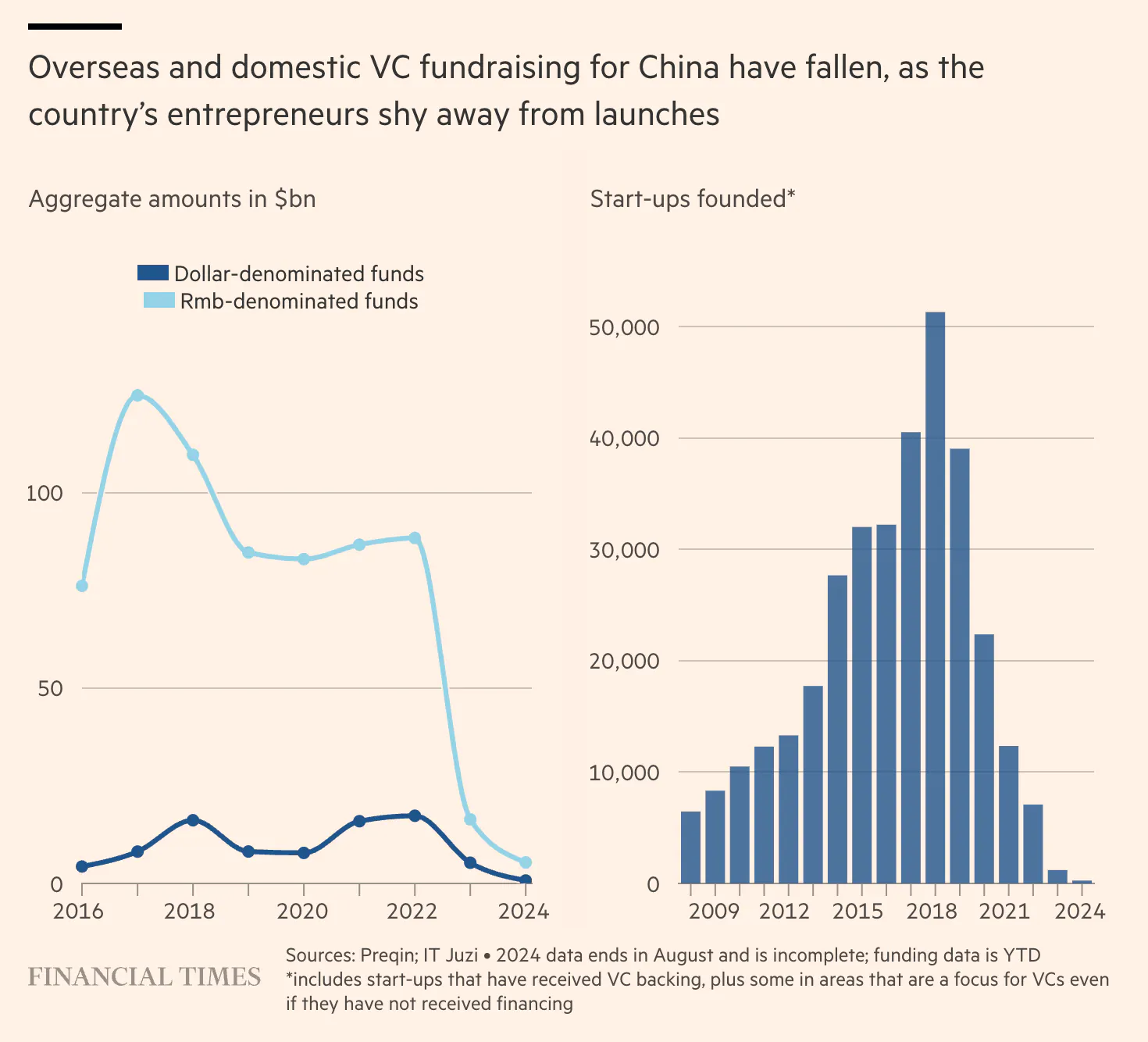
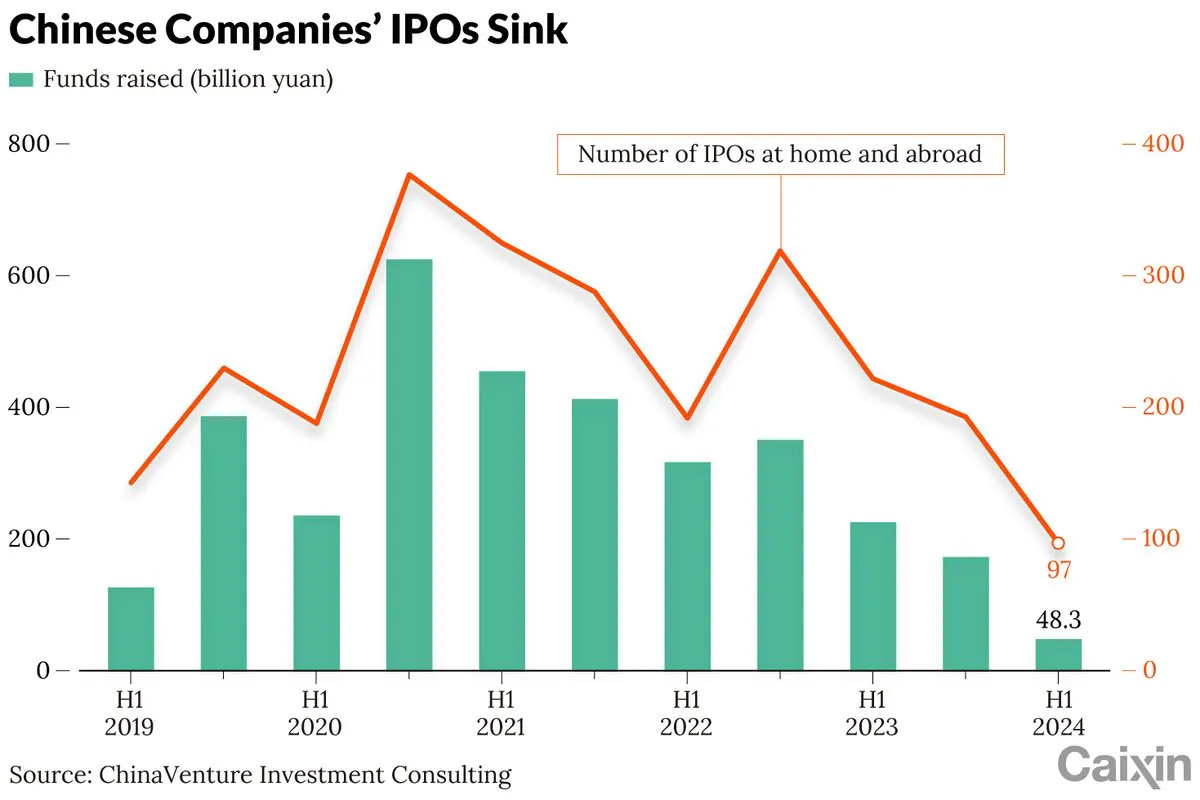
The volume of venture funding into Chinese companies saw an 82% decline from a peak in 2021 through September 2024. The number of deals has halved in the same time period. While foreign investors put in ~$14 billion per year from 2018 to 2022, the amount through 2023 and 2024 has been, effectively, zero. Chinese stocks have lost $6.5 trillion in value since their 2021 peaks. And Chinese IPOs have seen a massive decline in both the number of IPOs and the funding raised.
Now, China seems to be rushing to correct the economic damage that, at least in part, they caused. In late September, China announced it would pour out hundreds of billions of dollars of economic stimulus. To support the Chinese startup ecosystem, the government has pushed Chinese banks to start lending to startups, using intellectual property as collateral. These types of loans grew 40% annually to a massive $117 billion in 2023.

Unfortunately, the strategy doesn’t appear to be working. Banks aren’t the best at picking technology winners and, in August 2024, a report indicated that government investment funds had $1.3 billion already at risk of losses “because of bad investments.”

Despite China’s economic woes, many aspects of its technological prowess are undeniable. Chinese companies represent 80% of the commercial drone market. China also has 250x more shipbuilding capacity than the US, with 60% of the world's shipbuilding taking place in China. In 2023, the Secretary of the Navy stated that a single Chinese shipyard had more capacity to build ships than the entire US Navy.

In an increasingly antagonistic global competition between China and the US, there are a number of moving dynamics. Will conflict with China come before their economy comes crumbling down? Will the US be able to build back a manufacturing base in time to pose a competitive threat to China in a meaningful military conflict? One thing is for sure; what was already a difficult situation to predict is only getting less and less clear.

Important Disclosures

This material has been distributed solely for informational and educational purposes only and is not a solicitation or an offer to buy any security or to participate in any trading strategy. All material presented is compiled from sources believed to be reliable, but accuracy, adequacy, or completeness cannot be guaranteed, and Contrary LLC (Contrary LLC, together with its affiliates, “Contrary”) makes no representation as to its accuracy, adequacy, or completeness.

The information herein is based on Contrary beliefs, as well as certain assumptions regarding future events based on information available to Contrary on a formal and informal basis as of the date of this publication. The material may include projections or other forward-looking statements regarding future events, targets or expectations. Past performance of a company is no guarantee of future results. There is no guarantee that any opinions, forecasts, projections, risk assumptions, or commentary discussed herein will be realized. Actual experience may not reflect all of these opinions, forecasts, projections, risk assumptions, or commentary.

Contrary shall have no responsibility for: (i) determining that any opinions, forecasts, projections, risk assumptions, or commentary discussed herein is suitable for any particular reader; (ii) monitoring whether any opinions, forecasts, projections, risk assumptions, or commentary discussed herein continues to be suitable for any reader; or (iii) tailoring any opinions, forecasts, projections, risk assumptions, or commentary discussed herein to any particular reader’s objectives, guidelines, or restrictions. Receipt of this material does not, by itself, imply that Contrary has an advisory agreement, oral or otherwise, with any reader.

Contrary is registered with the Securities and Exchange Commission as an investment adviser under the Investment Advisers Act of 1940. The registration of Contrary in no way implies a certain level of skill or expertise or that the SEC has endorsed Contrary. Investment decisions for Contrary clients are made by Contrary. Please note that, although Contrary manages assets on behalf of Contrary clients, Contrary clients may take any position (whether positive or negative) with respect to the company described in this material. The information provided in this material does not represent any investment strategy that Contrary manages on behalf of, or recommends to, its clients.

Different types of investments involve varying degrees of risk, and there can be no assurance that the future performance of any specific investment, investment strategy, company or product made reference to directly or indirectly in this material, will be profitable, equal any corresponding indicated performance level(s), or be suitable for your portfolio. Due to rapidly changing market conditions and the complexity of investment decisions, supplemental information and other sources may be required to make informed investment decisions based on your individual investment objectives and suitability specifications. All expressions of opinions are subject to change without notice. Investors should seek financial advice regarding the appropriateness of investing in any security of the company discussed in this presentation.

Please see www.contrary.com/legal for additional important information.

Authors

Kyle Harrison

General Partner @ Contrary

Kyle leads Contrary’s investing efforts for companies from seed to scale. He’s previously worked at firms like Index and Coatue investing in companies like Databricks, Snowflake, Snyk, Plaid, Toast, and Persona.

See articles

© 2026 Contrary Research · All rights reserved

Privacy Policy

By navigating this website you agree to our privacy policy.