
Thesis
An estimated 67 million people worldwide identified as creators in 2025, a figure projected to reach 107 million by 2030. The rise of the creator economy, and the number of creators participating in it, has been accompanied by a rise in brand advertising through creator marketing. US brands spent $29.5 billion on creator advertising in 2024, and that spend was projected to reach $44 billion in 2026, after growing nearly 4x faster than the media industry overall in 2025.
This expenditure is concentrated disproportionately towards top creators. The top 10% of creators earned 62% of creator payments tracked by CreatorIQ in 2025, up from 53% in 2023, while the median creator earned $3K per campaign. In 2023, fewer than 4% of creators earned over $100K a year, and brand deals accounted for 70% of creator revenue. For creators outside that top tier, the alternative is selling directly to their own followers, and after Meta phased out native checkout from Instagram and Facebook Shops in 2025, a sale that starts on Instagram must be completed through an outside link such as the one in a creator's bio.
Stan sells a link-in-bio storefront that allows creators to sell digital products, courses, coaching sessions, and memberships directly to their audiences, for $29 or $99 a month and no transaction fee on creator sales. Its customers are what CEO John Hu and investor Gary Vaynerchuk call the "middle-class creator." In 2025, Stan launched a second product, Stanley, an AI tool that helps creators produce the content that builds their audiences. Stan is built for creators outside brand budgets who earn from their own audiences instead, putting the storefront, course hosting, coaching bookings, and email marketing behind one Stan Store subscription.
Founding Story
Stan was founded in 2020 by John Hu (CEO) and Vitalii Dodonov (CTO), and launched in May 2021.

Source: LinkedIn
Hu was raised by a single immigrant mother in North Carolina. He graduated from the University of North Carolina at Chapel Hill in 2016 with a double major in finance and computer science. At 19, he cold-called his way into a Goldman Sachs investment banking offer, and he later worked there as an analyst from August 2016 to December 2017 before joining Norwest Venture Partners as a senior associate.
Stan grew out of Hu's own attempt to make money from an audience. In 2020, Hu enrolled at Stanford Graduate School of Business, and during the COVID-19 pandemic, he started posting career and resume advice on TikTok as @jayhoovy. Hu wanted to monetize his growing audience but found that doing so required subscribing to separate services for email lists, course building, scheduling, and analytics. Hu surveyed online business owners and content creators about the problem before the team built a first basic version of Stan. Hu did not leave Stanford until he had raised $5 million for Stan. Explaining the wait to HubSpot's Scaling Smarter magazine in its first issue, he said, "I didn't quit until I raised five million dollars for my startup."
Dodonov moved to Canada from Russia in 2014 and studied chemical engineering at the University of Alberta, teaching himself to code along the way, and worked at Deloitte before joining eBay. Dodonov found Stan through a customer. In 2021, a customer of both Hu's and Dodonov's early projects introduced the two, when Stan was three months old. Dodonov, then a senior engineer at eBay, turned down a six-figure offer from Amazon to join Stan as co-founder instead.
Product
Stan sells two products on separate subscriptions. Stan Store is a link-in-bio storefront where creators sell digital products, courses, coaching, and memberships, and Stanley is an AI content tool that helps creators grow the audiences they sell to. Stan describes the split as follows: "Stanley is how you grow. Stan Store is how you monetize."
Stan Store
Source: Stan
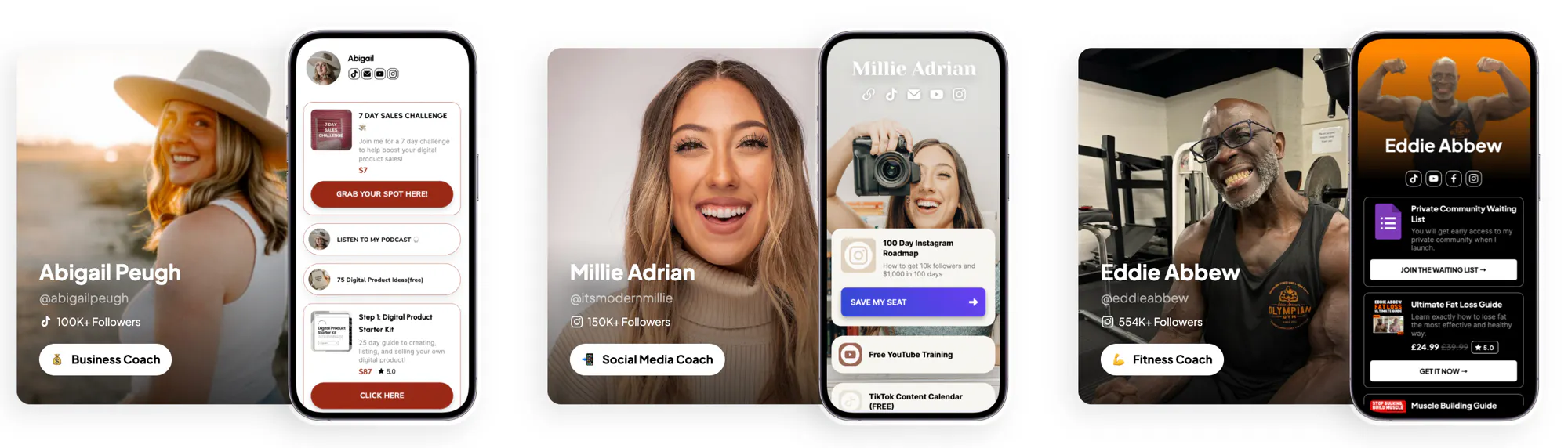
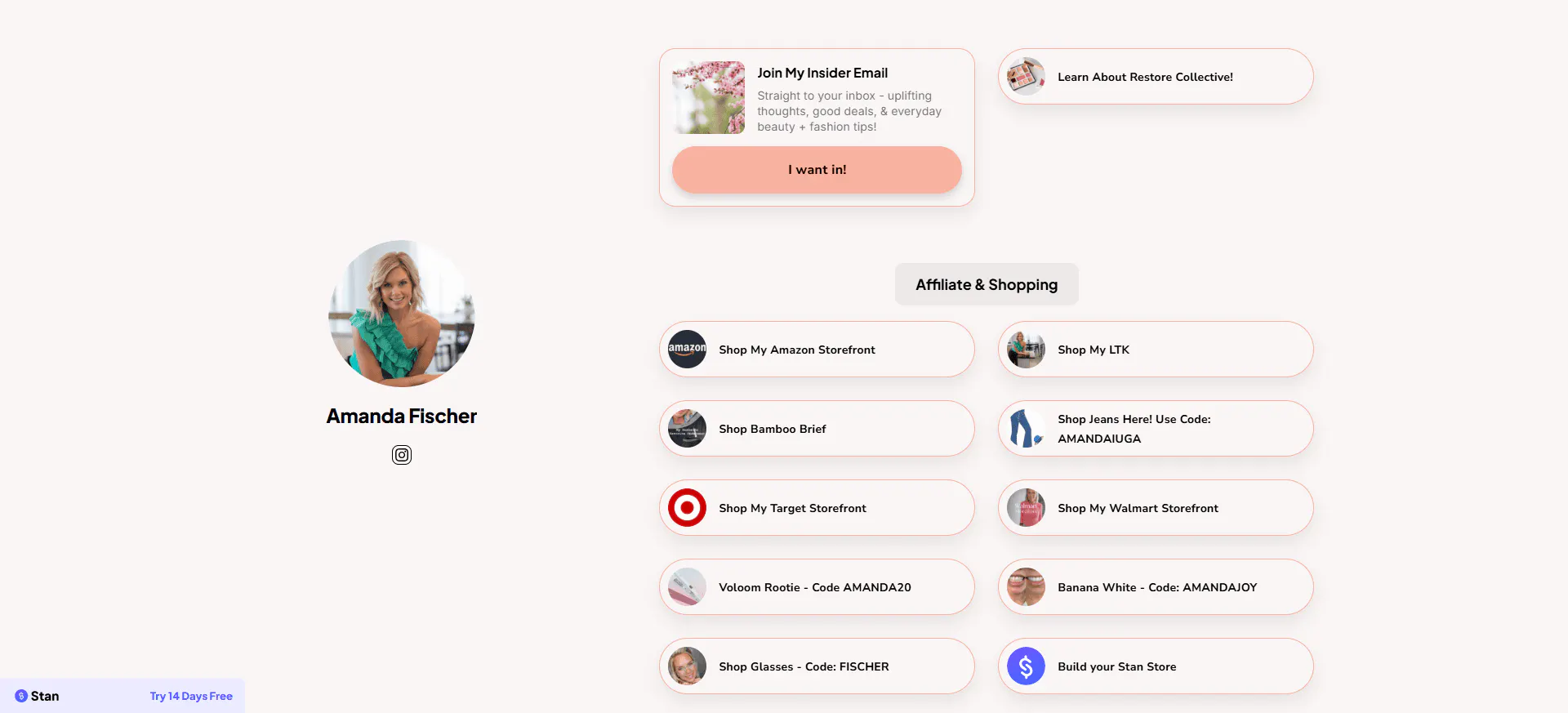
A creator's Stan Store lives at a single link the creator places in their Instagram, TikTok, YouTube, or LinkedIn bio. Creators choose from 11 templates, add products, and sell through a checkout that loads inside the store, so a follower who taps the bio link can buy without leaving the page. Stan offers two plans, Creator and Creator Pro, and a 14-day free trial, and creators can also run their store from Stan's iOS app.
Source: Stan
Digital downloads
Source: Stan
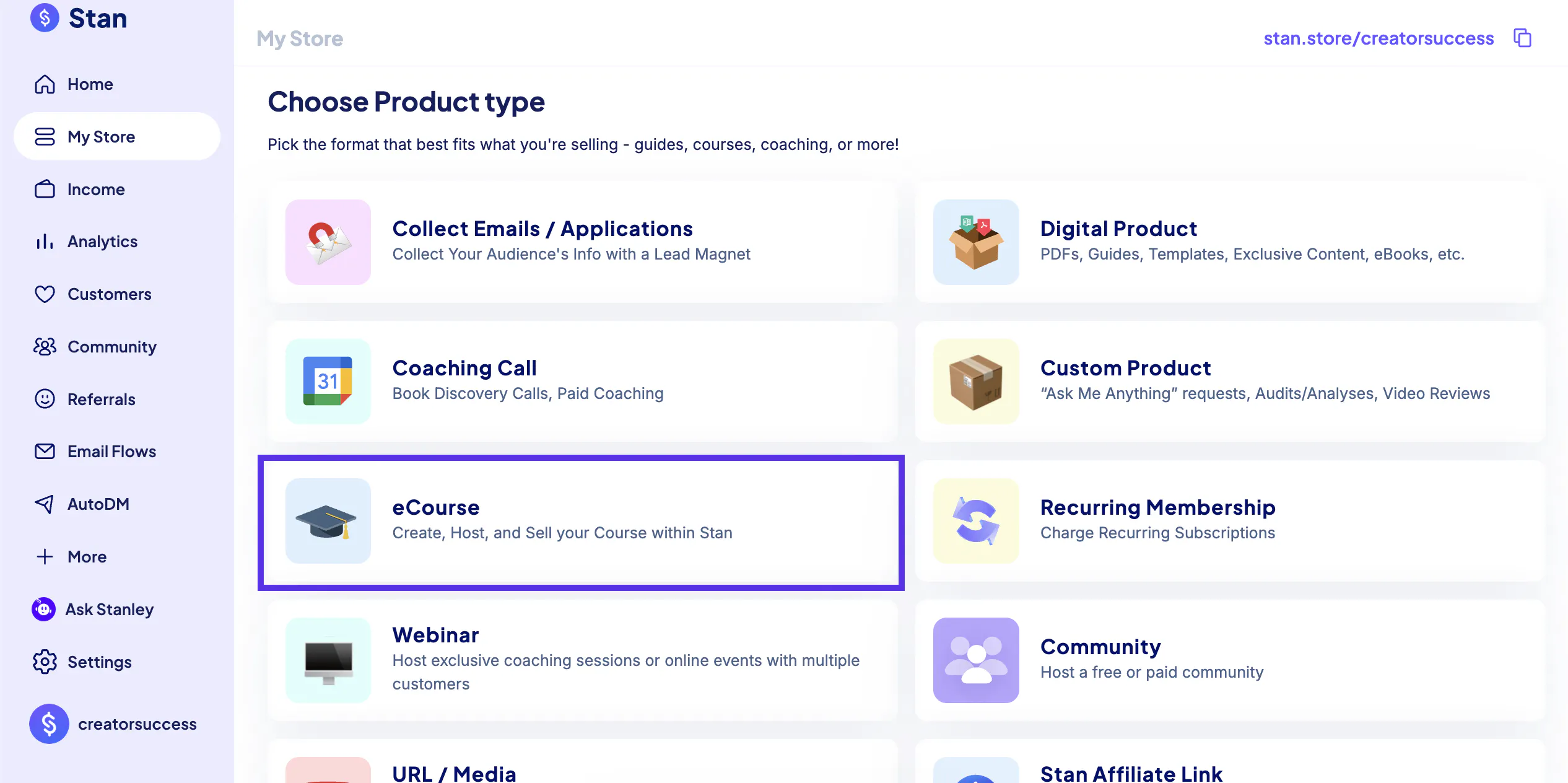
Creators upload and sell digital files such as ebooks, templates, guides, and presets, with no limit on the number of products on either plan and files of up to 5 GB. The buyer receives the file automatically after purchase.
Courses and Webinars
Source: Stan
Stan's course builder organizes a course into modules and lessons, each holding video, text, and downloadable resources, and can release lessons on a drip schedule. Webinars are sold and scheduled through Stan and delivered over Google Meet, Zoom, or another location the creator chooses.
Coaching Calls
Source: Stan
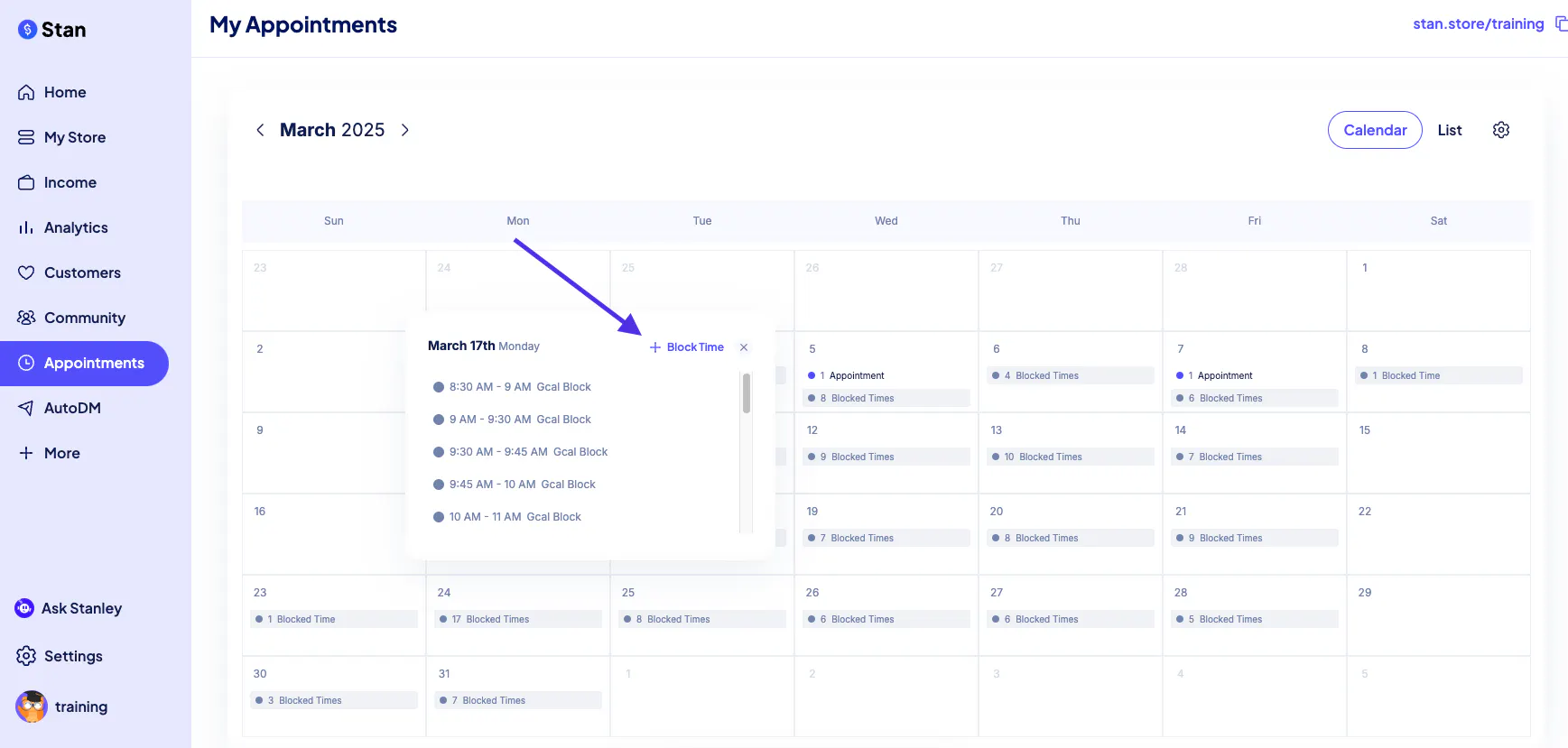
Creators sell one-on-one or group coaching sessions that followers book and pay for from the storefront. The booking tool connects to Google Calendar, blocks the time, and sends the meeting invite, which replaces a separate scheduling tool like Calendly.
Memberships and Community
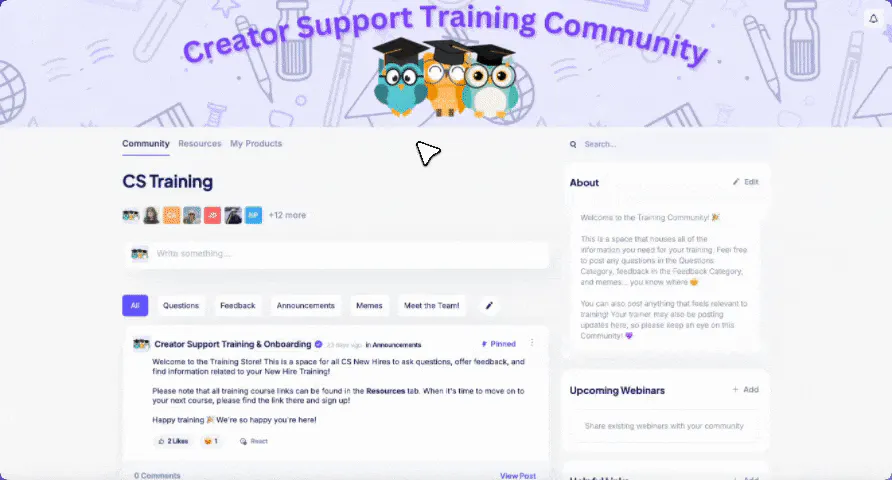
Memberships bill members daily, weekly, monthly, or annually for ongoing access to content the creator adds over time. Community, a discussion space for members, is included in all Stan plans.
Lead Magnets
Creators can also offer free products in exchange for a follower's email address, which builds the list they later market paid products to.
Stan AutoDM
Source: Stan
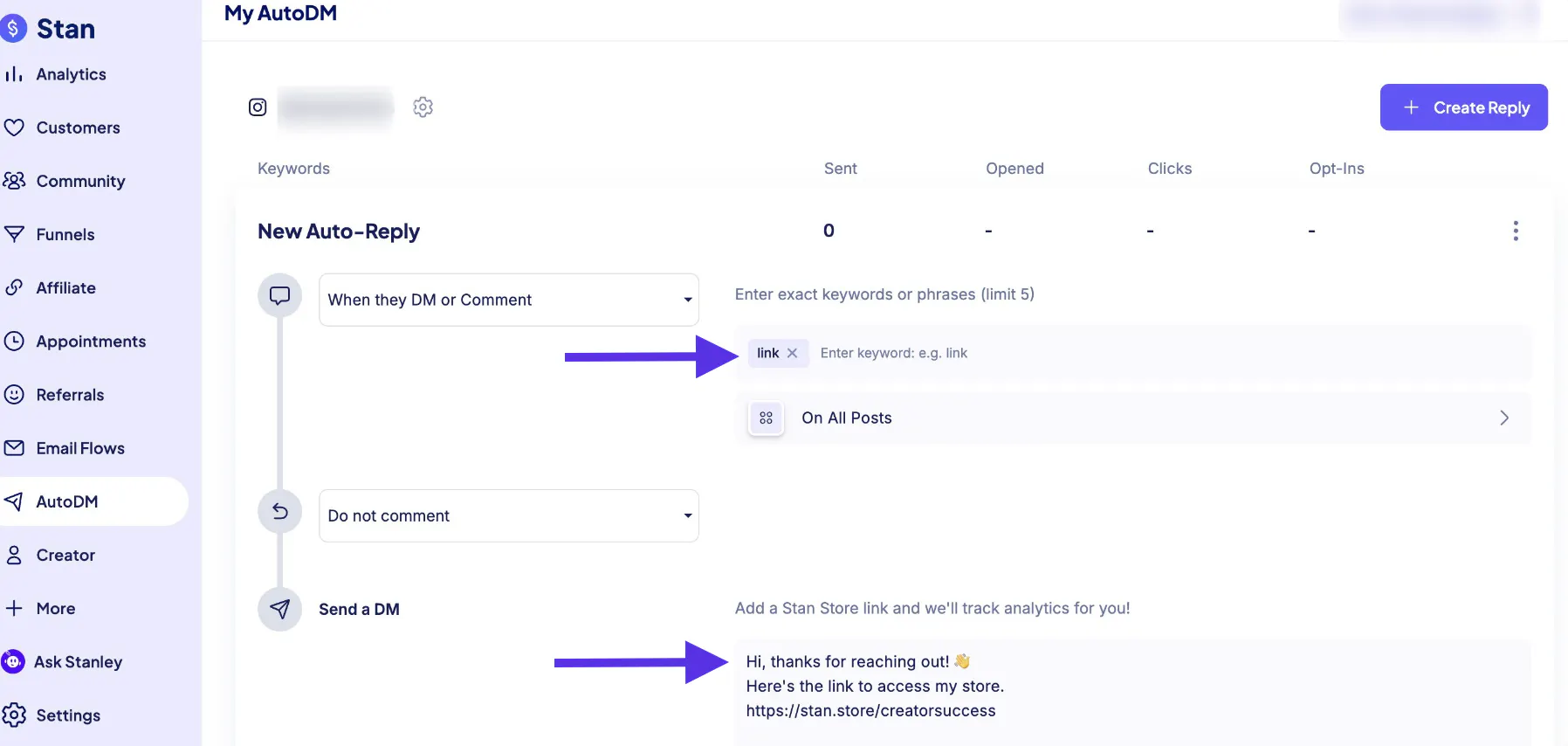
AutoDM automates Instagram direct messages. When a follower comments a chosen keyword on a post, replies to a story, or messages the creator, AutoDM sends a link to the relevant product in the creator's store and reports how many messages were sent, opened, and clicked. AutoDM is included in all Stan Store plans at no additional charge.
Email Marketing and Sales Tools
Source: Stan
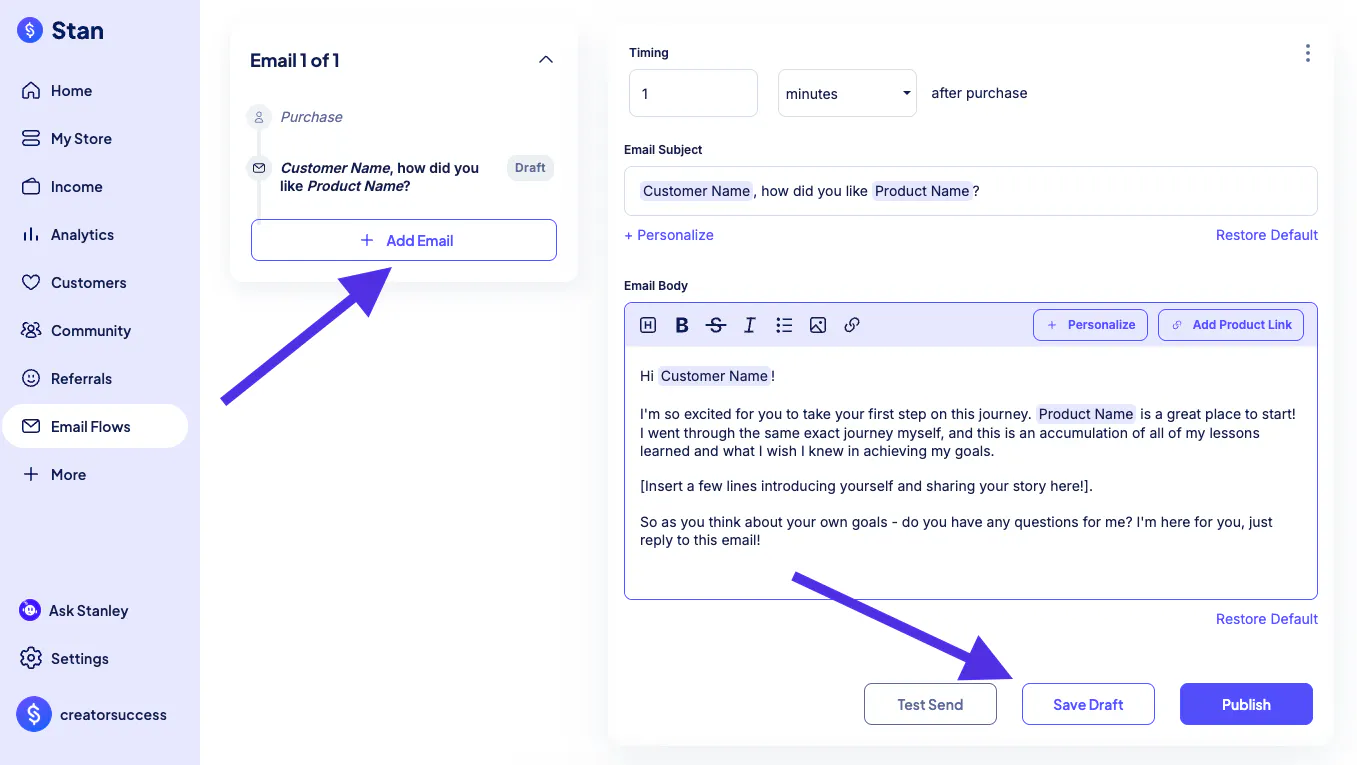
Creator Pro adds tools for emailing the list a creator has built and for raising revenue per buyer. Pro creators can send broadcast emails and automated sequences with no cap on contacts, add order bumps to their checkout, and build multi-product funnels. They can also offer installment plans through Afterpay and Klarna, recruit affiliates who earn a commission for reselling a creator's products, and track conversions with Meta, Google, Pinterest, and TikTok pixels. Creators on the Creator plan can collect email addresses but cannot send marketing campaigns to them.
Stanley
Source: Stanley
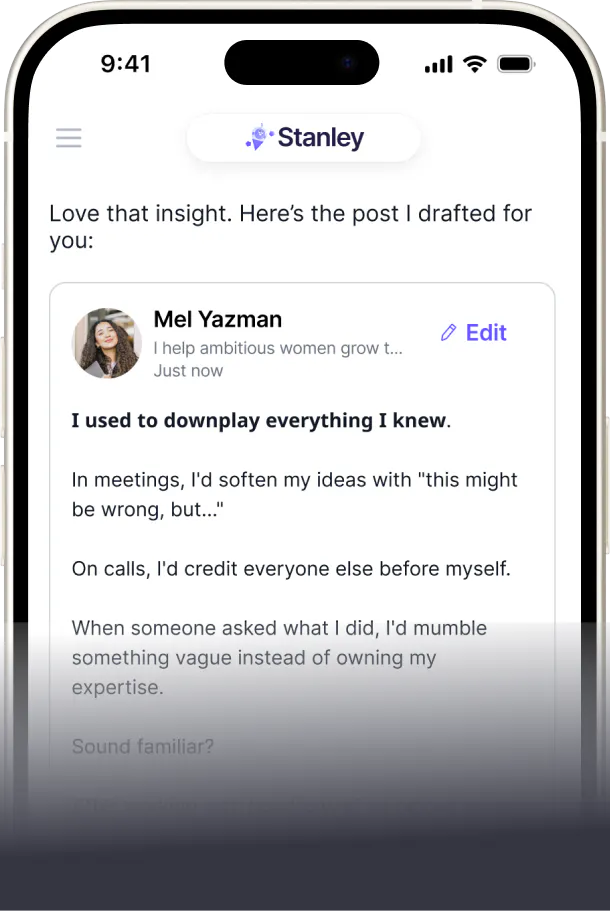
Stan says Stanley connects to a creator's accounts and learns their voice from past posts. It supports YouTube, LinkedIn, Instagram, X, Threads, and Substack, drafts and schedules posts, and checks back on how they performed, and creators work with it through iMessage, Telegram, or the web. Stan launched Stanley for LinkedIn in 2025 and formally announced it in March 2026, followed by Stanley for Instagram in April 2026 and Stanley for X later that month. Stan and Stanley are separate products with different pricing and support teams.
Market
Customer
Stan's customers are education-focused creators who monetize knowledge, skills, and expertise through products sold directly to their audiences. Stan was built for what Hu and Vaynerchuk call the "middle-class creator" rather than for megastar influencers, and Vaynerchuk described the group in September 2025 as creators who "make $1,000 to $10,000 a year from ads or random merch." These creators typically sell to followers they reach on Instagram or TikTok, and Stan's own guide to creator niches lists education, health and wellness, business and marketing, real estate, and personal development among the niches creators can build around.
Source: Stan
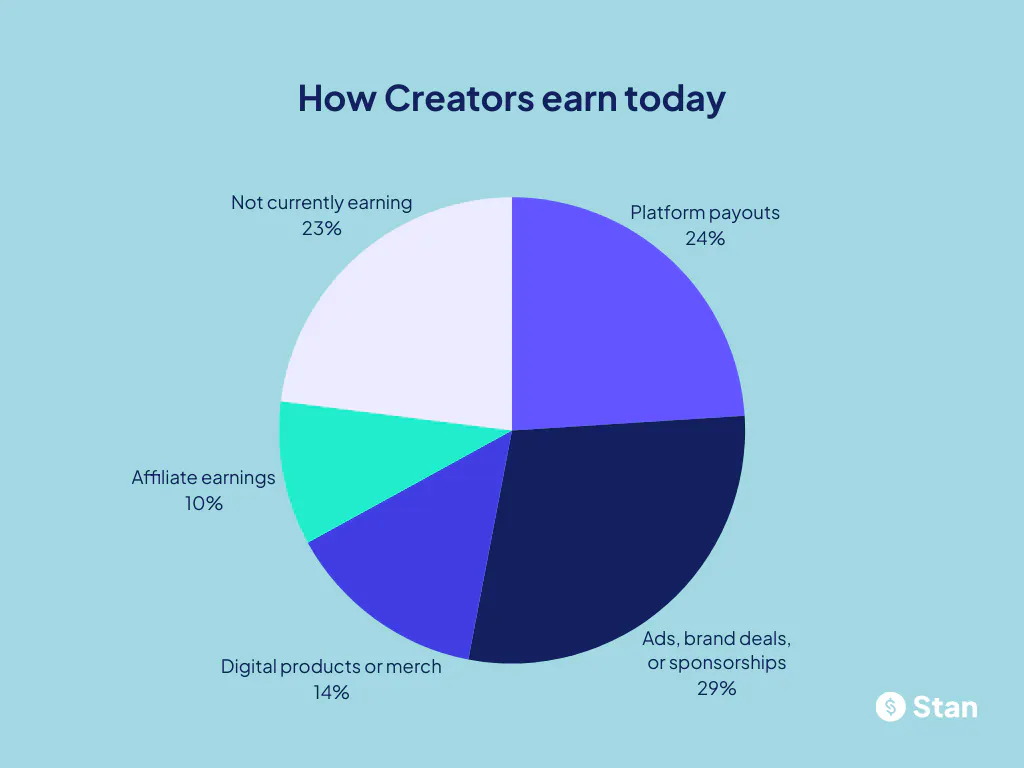
Stan's survey data itself shows how few creators sell directly. According to a 2026 survey by Stan, only 14% of creators earned from digital products or merch, compared with 29% of creators who earned from ads, brand deals, or sponsorships. More than 59K creators earned money on Stan in 2025, and Stan had 85K active creators as of August 2026. Digital downloads were the most common purchase in 2025, when creators on Stan sold 2.2 million digital downloads, 300K courses, and 236K memberships, and creators made $67 per sale on average that year.
Stan's most prominent creators built large businesses from small followings, largely on one-time digital products. For example, creator Jenny Reimold landed her first brand partnership with 4K Instagram followers and later launched a digital guide on building a creator business on her Stan Store. The guide earned $35K in its first 24 hours and over $60K in two weeks.
As another example, creator Abigail Peugh started selling a digital product about user-generated content on Stan with fewer than 10K TikTok followers. She earned $10.6K in her first month and $1 million in total revenue within 15 months of starting her brand, and in April 2026 Stan described her as one of the earliest creators on its platform to reach $1 million. As of April 2026, she had sold over 27K digital products and taught more than 13K students.
Market Size
Most estimates of the creator economy measure brand spending. US brands spent $29.5 billion on creator advertising in 2024, up from $13.9 billion in 2021, and that spend was projected to reach $44 billion in 2026.
Stan's market, however, is slightly different, as the company targets revenue creators directly, rather than brands. The platforms serving this segment indicate its overall size. Businesses selling through Whop, for example, were generating over $300 million a month as of May 2026, an annualized rate of over $3.6 billion. As of 2026, creators had earned over $10 billion through Patreon memberships since 2013.
Two trends are expanding this market. First, the number of people identifying as creators was projected to grow at a 10% CAGR from 2025 to 2030, widening the base of potential sellers. Second, after Meta phased out native checkout from Instagram and Facebook Shops in 2025, outside links, such as a creator's bio link, became the way to complete a sale that starts on Instagram.
Competition
Competitive Landscape
Creator monetization tools fall into four groups. Link-in-bio platforms have expanded into commerce, creator commerce platforms sell storefronts and memberships, course and community platforms host education businesses, and adjacent platforms overlap with parts of what Stan sells. Stan combines a link-in-bio page with commerce tools, at a price below most course platforms. Its Creator plan costs $29 a month with no cap on products, while Kajabi's entry plan costs $143 a month billed annually for five products. However, these groups are converging. For example, Linktree began selling digital products natively in April 2025, adding a storefront to the largest link-in-bio tool.
Competitors
Link-in-Bio Platforms
Linktree: Founded in 2016, Linktree is a link-in-bio tool with over 70 million users as of 2026. The company had raised $167.4 million in total funding as of September 2026. It was valued at $1.3 billion in March 2022, when it raised $110 million in an extension of its Series B led by Index Ventures and Coatue. Linktree expanded into commerce by acquiring Bento in June 2023 and Koji in December 2023, then added bookings and payments by acquiring Fingertip in November 2025. Linktree has sold digital products natively since April 2025, and as of February 2026, it kept 12% of each sale on its free plan, 9% of each sale on its Starter and Pro plans, and nothing on its Premium plan. Linktree's free plan carries its highest fee, while Stan has no free plan and takes no fee on sales.
Beacons: Founded in 2019 out of Y Combinator, Beacons is a link-in-bio platform with a storefront for digital products. It had over 7 million creators as of April 2025 and had raised $29.2 million in total funding as of September 2026, from investors including Andreessen Horowitz. Beacons offers a free plan that keeps 9% of each sale, and paid plans ranging from $10 to $90 a month. Of the link-in-bio platforms, Beacons overlaps most with Stan, offering a storefront, digital product delivery, and email marketing within a single link-in-bio page. Beacons also runs an affiliate marketplace connecting creators with brands, so it serves creators who earn from brand deals as well as those selling their own products.
Creator Commerce Platforms
Whop: Founded in 2021, Whop is a marketplace where creators and businesses sell digital products, communities, and courses, and where buyers can discover sellers on Whop itself. Businesses selling through Whop were generating over $300 million a month as of May 2026, and Whop's network had 22 million buyers. Whop reportedly raised $200 million from Tether in February 2026 at a $1.6 billion valuation, following a Series B led by Bain Capital Ventures in July 2024 at an $800 million valuation. It has raised a total of $273 million in funding as of September 2026. Whop pairs a storefront with marketplace discovery, which Stan does not offer, and one unverified estimate put its take rate at 5.5% of transaction value in early 2025.
Passes: Founded in 2022 by Lucy Guo, a co-founder of Scale AI, Passes is a creator monetization platform for creators building direct-to-fan subscription businesses. In April 2026, it rebranded as "the creator accelerator platform." The company has raised $49 million in total funding as of September 2026, including a $40 million Series A led by Bond in February 2024, and was reportedly valued at $150 million as of 2024. Passes lets creators keep 90% of their earnings, and the platform had around 1K creators as of May 2025. Unlike Stan's self-serve creators selling knowledge products, Passes targets high-follower creators building fan subscription businesses.
Gumroad: Founded in 2011, Gumroad is a digital product platform that allows independent creators to sell ebooks, courses, music, software, and other digital files directly to their audience. The company had raised $16.1 million as of 2025, including a $5 million Regulation Crowdfunding round on Republic in March 2021, sold as SAFEs with a $100 million valuation cap. Gumroad charges no monthly fee and instead takes 10% of each direct sale plus $0.50, and 30% of each sale made through its Discover marketplace. Gumroad and Stan make money in opposite ways. Gumroad earns a share of every sale and nothing from a creator who sells nothing, while Stan earns a fixed subscription whether or not the creator sells.
Course and Community Platforms
Kajabi: Founded in 2010, Kajabi is a course creation and membership platform. Kajabi raised $550 million in May 2021 in a round led by Tiger Global Management, which valued it at over $2 billion. As of September 2026, it has raised a total of $550 million in funding. In terms of pricing, Kajabi’s plans ranged from $143 to $399 a month billed annually as of September 2026, and its Basic plan allowed five products and 2.5K contacts.
Kajabi charges more than Stan at every tier and is built for creators running full-scale online education businesses, while Stan targets earlier-stage creators who need to start selling quickly. Its Trustpilot rating stood at 3.5 as of September 2026, compared with Stan's 4.7. Kajabi's Growth and Pro plans, from $199 a month billed annually, include a Comment-to-DM feature similar to Stan AutoDM, which Stan includes on both of its plans.
Circle: Founded in 2020, Circle is a community platform for creators and brands. The company had raised $30.4 million in total funding as of September 2026, including a $24.7 million Series A led by Tiger Global that valued it at $200 million in December 2021. One unverified estimate put its ARR at $68 million as of May 2026. Circle hosts communities for creators such as productivity YouTuber Ali Abdaal, and it overlaps with Stan in serving education-focused creators, but it is a community-first product built around discussion forums, live events, and member spaces rather than a storefront.
Skool: Founded in 2019, Skool is a community platform where creators build communities, courses, and events and charge subscription memberships or one-time course purchases. Skool is community-first, with courses inside each community, while Stan leads with the storefront and treats community as one product type among several. In 2024, Skool launched The Skool Games, a competition for its creators, with entrepreneur Alex Hormozi.
Adjacent Platforms
Shopify: Founded in 2004, Shopify is an ecommerce platform with a market cap of $173 billion as of September 2026, and it generated $11.6 billion in revenue in 2025. Shopify offers far more ecommerce depth than Stan, including inventory management, shipping, and physical products, but it is not built for the creator workflow of selling digital knowledge products from a social media bio link.
Patreon: Founded in 2013, Patreon is a membership platform through which creators have earned over $10 billion as of 2026. The company has raised $413.3 million in total funding, including an April 2021 round that valued it at $4 billion. However, it laid off 20% of its workforce in July 2026. Patreon focuses on recurring memberships for ongoing content such as podcasts, videos, and art, while Stan focuses on one-time and recurring purchases of digital products and services.
Business Model
Stan generates revenue through flat monthly subscriptions paid by creators. It earns nothing from the transactions creators make on the platform, so its revenue scales with the number of paying creators rather than with the volume of sales they process.
Pricing
Source: Stan; Contrary Research
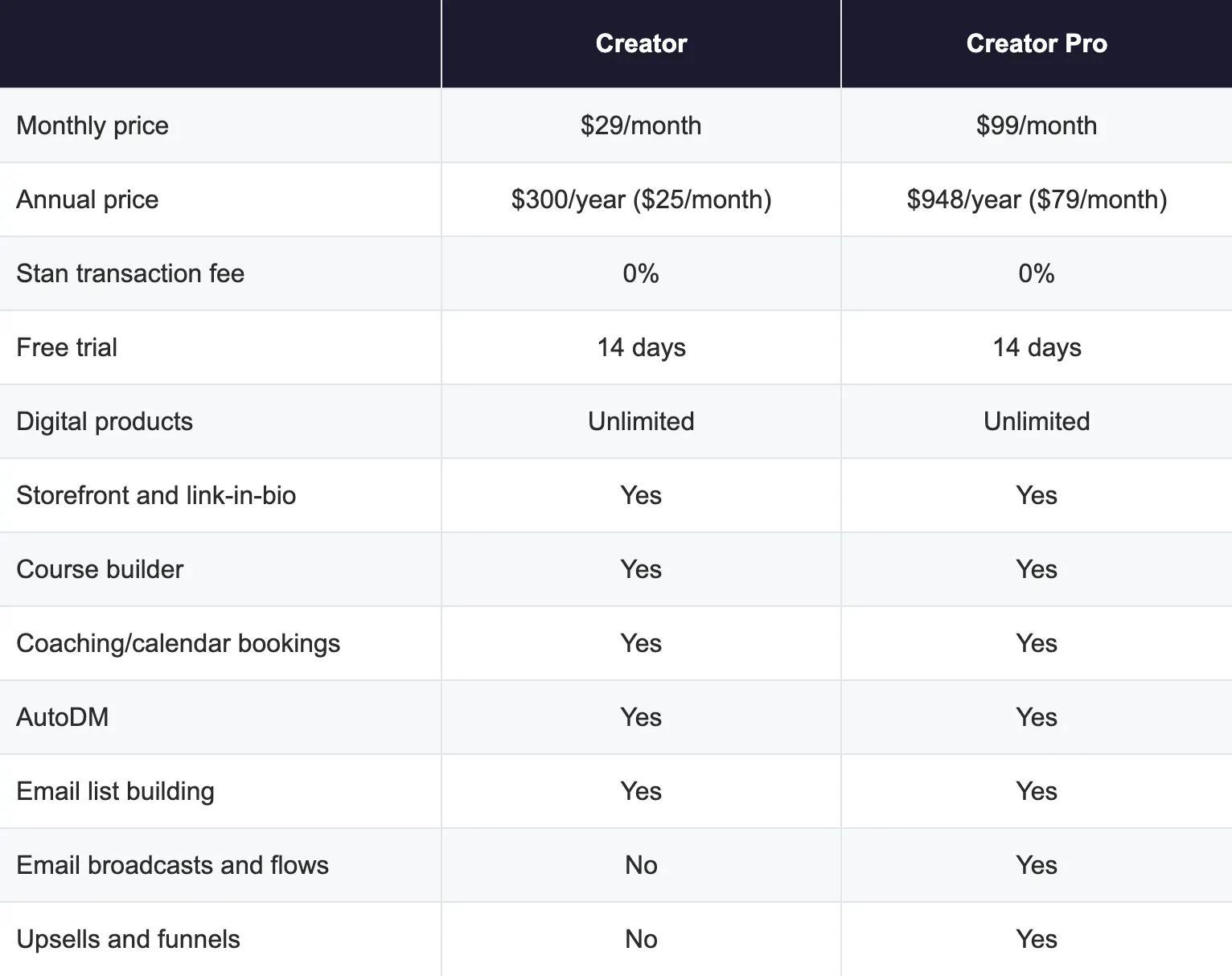
Creator costs $29 a month or $300 a year, and Creator Pro costs $99 a month or $948 a year. Both plans include the storefront, course builder, coaching bookings, community, and AutoDM, and Stan offers a 14-day free trial. There is no free plan. Creators pay standard processing fees to Stripe or PayPal, deducted from their payouts, at 2.9% of each transaction plus $0.30 for Stripe in the US, and Stan takes no cut of its own.
Because neither plan charges a transaction fee, the reason to upgrade is features rather than fees. A creator who wants to send marketing emails, offer payment plans, or run an affiliate program needs Creator Pro.
Revenue Composition
Stanley adds a second subscription, billed separately from Stan Store, so Stan's revenue comes from subscriptions to two products. The model differs from most creator economy platforms. Patreon charges creators who launched after August 2025 10% of their earnings, Gumroad takes 10% of each direct sale plus $0.50, and Substack takes 10% of paid subscription revenue. Stan's flat-fee approach caps what it earns from high-earning creators. A creator generating $100K a year on Creator Pro pays the same $99 a month as a creator generating $5K a year on the same plan.
Cost Structure and Margins
Stan operates an asset-light SaaS business. It reported EBITDA equal to 40% of revenue in 2024. Payment processing costs are passed through to creators by Stripe and PayPal rather than absorbed by Stan. With $30 million in annual revenue and about 30 employees as of August 2026, Stan generated $1 million in revenue per employee.
Traction
Revenue Growth
Stan's ARR grew from $1.7 million at the start of 2023 to $14.7 million by the end of 2023, an 8.6x increase in 12 months. ARR nearly doubled again to $28.3 million by the end of 2024, while the company achieved an EBITDA margin of 40%. Revenue for 2024 was an estimated $25 million.
Growth has slowed since. Stan put its ARR at $30 million in May 2025 and has not disclosed a higher ARR figure since, and in August 2026 Dodonov cited $30 million in annual revenue, a different measure from ARR. One unverified estimate put Stan's ARR at $35 million at the end of 2025 and $40 million as of April 2026, implying ARR growth of 24% in 2025. Meanwhile, Stanley has become an important second source of revenue. Stan reported that Stanley for LinkedIn generated $200K from its launch announcement, and by July 2026 the product had reached over $1 million in ARR.
Creator Earnings
Creator earnings on Stan have accelerated. In September 2025, Stan said creators had generated $300 million in sales on the platform over the previous three years. By January 2026, creators had earned over $400 million through the platform, and by August 2026, over $600 million, an increase of roughly $200 million in seven months. The September 2025 figure measured sales, while the later figures measure creator earnings.
Key Retention Metrics
Stan lost 13% of its customers each month as of 2024. One unverified report attributed that rate to the high turnover of Stan's small-business customers and noted strong reactivation among creators who cancel.
Valuation
Funding History
In September 2025, Gary Vaynerchuk became an investor in Stan on undisclosed terms. In May 2025, Steven Bartlett, host of The Diary of a CEO podcast, became a co-owner of Stan through what was announced as a "major, double digit equity investment deal." Neither the size of that investment nor the valuation it implied was disclosed.
Before those investments, Stan's only priced round was a $5 million seed led by Forerunner Ventures, announced in January 2022, at a $25 million valuation. Other investors include Pear VC and angel investors Kevin Hartz, co-founder of Eventbrite, and Michael Ovitz, co-founder of CAA. As of August 2025, Stan had been profitable since that seed round and had not needed to raise more capital.
Key Opportunities
Selling the Step Before a Sale
Stanley gives Stan a second product, sold on its own subscription, for the step before a sale, and Stanley for LinkedIn passed $1 million in ARR by July 2026. Stanley for Instagram is sold in Apple's App Store as a subscription priced at $45 a month, more than the $29 Creator plan on its own.
Stan's existing creators are a ready audience for it. Stan had 85K active creators as of August 2026, and their store sales depend on the followers they attract with content. Stan already automates the step between a post and a sale with AutoDM, which is included in every plan. A creator who adopted both products would pay Stan for the full path from a post to a purchase, raising what Stan earns per creator without adding a new customer. Stan and Stanley are separate products, with different pricing and support teams, so that cross-sell is an opportunity Stan has yet to capture rather than one it has shown.
Earning a Share of Creator Sales Through Payments
Stan earns nothing on the sales creators make through its checkout, and those sales are growing faster than Stan's own revenue. Creators' cumulative earnings on Stan rose from over $400 million in January 2026 to over $600 million by August 2026, a pace of roughly $340 million a year. Each percentage point of transaction value Stan kept at that pace would be worth $3.4 million a year, about a tenth of its annual revenue.
Stan already controls the checkout where those sales happen and routes them through Stripe and PayPal. One unverified report suggested Stan could capture part of the 2.9% processing fee on each transaction by becoming a payment facilitator, as Shopify did. Shopify's merchant solutions segment, which includes Shopify Payments, generated $8.8 billion of its $11.6 billion in revenue in 2025. Because processing fees are already deducted from creators' payouts, a payment facilitator model could let Stan keep part of that fee without raising what creators pay.
Key Risks
High Churn and Slowing Growth
At the rate Stan reported in 2024, losing 13% of its customers each month, 81% of a year's starting customers would be gone within 12 months, and Hu has said churn is Stan's biggest existential risk.
The risk is compounded by Stan's limited expansion revenue. The two-tier pricing structure caps what Stan earns from its most successful creators, so churn has to be offset by new customers rather than by growth within existing accounts. Growth has slowed. ARR nearly doubled in 2024, but Stan has not disclosed an ARR figure above the $30 million it reported in May 2025, and one unverified estimate put Stan's ARR growth in 2025 at 24%.
Platform Dependency
Stan's growth depends on the social platforms where its creators find their audiences. One unverified estimate found that nearly half of the GMV flowing through Stan, 45%, originated from TikTok and Instagram.
TikTok went dark for 170 million US users in January 2025, cutting creators off from the followers who buy from them, until TikTok's US business was restructured into a joint venture in January 2026. A single platform decision can remove a creator's audience overnight.
AutoDM runs on Instagram messages, so a change to Instagram's rules for third-party messaging tools would impair one of Stan's core conversion features. Stan has begun diversifying by extending Stanley to six platforms, but Stanley is a content tool, and Stan Store's sales still depend on the followers creators build on Instagram and TikTok.
Competitive Convergence
Linktree and Beacons are adding the commerce features Stan was built around. Linktree, with over 70 million users against Stan's 85K active creators, has sold digital products natively since April 2025, and Beacons offers a free plan with digital product sales and email marketing.
Stan's own comparison content positions it as "built for selling" and Beacons as "built for branding." Stan's defense is price and integration, and if a competitor with a free plan or marketplace discovery offers a comparable storefront, Stan's subscription-only pricing becomes harder to defend.
Summary
Stan sells a link-in-bio storefront to creators who earn money directly from their audiences, charging a flat monthly subscription and no transaction fee. It combines a storefront, course hosting, coaching bookings, email marketing, and Instagram automation in one product, and in 2025 it added Stanley, a separately priced AI content tool. As of August 2026, Stan had 85K active creators, and creators had earned more than $600 million through the platform.
As of August 2025, Stan had been profitable since its $5 million seed round, but it has not disclosed ARR above $30 million since May 2025; it was losing around 13% of its customers a month as of 2024, and Linktree has added native digital product sales while Kajabi has added a Comment-to-DM feature. The key question is whether Stanley, and potentially payments, can raise what Stan earns from each creator faster than churn and competition wear down its base.