Thesis
By 2025, AI had moved from being experimental to producing usable software. Enterprises spent $37 billion on generative AI in 2025, up from $11.5 billion in 2024. In a survey conducted in mid-2026, 40% of respondents from organizations with more than $1 billion in annual revenue reported scaling AI agents, up from 27% a year earlier. The models those products run on are also replaced quickly. US-based institutions produced 59 notable AI models in 2025, up from 40 in 2024, and each new model is a potential upgrade for products built on earlier models.
Conventional software tests check that a given input produces an expected output, an approach that fits AI products poorly. Model outputs vary between runs, and agents work across many turns, calling tools and acting on intermediate results, so an early mistake can compound through the rest of a task. Without systematic evaluations, teams typically learn that a change made a product worse when users report it, and they face weeks of testing each time a more capable model comes out, against days for teams that have evaluations in place. One forecast projects that 40% of organizations deploying AI will adopt dedicated AI observability tools by 2028 to monitor model performance and outputs.
Braintrust provides an evaluation and observability platform for companies building AI products and agents. It records how an application handles real requests and turns production failures into versioned test datasets. Teams then score proposed changes against those datasets with code-based checks, model-based judges, and human review. Because the platform works across model providers and agent frameworks, the same tests carry over when a team switches models. Braintrust lets companies make evaluation results the condition for shipping a change, so that a new model, prompt, or agent workflow reaches production only after it has been tested against the failures the product has already had.
Weekly Newsletter
Subscribe to the Research Rundown
Founding Story
In August 2023, Ankur Goyal (CEO) founded Braintrust, with his brother Manu Goyal joining as founding engineer and Coleen Baik as founding designer. Elad Gil helped incubate the initial evaluation product and team, while David Song, a member of Gil's team who had previously built evaluation tools at Mem, supported the early product. Braintrust launched publicly in September 2023.
Goyal studied computer science at Carnegie Mellon University and left in 2011 to join the early team at MemSQL, later renamed SingleStore, when the company consisted of its founders and only a few other employees. He spent five and a half years at the database company and eventually became vice president of engineering.
After leaving MemSQL, Goyal co-founded Impira in 2017, an AI platform for extracting and organizing information from documents, images, and other unstructured data. Impira initially explored several applications of computer vision before finding commercial demand in document processing. The company eventually reached a few million dollars in ARR, but its customers often wanted materially different products, which made the business difficult to scale through a repeatable sales process. In a podcast interview, Goyal later said the business had "very little repeatability."
The experience changed how Goyal approached his second company. At Impira, he had tried to operate like the leader of a larger organization, delegating much of the product and engineering work despite those being his strongest skills. At Braintrust, Goyal chose to remain closely involved in product development, and he has said in the same interview that "if you have to convince people, it's super unlikely that you have product market fit."
Braintrust's initial idea emerged from a technical problem Goyal encountered at both Impira and Figma. At Impira, customers used the same underlying product for different document types, including invoices and bank statements. Updating a model or prompt could improve performance on invoices while making the product worse at processing bank statements. Because financial-services customers could not tolerate discovering those regressions in production, Impira built internal tools to measure model quality during development.
After Figma acquired Impira, Goyal became head of Figma's machine learning platform in January 2023 and encountered essentially the same evaluation problem. Figma also needed a way to test non-deterministic AI features, compare versions, and identify regressions before releasing changes to users. The team again built much of the required evaluation infrastructure internally.
Goyal was not initially looking to start another company, but the idea became clearer through a series of conversations with Gil, who had backed Impira and remained in contact with Goyal after its acquisition. When Goyal mentioned that he had been forced to build similar evaluation systems at both Impira and Figma, Gil pointed out that the repetition could signal a broader market.
Rather than assume the idea was valid, Goyal and Gil identified roughly 50 companies that were early in building generative AI products, including Notion, Airtable, Zapier, Coda, and Instacart. The pair interviewed the people leading AI development at those companies using intentionally open-ended questions about the most difficult parts of building AI products. Goyal entered the process skeptical that evaluation infrastructure represented a large standalone market, but the interviews repeatedly surfaced evals and observability as major problems.
Around the same time, Goyal began discussing working together with his brother, Manu. The brothers were attending a wedding in Switzerland and joked that they did not spend enough time together, while much of the time they did share was spent discussing computer science. Manu had spent more than six years at Nuro, where he worked on behavior prediction and planning for autonomous vehicles. The brothers concluded that the next logical step was to build something together, and Manu became the first person to join Braintrust.
Baik, who served as founding designer until November 2023, added a different set of capabilities to the initial team. Before joining Braintrust, she had spent more than two decades working across interaction, motion, and systems design. Baik joined Twitter's early design team in 2010, where she worked on foundational experiences including media, conversations, and messaging, and later spent years advising startups through Sequoia Capital. Song, meanwhile, brought direct experience with the problem itself, having built evaluation systems at Mem and worked as part of Gil's team.
Product
Braintrust is an observability and evaluation platform for companies building AI applications and agents. Traditional software monitoring can show whether an application returned a response, how long the request took, and whether the underlying infrastructure produced an error. It cannot necessarily determine whether an AI response was accurate, whether an agent selected the correct tool, or whether the completed task was useful to the customer. Braintrust records this behavior, helps a company define what acceptable performance looks like, and then tests whether proposed changes improve or degrade the product. It organizes the platform into three connected surfaces: Observe, Evaluate, and Discover.
Although Braintrust presents these as separate product areas, the platform is best understood as a continuous quality-control loop. A company first instruments an AI application and sends production activity to Braintrust. Each request becomes a trace containing the model calls, retrieved information, tool use, intermediate steps, latency, cost, and final result. Engineers and product teams can inspect those traces, score the outputs, and identify examples where the application behaved poorly. Those examples can then become entries in a versioned evaluation dataset. When the company changes a prompt, model, retrieval system, or agent workflow, it can run the new version against the same dataset and prevent the change from reaching production if quality declines. Production behavior then supplies additional examples, which expands the test suite over time.
Observe
Source: Braintrust
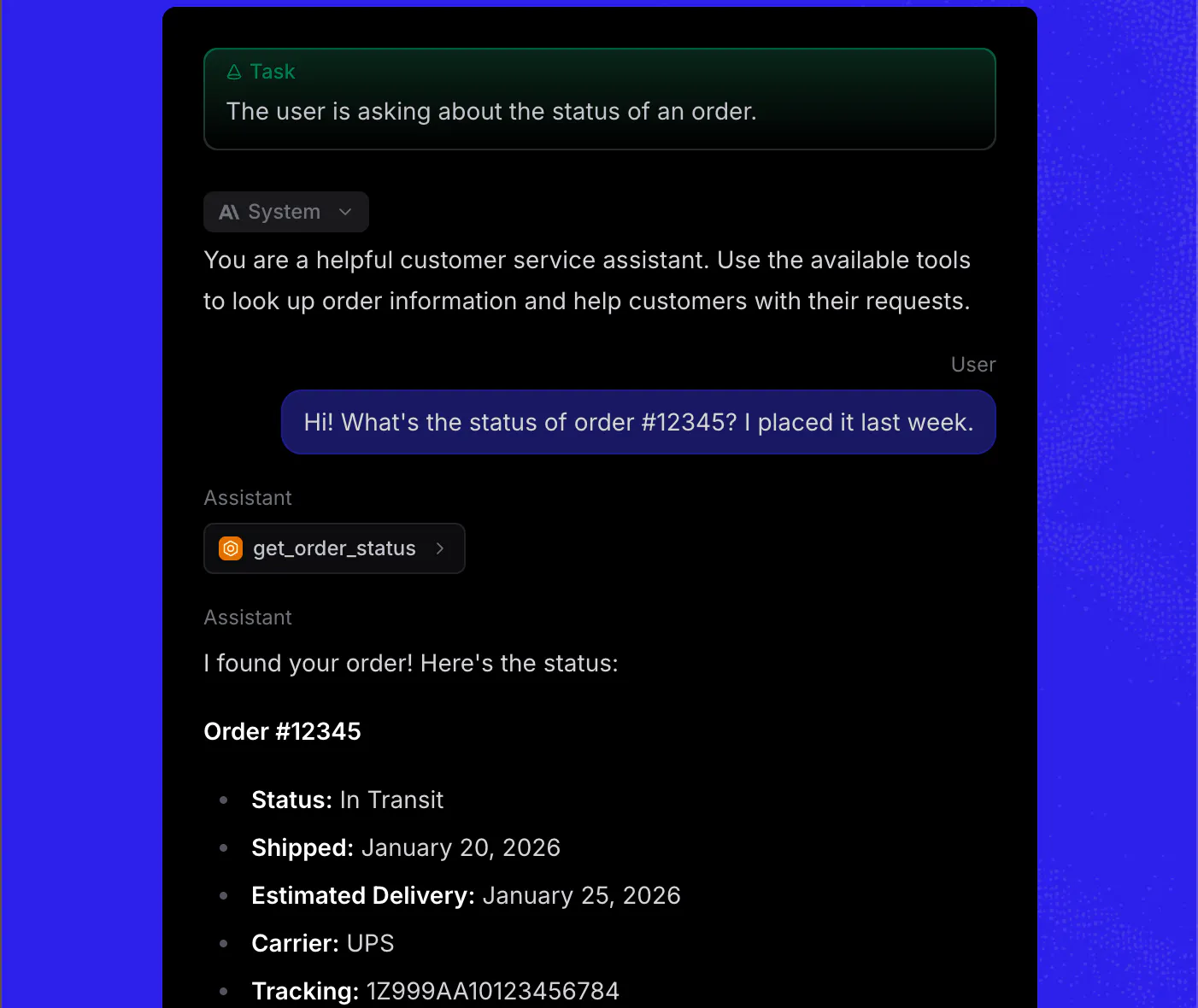
Braintrust's Observe product captures what an AI application does after deployment. A company can instrument an application using Braintrust's software development kits or route model requests through the Braintrust Gateway. The Gateway provides a common interface for models from OpenAI, Anthropic, Google, AWS, and other providers while automatically recording each request. The software development kits provide more detailed instrumentation, allowing a company to record custom application logic such as retrieval steps, tool calls, agent planning, retries, and loops.
Braintrust represents each request as a tree of nested "spans." A customer-support agent, for example, might contain one span for the initial model call, another for searching an order database, another for interpreting the result, and a final span for writing the response. Braintrust attaches metrics such as token usage, cost, latency, and errors to each step, allowing a developer to identify whether a failure came from the model, a tool, the retrieved context, or the surrounding application code. This matters more for agents than for simple chatbots because an agent can return a plausible answer even after selecting the wrong tool or taking an inefficient sequence of actions.
Beyond reviewing individual traces, companies can use dashboards to monitor aggregate cost, latency, volume, and quality. Braintrust also supports alerts when a metric crosses a defined threshold and online scoring, which automatically applies evaluation criteria to a sample or stream of production traffic. The scorer runs asynchronously so it does not add latency to the customer-facing application, and Braintrust stores the scorer's input, output, and reasoning alongside the original trace. This allows a company to monitor subjective measures such as helpfulness or factual accuracy in a similar way to how an infrastructure team monitors error rates. In October 2026, Braintrust extended Observe beyond AI calls by adding application logs alongside agent traces, in public preview.
Evaluate
Source: Braintrust
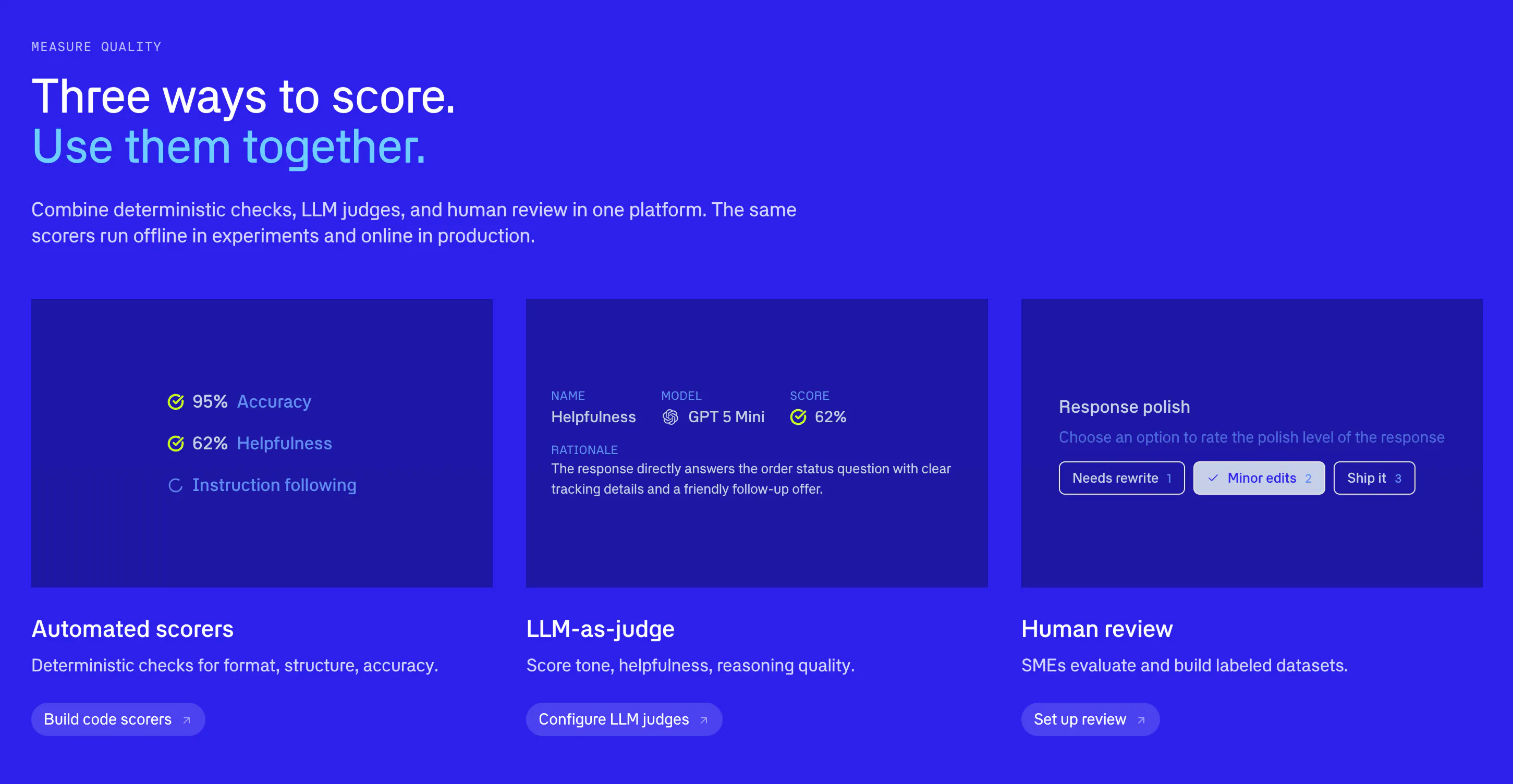
Evaluate helps companies test AI behavior before releasing a change. Each evaluation has three basic components: a dataset of test cases, the task or application being tested, and a set of scorers that judge the result. The task can be a single model call, a retrieval pipeline, or a multi-step agent. Unlike a traditional unit test, the expected result does not always need to be an exact answer. A company can instead evaluate whether the output is factually grounded, follows instructions, includes the correct citations, uses the appropriate tools, or meets a domain-specific quality threshold.
Braintrust's datasets are versioned collections of test cases built from production traces, user feedback, manually written examples, or generated examples. Versioning is important because the definition of a good response changes as the application, underlying models, and customer behavior evolve. A company can preserve the dataset used for an earlier release, understand when an example was added or changed, and compare performance against the same baseline over time.
The platform provides three main ways to score an output. Code-based scorers can check objective criteria such as whether a response follows the required format, cites the correct document, or invokes the expected tool. Large language models can act as judges for more subjective criteria such as helpfulness, tone, or completeness. Human reviewers can label outputs when the task requires specialist knowledge, product judgment, or a higher level of confidence. Braintrust allows the same scorer to run during offline experiments and against production traffic, reducing the risk that a company measures one set of criteria before launch and a different set afterward.
Teams can first use Playgrounds to test different prompts, models, parameters, and scorers in a browser. Playgrounds are intended for rapid iteration, so rerunning a configuration replaces the previous results. Once a team identifies a configuration worth preserving, it can promote the run to an experiment. Each experiment is an immutable record of the dataset, application configuration, outputs, scores, latency, token usage, and estimated cost at the time of the test. Teams can compare experiments side by side and examine both aggregate changes and the individual examples that improved or regressed.
Braintrust can also integrate evaluations into continuous integration and deployment workflows. A proposed software or prompt change runs against an established test suite, and a quality gate can fail the build if a score falls below a defined threshold. In a case study Braintrust published, Dropbox runs 150 targeted tests before a code change can merge, a suite of more than 10K tests after the merge, and model-based scoring on sampled production traffic. Feedback from production traces then becomes new test data, expanding the suite when customers encounter a failure that the existing evaluations did not cover.
Discover
Offline evaluations are effective at catching known failure modes, but they are limited by the examples and criteria a company has already defined. Braintrust expanded its product into Discover to help companies find patterns that are difficult to identify by manually reviewing individual traces. With Discover, Braintrust is attempting to identify which tests a company should create next, in addition to running them.
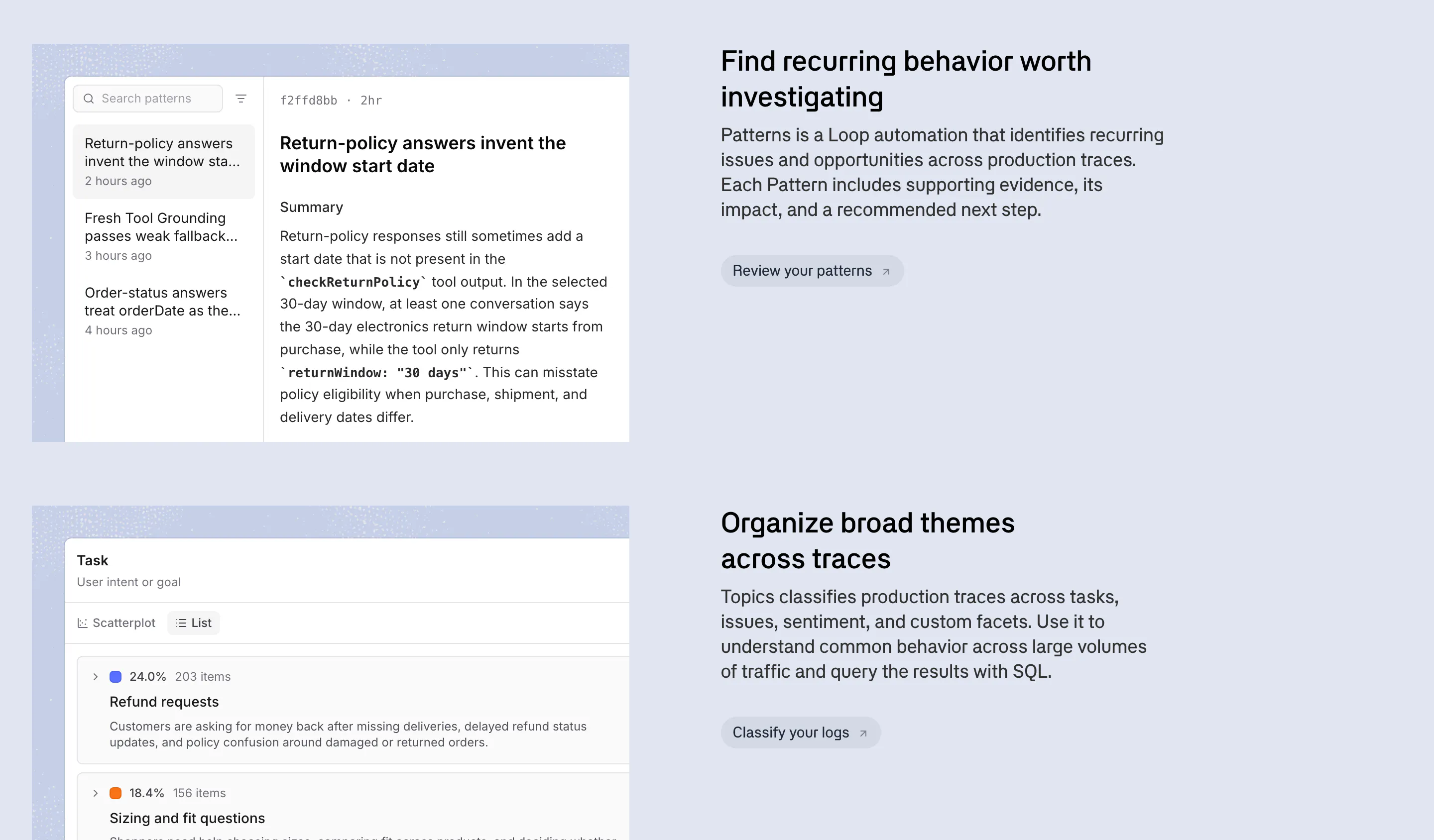
Braintrust made Topics generally available in June 2026. Topics groups production traces into recurring patterns and assigns labels across three built-in dimensions: what task the customer is attempting, what issue occurred, and the apparent sentiment of the interaction. Companies can also create custom dimensions based on factors such as use case, customer segment, region, compliance category, or product line. Braintrust stores each classification as a queryable signal, allowing a team to filter traces by a particular failure mode, turn those traces into a dataset, apply an online scorer, and test a proposed fix against the same pattern.
For example, Notion used Braintrust's search, datasets, and LLM judges to identify cases where its AI responded in the wrong language inside multilingual workspaces. The issue affected only a subset of customers and could have been difficult to identify through aggregate metrics. Notion created a dataset of examples where language adherence failed and added an LLM-based judge to test future changes against the same behavior. The case follows the loop Braintrust is designed around, in which a team detects a production pattern, turns it into a measurable test, makes a change, and prevents the failure from recurring.
Source: Braintrust
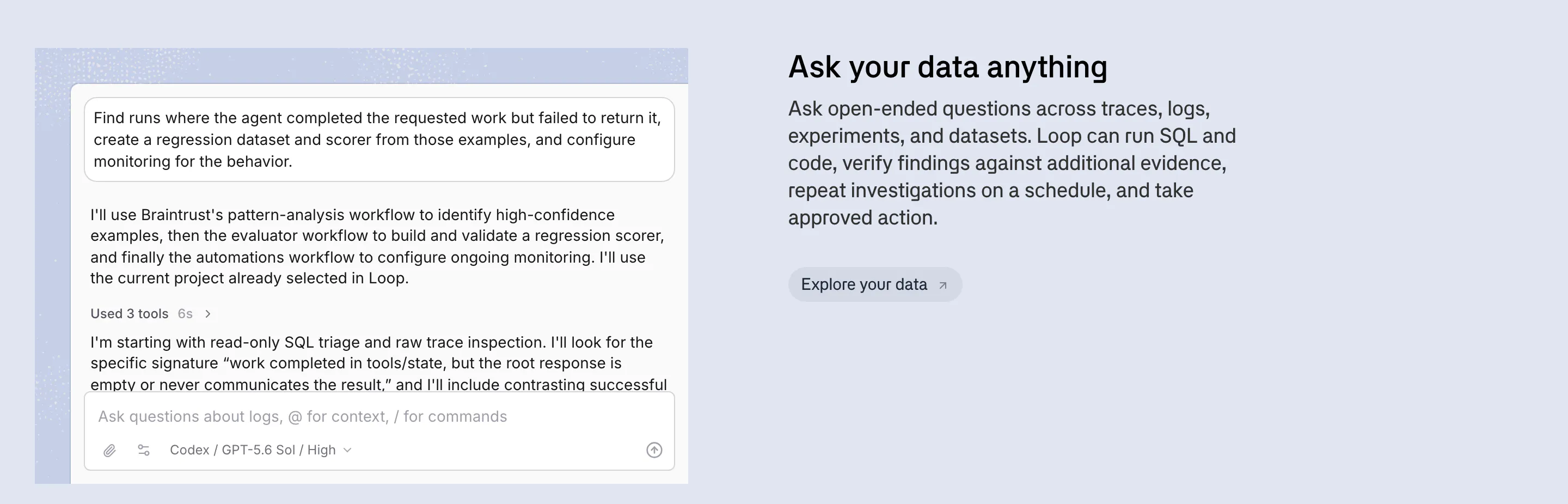
Braintrust also provides Loop, an AI agent available throughout the platform. A user can ask Loop to analyze logs, generate a database filter from natural language, find similar traces, build a dataset, create a scorer, or optimize a prompt in a Playground. Loop makes the platform more accessible to product managers and subject-matter experts who may understand the desired behavior but do not want to write database queries or evaluation code. Its usefulness, however, depends on the quality of the underlying traces, datasets, and evaluation criteria; it automates the analysis workflow rather than replacing the need for a company to define what good performance means.
Source: Braintrust
In September 2026, Braintrust released Patterns in public preview. Patterns is a Loop automation that scans production traces on a schedule and reports recurring failures with supporting evidence, an explanation of their impact, and a recommended next step. Where Topics organizes traffic into broad themes, Patterns is meant to surface specific behaviors worth investigating before a customer reports them.
Brainstore
The Observe, Evaluate, and Discover products run on Brainstore, Braintrust's purpose-built database for AI observability data. AI traces differ from ordinary application logs because they can contain long prompts, model responses, retrieved documents, tool schemas, intermediate state, and delayed user feedback. Braintrust has reported that a typical AI trace is about 10 MB, and that at the 90th percentile traces can reach tens of GB. Traces may also remain open for hours or days and receive new spans or feedback after earlier steps have completed. These figures are company estimates, but they illustrate why storing and searching agent activity can place different demands on a database than conventional application monitoring.
Brainstore stores durable data in object storage, separates each customer's data into its own partition, and treats deeply nested, semi-structured data as a primary workload rather than forcing it into a fixed relational schema. It uses the Tantivy search and indexing library for full-text and structured queries and a custom write-ahead log that makes new information readable before it has been compacted into the main index. This architecture is also designed to be relatively simple to deploy inside a customer's cloud environment, without requiring persistent local disks or a large database cluster.
Source: Braintrust
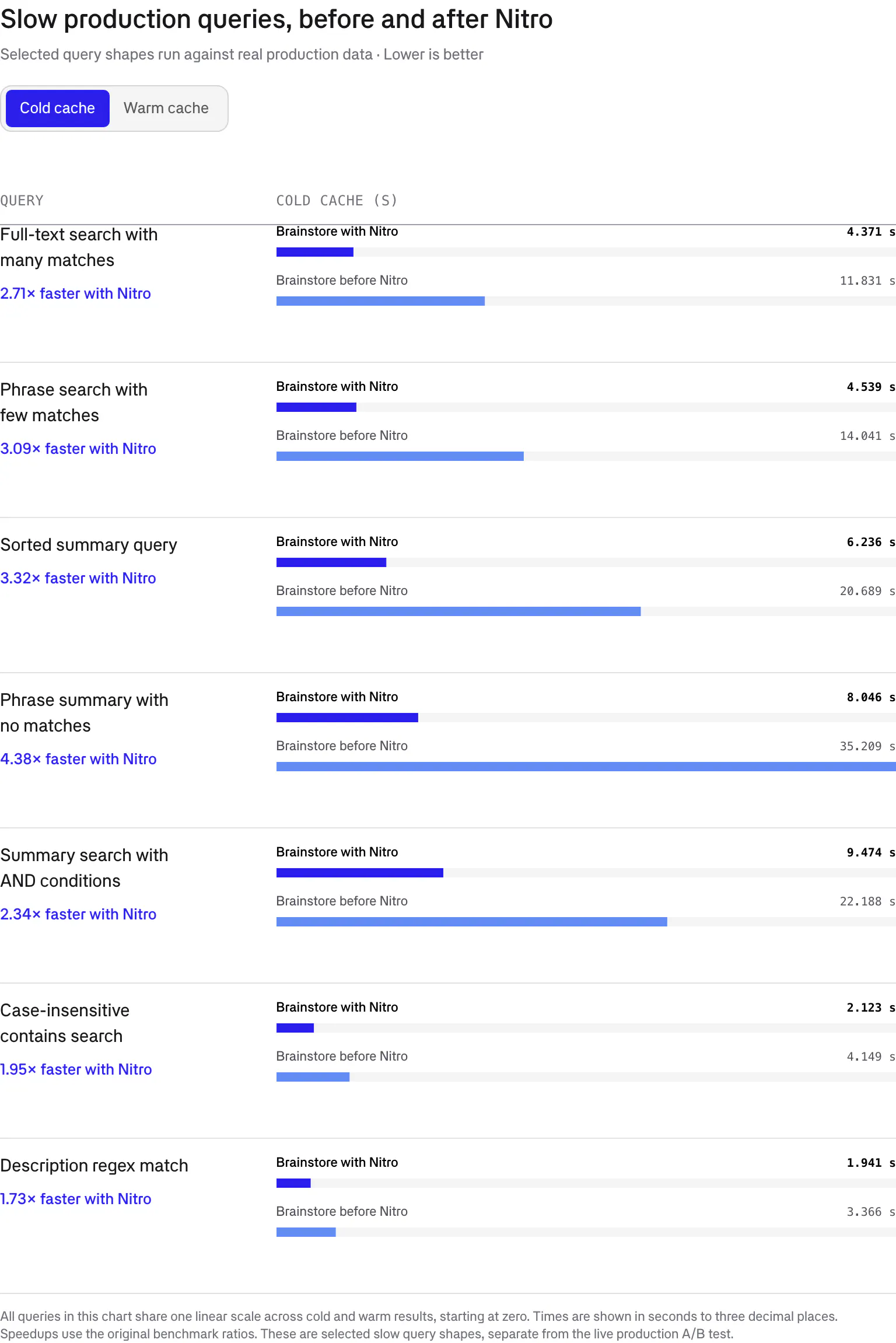
In a December 2025 company benchmark covering 3.9 million production traces, Braintrust reported that Brainstore delivered 23.9x faster full-text search, 2.6x faster writes, and 3.7x faster span loading than an unnamed competitor. Because Braintrust selected the workload and did not identify the comparison product, the results should be treated as a vendor benchmark rather than an independent measure. In September 2026, Braintrust launched Nitro, a query engine for Brainstore, and reported that in an A/B test on more than 1 million live queries, full-text search ran more than twice as fast and other queries 15% faster.
Market
Customer
Braintrust's customers are companies operating AI applications whose quality cannot be measured through ordinary software tests. As of November 2026, the companies Braintrust named as customers spanned workplace software such as Notion, content management such as Box, cloud infrastructure such as Cloudflare, legal software such as Eve, and customer support such as Pylon.
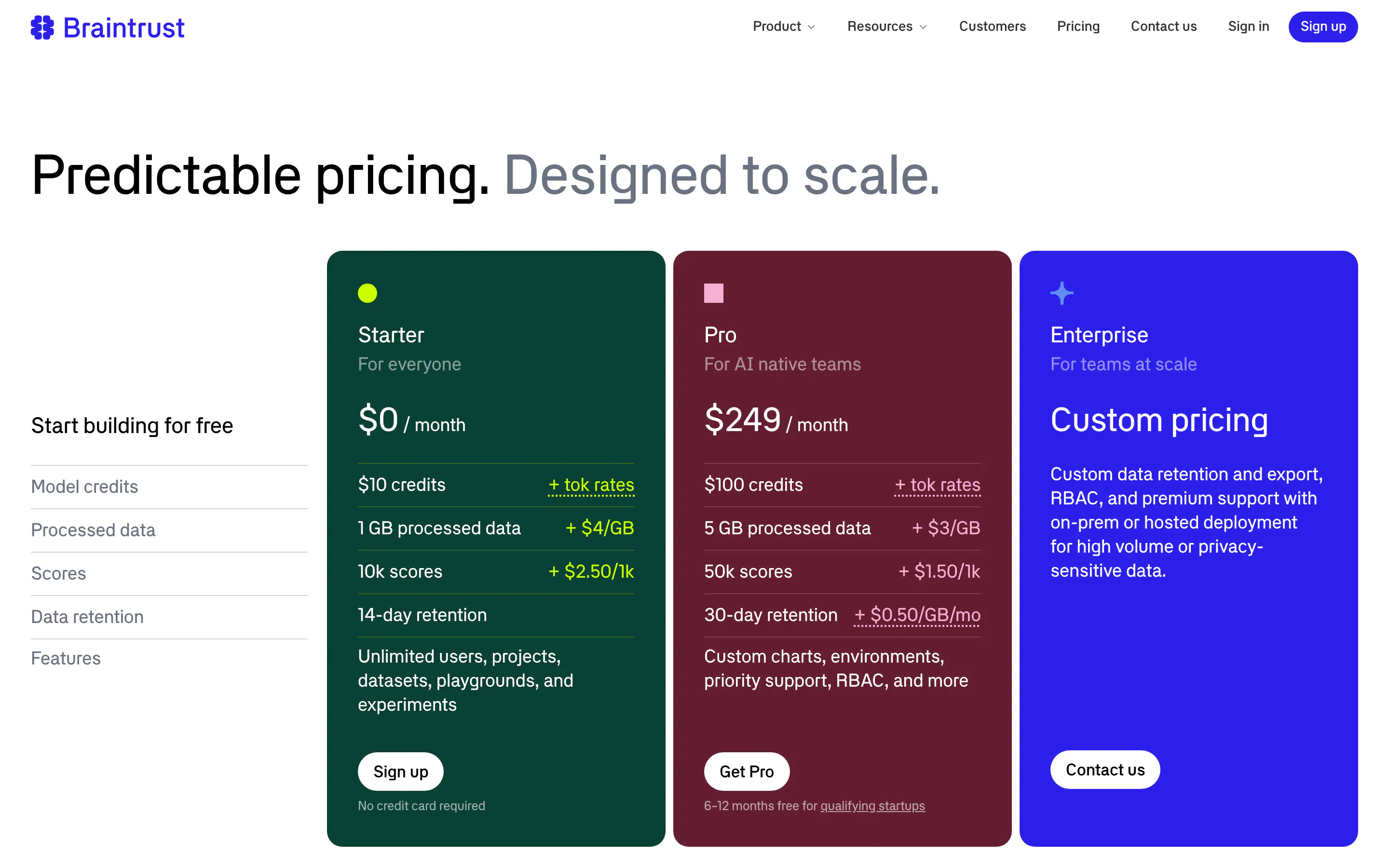
Braintrust serves two primary customer segments. AI-native startups such as Eve, Pylon, and Graphite can adopt the product early, move quickly, and integrate evaluations directly into their development processes. Larger software companies such as Notion, Dropbox, Box, and Cloudflare generate more traces, involve more users, and require formal security, retention, and release controls. As of November 2026, Braintrust's pricing supported both, with a free Starter plan, a Pro plan for AI-native teams at $249 per month, and custom enterprise contracts with role-based access controls, data export, premium support, and hosted or on-premises deployment.
Source: Braintrust
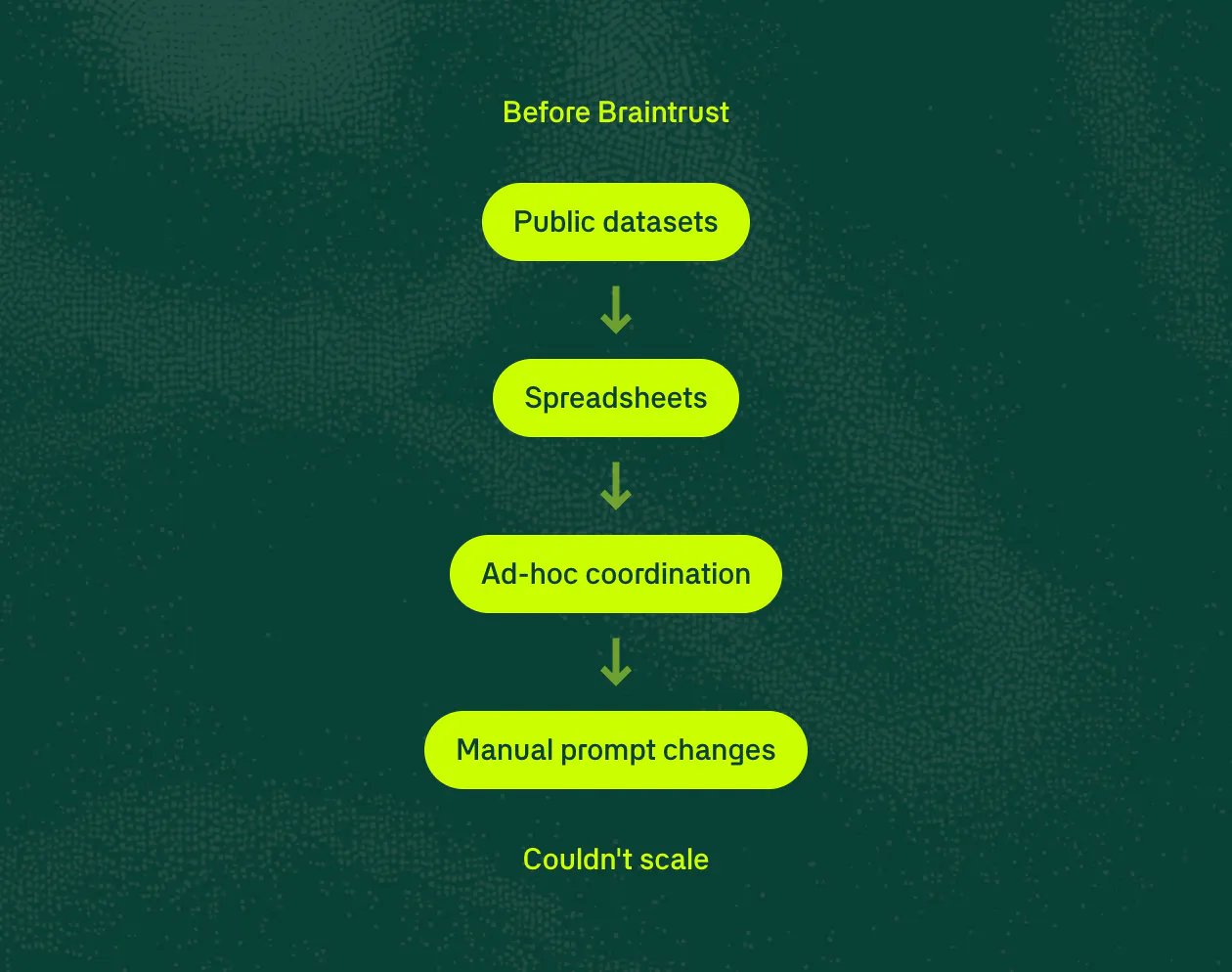
The main alternatives are internal evaluation scripts, spreadsheets, model-provider dashboards, open-source products, and traditional observability platforms. These options may be sufficient for a team testing a limited number of prompts or reviewing a small sample of outputs. Braintrust becomes more useful when several employees need to share datasets and quality metrics, production failures need to become regression tests, or evaluations must formally block releases. Enterprise sales may still be difficult because production traces often contain sensitive customer data and because large companies often already run observability and data infrastructure from vendors such as Datadog, which counted about 4.9K customers paying it $100K or more a year as of September 2026, and Dynatrace.
Market Size
Braintrust sits within several overlapping software categories, including AI infrastructure, application observability, developer tools, quality assurance, and AI governance. Enterprise AI spending is a useful reference point, but overstates the portion of the market that Braintrust can actually serve.
Enterprise generative AI spending reached an estimated $37 billion in 2025, up from $11.5 billion in 2024. Of that amount, $19 billion went to AI applications and $18 billion to infrastructure. Within infrastructure, $1.5 billion went to the storage, retrieval, and orchestration software connecting models with enterprise systems. This $1.5 billion segment is a closer reference point than the entire AI infrastructure market, although it still includes products that do not compete with Braintrust.
The potential customer base is expanding as more companies build AI into their own products. In a survey published in March 2025, 78% of respondents reported that their organizations used AI in at least one business function, while 71% of respondents' organizations regularly used generative AI. However, general AI adoption is not equivalent to demand for Braintrust, since companies using packaged copilots do not necessarily need dedicated evaluation infrastructure. The addressable customer is the smaller subset developing, operating, and regularly updating proprietary AI applications or agents.
Demand should increase as those applications move from prototypes into production. By the end of 2025, at least 50% of generative AI projects had been abandoned after proof of concept because of poor data quality, inadequate risk controls, escalating costs, or unclear business value. Evaluation and observability do not solve all of these problems, but they give companies a way to measure quality, monitor cost, and determine whether changes improve an application before expanding its deployment.
In August 2026, Dynatrace estimated that the broader AI observability market would exceed $10 billion by 2030. That forecast accompanied Dynatrace's acquisition of Braintrust competitor Arize and should therefore be treated as an industry estimate rather than an independent market measurement. One unverified estimate valued the market for LLM observability platforms at $2 billion in 2025 and projected it to reach $9.3 billion by 2030. Based on the $1.5 billion spent on adjacent AI data and orchestration infrastructure in 2025 and the expansion of AI observability into existing monitoring and release-management budgets, Braintrust's realistic near-term addressable market is likely in the low-single-digit billions. Datadog alone reported $1.2 billion in revenue for the third quarter of 2026, up 35% year over year, which indicates the size of the monitoring budgets that AI observability is expanding into.
Competition
Competitive Landscape
Braintrust operates in a crowded AI evaluation and observability market where most products increasingly offer the same core functionality, including tracing, datasets, offline and online evaluations, prompt management, and production monitoring. The main competitors include LangSmith, Arize, Weights & Biases, Galileo, and Langfuse. Traditional observability companies such as Datadog also compete as AI monitoring becomes part of broader application observability.
The market has consolidated quickly. CoreWeave acquired Weights & Biases in May 2025, ClickHouse acquired Langfuse in January 2026, and Cisco acquired Galileo in May 2026. In October 2026, Dynatrace completed its acquisition of Arize for $915 million. The consolidation validates demand for AI-specific observability but also increases competitive pressure on Braintrust as these products gain distribution through larger infrastructure platforms.
As of November 2026, several competitors offered the same core loop of turning production traces into datasets and testing changes against them, so Braintrust's differentiation rests on its emphasis on using evaluations to gate releases, blocking a change that falls below a defined quality threshold before it reaches production. Braintrust also remains framework-agnostic, and its Gateway routes requests to models from many providers through one interface, and its tracing supports OpenTelemetry as well as framework-specific SDKs.
Competitors
Weights & Biases: Founded in 2017, Weights & Biases (W&B) raised $250 million before its acquisition by CoreWeave, which closed in May 2025 for a reported $1.7 billion. W&B historically focused on model training, experiment tracking, and MLOps, but as of November 2026, its Weave product offered tracing, monitoring, and evaluations for AI applications and agents. W&B has a broader position across the machine learning lifecycle and an established base of ML practitioners, while Braintrust is more narrowly focused on evaluating and improving production AI applications.
LangChain / LangSmith: LangChain was founded in October 2022, when the open-source project it is built on launched. In October 2025, it raised a $125 million Series B led by IVP at a $1.3 billion valuation, bringing total funding to $160 million. Its commercial product, LangSmith, combines agent observability, evaluation, prompt engineering, and deployment. LangSmith's largest advantage is distribution through LangChain and LangGraph, since teams already building agents with those frameworks can add LangSmith with relatively little additional work. LangSmith is also framework-agnostic, but its deepest integration remains with the LangChain ecosystem. Braintrust is more explicitly centered on evaluation-driven release workflows and positions its framework neutrality as an advantage for companies using several agent frameworks or model providers.
Arize AI: Founded in 2020, Arize AI raised $131 million prior to its acquisition by Dynatrace, which completed the deal in October 2026 for $915 million. Arize began with traditional machine learning observability before expanding into generative AI through its open-source Phoenix platform, which provides tracing, experimentation, and evaluations for AI applications and agents. This gives Arize broader coverage across classical machine learning and generative AI, while Braintrust has been built specifically around the AI application development loop. Phoenix's open-source distribution and OpenTelemetry-native architecture are meaningful advantages; Braintrust's differentiation is a more integrated path from production traces to evaluation datasets and release decisions.
Comet: Founded in 2017, Comet began as a machine learning experiment-tracking company and offers Opik, an open-source platform that traces agent steps, scores them with more than 30 LLM-as-a-judge metrics and test-suite assertions, and includes a prompt optimizer. Comet raised a $50 million Series B led by OpenView in November 2021 at an undisclosed valuation, and had raised $69.9 million in total as of November 2026. Opik competes with Braintrust as an open-source option from a company that remains independent, while Braintrust's core product is proprietary.
Galileo: Founded in 2021, Galileo raised $68.1 million prior to its acquisition by Cisco, which occurred in May 2026 on undisclosed terms. Cisco has since folded Galileo's technology into Splunk Observability's AI Agent Monitoring. Galileo overlaps with Braintrust in evaluation and observability but differentiates around production guardrails, with evaluators that run in real time and can intervene when an agent violates defined policies. Braintrust is more focused on using evaluations to improve and control the software development and release process; Galileo is stronger when a customer wants evaluations to become real-time runtime controls.
Raindrop: Founded in 2024, Raindrop monitors AI agents in production, flagging problems such as hallucinated answers, tool misuse, and behavior changes after model upgrades, and its Simulations product replays production traffic against a proposed change before it ships. In September 2026, it raised a Series A of undisclosed size led by CRV, at an undisclosed valuation, that brought its total funding to $50 million. Raindrop starts with production monitoring and anomaly detection and added pre-release testing later, the reverse of Braintrust's evaluation-first path. Raindrop's customers include Vercel, which is also a Braintrust customer.
Langfuse: Founded in 2022, Langfuse raised $4 million prior to its acquisition by ClickHouse, which announced the deal in January 2026 on undisclosed terms. Langfuse offers tracing, datasets, experiments, evaluations, and prompt management, making its product surface increasingly similar to Braintrust's. The primary difference is that the platform is open source and self-hostable, which appeals to engineering teams that want greater control over their data and infrastructure. Braintrust provides a more managed product and places greater emphasis on CI/CD release gates and cross-functional workflows, while Langfuse represents a lower-lock-in alternative for teams willing to operate more of the stack themselves.
Datadog: Datadog's competing offering is LLM Observability, which traces prompts, retrieval, tool calls, and agent decisions, links them to Datadog's application and infrastructure monitoring data, and offers evaluators, human review, versioned datasets built from production traces, and experiments. As of November 2026, its first paid tier cost $160 per month for up to 100K LLM spans, and Datadog added evaluations for AI agents at its conference in June 2026. Datadog's advantage is distribution, since it offers AI observability as an extension of the monitoring a customer already runs, while Braintrust has no existing monitoring footprint and competes on the depth of its evaluation workflow.
Business Model
Source: Braintrust
Braintrust generates revenue through platform subscriptions and usage-based fees. As of November 2026, its Starter plan charged no monthly fee and included 1 GB of processed data, 10K scores, and $10 in model credits, while Pro cost $249 per month and included 5 GB of data, 50K scores, and $100 in model credits. Usage above those limits was charged based on processed data, scored outputs, model tokens, and additional retention; on Pro, additional data cost $3 per GB and additional scores $1.50 per 1K. Enterprise plans used custom pricing for higher volumes, longer retention, data exports, premium support, and hosted, hybrid, or on-premises deployment.
Because Braintrust includes unlimited users, revenue grows primarily as customers send more production traces and run more evaluations, not by adding seats. Braintrust also offers qualifying startups six to 12 months of Pro at no cost. Braintrust's main observable costs include engineering headcount, storage and compute for ingesting and searching AI traces, and model inference for features such as LLM-as-a-judge scorers. Brainstore places durable data in relatively inexpensive object storage, while Braintrust's customer-cloud deployment option lets customers host Braintrust's data plane in their own cloud accounts, so sensitive trace data stays there. During the public preview of Patterns, Braintrust charged customers only for the model inference those automations use.
Traction
In a March 2026 interview, CEO Ankur Goyal said that Braintrust had many hundreds of customers and many tens of thousands of organizations using the product, and about 100 employees. Although Braintrust did not disclose revenue, Goyal said the company had grown by more than an order of magnitude on every axis since its October 2024 Series A and had been cash-flow positive for an extended period. As of November 2026, 185 people listed Braintrust as their employer on LinkedIn.
Usage has also grown as customers have moved from testing individual prompts to monitoring more complex agents. In the same interview, Goyal said organizations were running approximately 10 times as many evaluations as they had one year earlier, and that Braintrust was ingesting roughly twice as much data each day as it had processed during the entire first year after its launch.

Source: Braintrust
As of November 2026, Braintrust's customers included Notion, Stripe, Vercel, Cloudflare, *Replit, Dropbox, and Box, and the company named *Ramp as a customer when it announced its Series B in February 2026. In customer stories Braintrust has published, Retool reported raising its query classifier's accuracy from 72% to 95% by building evaluations from misclassified production queries, and Coursera used Braintrust to evaluate AI grading that it credited with a 16.7% increase in course completions within a day of peer review.
Valuation
As of November 2026, Braintrust had raised a total of $121.1 million. In February 2026, it raised an $80 million Series B led by ICONIQ at an $800 million post-money valuation, with Andreessen Horowitz, Greylock, Elad Gil, and Basecase Capital also participating. Braintrust previously raised a $36 million Series A led by Andreessen Horowitz in October 2024 at a valuation of approximately $150 million, and a $5.1 million seed round led by Greylock in December 2023 at an undisclosed valuation, following an initial round of undisclosed size led by Elad Gil and Basecase Capital. The February 2026 Series B valuation of $800 million was 5.3x the $150 million Series A valuation, which occurred 16 months earlier.
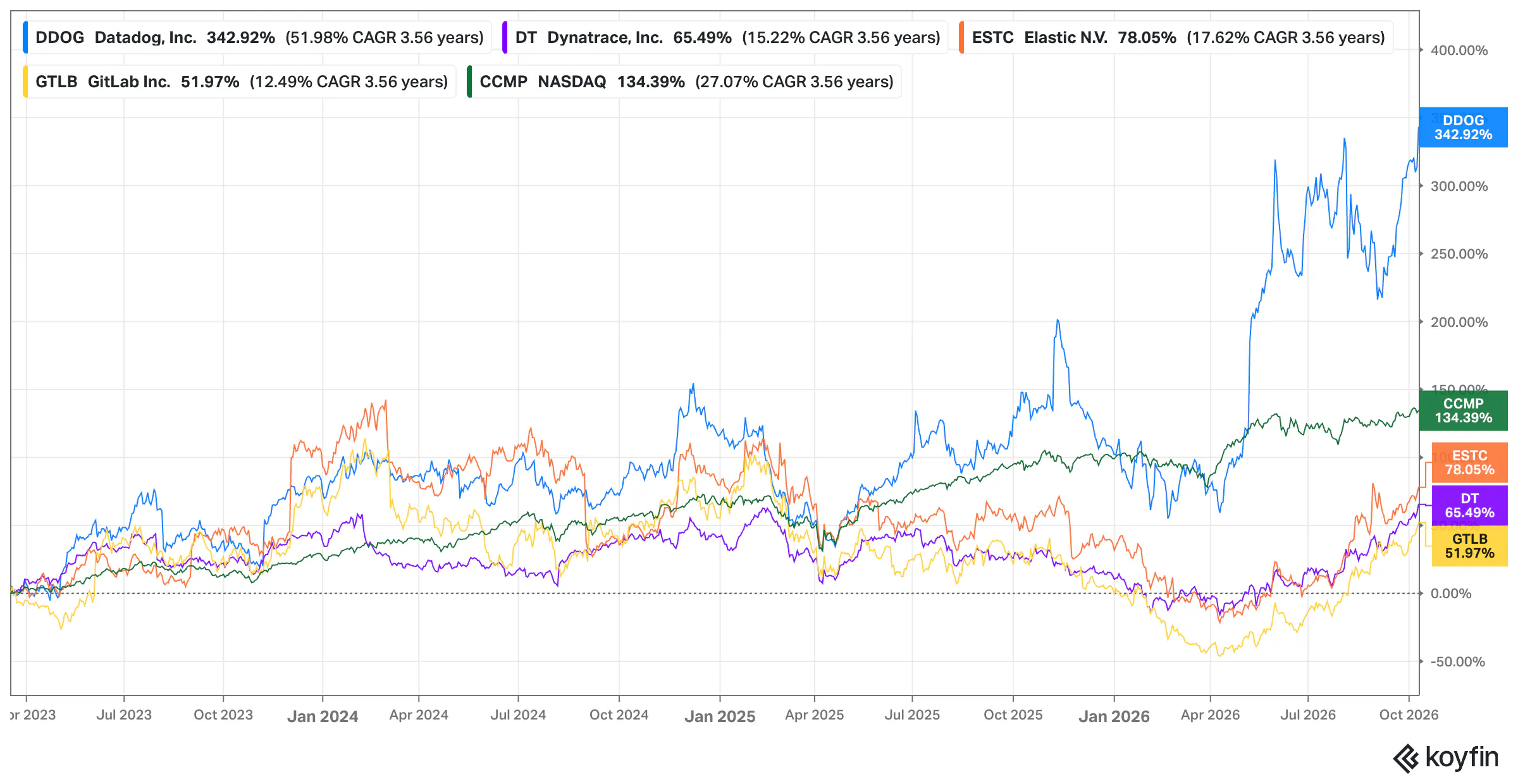
As of November 2026, public observability and developer-tool companies traded at revenue multiples of 14.3x for Datadog, 5.4x for Dynatrace, 4.5x for Elastic, and 6.4x for GitLab. Their share prices diverged between the start of 2026 and November 2026. Datadog's share price rose 32.1% over that period, GitLab's 25.6%, Elastic's 19.6%, and Dynatrace's 1.5%, while the NASDAQ Composite gained 8.7%.
Source: Koyfin
Key Opportunities
Becoming the System of Record for AI Quality
Braintrust can expand from an evaluation tool into the system through which companies define and enforce AI quality. In customer stories Braintrust has published, Notion used Braintrust across 70 engineers, while Dropbox ran 150 tests before code changes could merge and more than 10K tests afterward. Cloudflare also used Braintrust to block releases that introduced regressions. As customers accumulate production traces, evaluation datasets, custom scorers, annotations, and release requirements, Braintrust can become more difficult to replace. Its unlimited-user pricing also allows product managers and domain experts to participate without creating additional seat costs, which then supports expansion from one AI team into a company-wide platform.
Agent Adoption Expands the Observability Workload
Agents produce substantially more data than simple prompt-response applications because each session can include multiple model calls, retrieved documents, tool calls, retries, and intermediate decisions. On its third-quarter 2026 earnings call, Datadog said that spans sent to its agent observability product had grown ninefold during 2026. This increases the need for tools that can search across sessions, identify recurring failures, and turn those patterns into regression tests. Braintrust's Topics and Patterns products automate part of this process, while Brainstore is designed to store and query large agent traces. Because Braintrust charges for processed data and scores, increasing agent usage can directly expand revenue, provided infrastructure costs grow more slowly than customer usage.
Becoming a Model-Neutral Control Layer
AI teams that switch models need to test each candidate against their own tasks rather than public benchmarks. Notion, for example, deployed new frontier models in less than 24 hours using Braintrust evaluations. Braintrust's Gateway supports models from providers including OpenAI, Anthropic, Google, and Mistral AI, and its tracing works with frameworks such as LangChain and LlamaIndex, which allows customers to retain the same datasets and quality standards as the underlying stack changes. Braintrust has also expanded into prompt deployment, model access through its Gateway, and separate development and production environments. Connecting these capabilities with evaluations could allow Braintrust to influence which model, prompt, or agent configuration reaches production, and expand into model routing, cost management, and release governance.
Key Risks
Larger Platforms Can Bundle AI Evaluation
Braintrust's closest competitors are increasingly owned by larger infrastructure companies. CoreWeave acquired Weights & Biases in May 2025, ClickHouse acquired Langfuse in January 2026, and Cisco acquired Galileo in May 2026. Dynatrace also completed its acquisition of Arize in October 2026, and Datadog added evaluations for AI agents to its own platform in June 2026. These companies can bundle AI evaluation with compute, databases, or existing observability products, making procurement simpler for enterprise customers. Braintrust must show that AI quality is a sufficiently distinct workflow to justify a separate platform and budget.
Evaluations Can Optimize for the Wrong Metric
Braintrust's value depends on customers creating representative datasets and reliable scorers. LLM judges can exhibit position, verbosity, and self-enhancement biases, while some tasks require a combination of code-based, model-based, and human graders. An evaluation score may therefore improve even when the customer experience does not, particularly when test cases fail to reflect production behavior. Braintrust must help customers connect evaluation results with outcomes such as task completion, user acceptance, escalation rates, and retention; otherwise, the platform risks measuring proxies that engineering teams eventually stop trusting.
Open-Source Alternatives
Braintrust also competes with software that companies can operate themselves. Langfuse is open source and self-hostable, while Arize's Phoenix provides open-source tracing and evaluation on top of OpenTelemetry. Technically sophisticated companies can combine these products with internal scripts and existing data infrastructure rather than purchase another proprietary platform. Open standards also make traces easier to move between vendors, reducing lock-in at the data-collection layer. Braintrust must therefore differentiate through shared datasets, production-to-evaluation workflows, and integration into release decisions, since a better interface alone may not create durable switching costs.
Growing Trace Volume Could Pressure Margins
Braintrust charges customers based partly on processed data, scores, and retention. However, agent workloads are expensive to store and analyze. Braintrust has reported that a typical AI trace is about 10 MB, and that at the 90th percentile traces can reach tens of GB. Higher usage therefore increases revenue but also raises storage, indexing, search, and model-scoring costs. Customers may respond by sampling traffic or moving data into existing infrastructure. Brainstore is intended to improve these economics, but Braintrust has not disclosed the gross margins required to determine whether growing agent usage will translate into attractive software margins.
Security of Stored Provider Keys
Braintrust's Gateway uses AI-provider API keys that customers store with Braintrust, and its hosted plans process customers' production traces on Braintrust's infrastructure. In May 2026, Braintrust confirmed unauthorized access to one of its AWS accounts that held customers' provider keys and told every customer to rotate the keys stored with it, saying it had identified one affected customer. A product that sits between a company's application and its model providers concentrates credentials and data in one place, so a second incident could push security-sensitive customers toward self-hosted tools or toward observability vendors they already trust with production data.
Weekly Newsletter
Subscribe to the Research Rundown
Summary
Braintrust has evolved from an AI evaluation tool into a broader observability and quality-control platform for production AI applications and agents. Its product connects production traces, evaluation datasets, scorers, experiments, and release gates, allowing customers such as Notion, Dropbox, Box, and Cloudflare to identify failures and test changes before deployment. As AI systems become more agentic and difficult to evaluate through traditional software tests, Braintrust has an opportunity to become the system through which companies define and enforce AI quality. That opportunity is balanced by competition from larger observability platforms and open-source alternatives, the difficulty of designing evaluations that reflect real customer outcomes, the security exposure of holding customers' provider keys, and the infrastructure costs associated with storing and analyzing increasingly large agent traces.
*Contrary is an investor in Ramp and Replit through one or more affiliates.